中国主权和领土完整

Search documents
人民日报仲音:严重越线挑衅,高市早苗终将自食其果
Ren Min Ri Bao· 2025-11-27 23:19
Core Points - Japanese Prime Minister Kishi Nobuo's provocative remarks regarding Taiwan suggest a potential military intervention, which has been met with stern objections from China [1][2] - The comments are seen as a serious challenge to China's sovereignty and territorial integrity, violating international principles and agreements [1][2] - The remarks have sparked widespread criticism within Japan, indicating a disconnect between the government and public sentiment [3][4] Group 1: Provocation and Sovereignty - Kishi Nobuo's statements represent the first time a Japanese leader has linked Taiwan's situation to Japan's collective self-defense, signaling a dangerous ambition for military involvement [1] - The remarks challenge China's sovereignty as established by historical documents and international resolutions, emphasizing that Taiwan is a core interest of China [1][2] Group 2: Historical Context and Public Reaction - The year marks the 80th anniversary of both the victory in the Anti-Japanese War and Taiwan's liberation, highlighting the historical grievances against Japan's past actions [2] - There is significant domestic backlash in Japan, with public protests against Kishi Nobuo's comments, reflecting a strong sentiment against militaristic rhetoric [3][4] Group 3: International Relations and Stability - Kishi Nobuo's comments threaten regional peace and stability, drawing condemnation from various international figures and organizations [4] - The remarks undermine Japan's post-war international standing and could lead to Japan's isolation on the global stage due to perceived unreliability in foreign policy [3][4]
严重越线挑衅,高市早苗终将自食其果
Ren Min Ri Bao· 2025-11-27 22:30
Core Viewpoint - The recent provocative remarks by Japanese Prime Minister Sanae Takaichi regarding Taiwan have escalated tensions, suggesting potential military intervention in the Taiwan Strait, which has been met with strong opposition from China [1][2][3][4]. Group 1: Provocation and Sovereignty - Takaichi's statements are seen as a serious provocation against China's sovereignty and territorial integrity, marking the first time a Japanese leader has linked Taiwan's situation to Japan's collective self-defense [1]. - The remarks contradict established international agreements that affirm China's sovereignty over Taiwan, including the Cairo Declaration and the Potsdam Proclamation [1]. Group 2: Historical Context and National Sentiment - This year marks the 80th anniversary of both the victory in the Chinese People's Anti-Japanese War and the recovery of Taiwan, highlighting the historical grievances stemming from Japan's colonial rule over Taiwan [2]. - Takaichi's comments are viewed as an affront to the collective memory of the suffering caused by Japan's wartime actions, which included significant atrocities against Chinese and Asian peoples [2]. Group 3: Military Expansion and International Relations - Takaichi's linkage of Taiwan's situation to Japan's collective self-defense is perceived as a pretext for military expansion, raising concerns about a resurgence of militarism in Japan [2][3]. - The remarks have drawn widespread criticism within Japan, with public protests indicating a significant portion of the population opposes Takaichi's stance [3]. Group 4: International Order and Legal Principles - Takaichi's statements challenge the post-World War II international order and Japan's pacifist constitution, which restricts military actions [3][4]. - The inconsistency in Japan's foreign policy regarding Taiwan undermines its credibility on the international stage, potentially isolating Japan diplomatically [3][4]. Group 5: Regional Stability and Global Reactions - The assertion that "Taiwan's issues are Japan's issues" poses a threat to regional peace and stability, with international figures expressing concern over the implications of Takaichi's remarks [4]. - The potential for Japan to become a destabilizing factor in the region is highlighted by reactions from other countries, emphasizing the need for Japan to reflect on its historical actions [4].
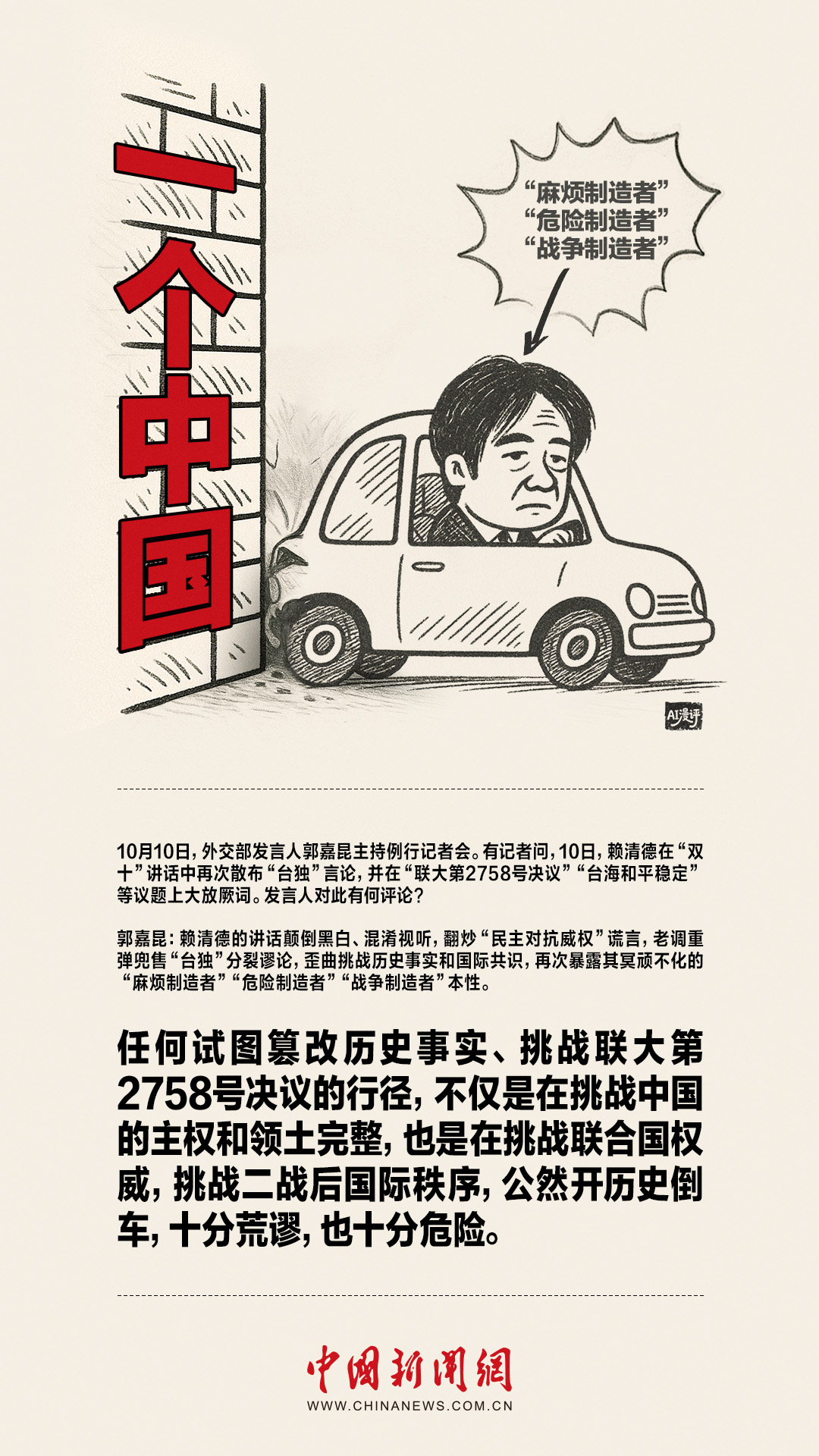
AI漫评|开历史倒车,十分危险!
Zhong Guo Xin Wen Wang· 2025-10-11 09:18
Core Viewpoint - Any attempt to distort historical facts and challenge UN General Assembly Resolution 2758 not only undermines China's sovereignty and territorial integrity but also challenges the authority of the United Nations and the post-World War II international order, which is both absurd and dangerous [1] Group 1 - The actions in question are seen as a direct challenge to China's sovereignty [1] - Such actions are viewed as a threat to the authority of the United Nations [1] - The implications of these actions are described as a regression in historical progress [1]