
秸秆综合利用

Search documents
黑龙江绥化市多举措筑牢粮食安全“压舱石”
Zhong Guo Chan Ye Jing Ji Xin Xi Wang· 2025-06-07 23:19
Group 1 - The core viewpoint emphasizes the proactive measures taken by the agricultural sector in Suhua City, Heilongjiang Province, to ensure food security through comprehensive planning and execution of grain production tasks [1][4] - The city has completed a planting plan for 27.79 million acres of grain crops, with spring plowing progress ahead of schedule by 15 days compared to previous years [1] - Financial support for farmers includes innovative loan products with reduced interest rates, such as the "Planting Quick Loan" from Agricultural Commercial Bank, which shortens loan processing time to about ten minutes [1] Group 2 - Technological empowerment is highlighted as a key support mechanism, with various educational initiatives and platforms established to enhance farmers' knowledge on seed selection, agricultural inputs, and high-yield practices [2] - The city has established 115 modern agricultural demonstration parks, focusing on high-yield technology promotion, with plans to implement large-row dense planting over 5.82 million acres, an increase of 4.39 million acres from last year [2] - The comprehensive utilization of straw is being accelerated, aiming for both ecological and economic benefits through a model that prioritizes fertilizer production [2] Group 3 - A joint enforcement plan has been issued to maintain high-pressure law enforcement against illegal activities in agricultural inputs, with multiple rounds of inspections conducted across the region [3] - High-standard farmland construction is progressing, with a completion rate of 19.66% for a long-term national bond project covering 1.0669 million acres [3] - The city is promoting customized agriculture, targeting over 400,000 acres in crop customization and a livestock scale of 39,000 heads, while also developing local characteristic models [3] Group 4 - The city has addressed 747 issues in the management of "three funds," establishing a property transaction platform that has facilitated over 10,232 transactions, generating additional income for village collectives [4] - A total of 1.431 billion yuan in village-level debt has been resolved, reflecting efforts to control unreasonable expenditures and prevent new debts [4] - The initiatives taken by Suhua City are contributing to high-quality development in grain production, reinforcing its role in ensuring national food security [4]
2025年中国秸秆垃圾处理行业发展背景、产业链、发展现状、竞争格局及发展趋势研判:市场格局较为分散[图]
Chan Ye Xin Xi Wang· 2025-06-06 01:40
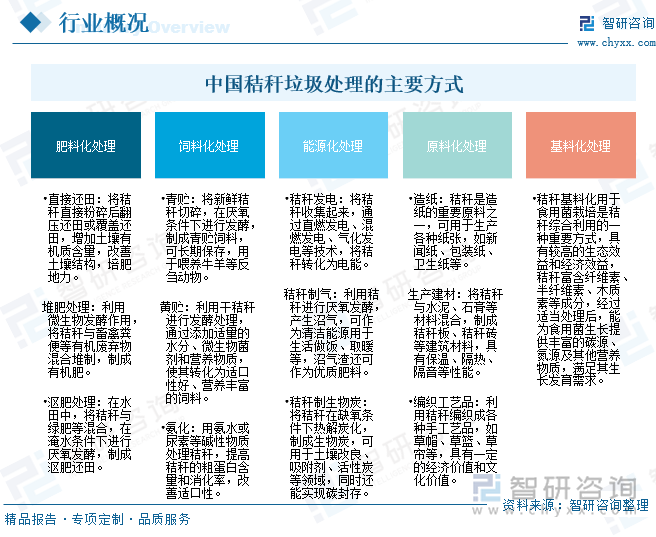
Overview - The increasing scale of agricultural production in China has led to a continuous rise in straw yield, with the straw treatment market becoming increasingly important due to strict regulations against traditional burning methods that cause air pollution [1][11] - The straw treatment market in China is projected to reach a market size of 60 billion yuan in 2024, with a year-on-year growth of 9.1% [1][11] Market Policies - The Chinese government has issued a series of policies to promote straw comprehensive utilization, including the "Air Quality Improvement Action Plan" and various guidelines aimed at enhancing the efficiency of straw utilization and encouraging enterprise participation [6][7] - Policies emphasize the importance of establishing a standardized and systematic straw collection and transportation service to improve the overall efficiency of straw utilization [7] Industry Chain - The straw treatment industry chain consists of upstream activities such as straw collection and transportation, midstream processing methods including fertilizer, feed, energy, raw material, and substrate processing, and downstream applications in agriculture, livestock feeding, and energy production [8][9] - In 2024, the theoretical resource amount of straw in China is estimated to be 994 million tons, with significant contributions from rice straw (222 million tons), wheat straw (175 million tons), and corn stalks (341 million tons) [9] Competitive Landscape - The straw treatment industry in China is characterized by a fragmented market with numerous participants, primarily small and medium-sized enterprises [13] - Key players in the industry include Guoneng Bioenergy Group, Wanhua Ecological Industry Group, Jinan Shengquan Group, and Changqing Group, among others [13][14] Development Trends - The straw treatment industry is expected to extend upstream to include straw collection and transportation equipment manufacturing, as well as related technology research and development [20] - There is a focus on forming straw treatment industry clusters in regions rich in straw resources to optimize resource utilization and enhance regional competitiveness through collaboration and innovation [20]


绿色循环链扮靓美丽乡村
Ren Min Ri Bao Hai Wai Ban· 2025-05-19 21:22
Group 1 - The core viewpoint emphasizes the transformation of corn straw into valuable feed through silage technology, significantly reducing labor and costs while enhancing livestock quality [1] - In the past three years, rising prices of raw materials like soybean meal and corn have increased feed costs, making corn straw silage a cost-effective alternative [1] - The local government has implemented a comprehensive straw utilization strategy, achieving a straw utilization rate of 94.5% with 40 operational entities, including 10 that utilize over 500 tons [2] Group 2 - The implementation of a wastewater treatment project in Zhoukeng Village has improved the local environment and effectively managed livestock waste, contributing to the ecological protection of the Dengen River National Aquatic Germplasm Resource Reserve [4] - The project promotes a model of decentralized waste collection and centralized ecological utilization, creating a complete ecological chain that reduces costs and beautifies the environment [4] - Following the success of the pilot project, the county plans to expand similar initiatives, investing 16 million yuan in rural wastewater treatment projects to enhance living conditions and promote sustainable agricultural practices [4][5]

尾菜“驿站”、纳米膜发酵,京郊秸秆利用有妙招
Xin Jing Bao· 2025-04-15 14:18
北京市怀柔区杨宋镇被称为"中国影都",这里有影视基地、商业街区和花海。每到春天,来这里参观影 视园区的游客络绎不绝。但很多人不知道,就在离影都花海1公里处的地方,还有个很时尚的休闲农业 园区,这里有尾菜转化驿站,可以将秸秆、蔬菜尾菜等农业废弃物转化为有机肥料。 近日,记者随中国农业科学院农业环境与可持续发展研究所专家参加怀柔区秸秆综合利用重点区建设项 目技术交流会发现,在京郊,秸秆综合利用呈现多元化发展,除了秸秆粉碎覆盖还田、尾菜堆肥处理利 用等模式外,还有更具科技含量的纳米膜发酵技术。 据媒体报道,2024年6月18日,北京市农业技术推广站携手怀柔区农业农村局及桥梓镇政府,共同见证 了怀柔区桥梓镇平义分村小麦示范田的高产。当日,专家们对这片占地160亩的小麦示范田进行了实收 测产。经专家测产现场实收面积21.4亩,实收籽粒鲜重15060.0公斤,现场测定含水率平均为16.72%, 去除杂质0.1%,按13%水分折合亩产为672.63公斤,创造了怀柔区近30年来小麦单产新纪录。 农业基地成科普园,"烂菜叶"化泥护庄稼 一走进中农坤威农业园区,会让人以为这是个航天模型展览中心。大厅走廊两侧,摆放着各种航天设备 ...