RWA

Search documents
X @Ignas | DeFi
Ignas | DeFi· 2025-10-04 00:12
Store of Value (SoV) Potential - Ethereum's potential for price appreciation is limited by its failure to be widely accepted as a store of value [1] - To justify holding Ethereum, investors need to believe in its potential to become a store of value asset [1] - Ethereum needs to gain acceptance from passive institutional and retail holders, similar to Bitcoin [2] - A deflationary supply is considered a crucial element for Ethereum to become a superior store of value compared to Bitcoin [2][3] Tokenization and Real World Assets (RWAs) - The current narrative of tokenization and RWAs may not be sufficient to significantly increase Ethereum's price without the store of value premium [1] - New chains are already competing for RWA and stablecoin adoption with features like privacy, speed, and low fees, potentially hindering Ethereum's growth in this area [1] Ethereum's Advantages - Ethereum possesses native yield and smart contract utility for usage within DeFi [4] - Some DeFi users already treat Ethereum as a yield-bearing collateral, indicating existing adoption as a store of value [2] Challenges and Future Outlook - Alt L1s are unlikely to be as neutral or decentralized as Ethereum, giving Ethereum a potential advantage [2] - Ethereum needs to find a way to tax the L2s, and adoption needs to grow enough to burn supply for it to become a superior SoV [3]
马云入局的千亿平台 密集出招区块链
2 1 Shi Ji Jing Ji Bao Dao· 2025-10-03 13:52
Core Insights - Jack Ma's financial venture, Yunfeng Financial, is increasingly active in the blockchain and insurance sectors, particularly through a strategic investment in Anthea Holding Limited, a global cryptocurrency life insurance company [2][10]. Company Developments - Yunfeng Financial announced a strategic investment in Anthea Holding Limited to explore the application of blockchain technology in insurance, focusing on compliance processes like KYC and anti-money laundering [2][10]. - The company has a substantial asset base of HKD 105 billion and is co-founded by Jack Ma and Yu Feng, with respective shareholdings of 29.85% and 70.15% [3]. - In recent months, Yunfeng has made significant investments in blockchain, including purchasing 10,000 Ethereum (ETH) for approximately USD 44 million and launching various projects in the sector [4][7]. Financial Performance - For the first half of the year, Yunfeng Financial reported a revenue of HKD 1.532 billion, with a significant year-on-year profit increase of 142%, primarily driven by its insurance business [13]. - The core of Yunfeng's business remains in life insurance, with its subsidiary, Wantong Insurance, contributing HKD 696 million in net operating profit [14][15]. Strategic Initiatives - The company is actively pursuing Web 3.0 and digital currency initiatives to enhance its insurance operations, aiming to address traditional financial pain points such as cost, efficiency, and security [16]. - The recent acquisition of Anthea is part of a broader strategy to capitalize on the potential growth opportunities in the global cryptocurrency life insurance market [17][18]. Leadership and Talent Acquisition - The leadership team includes notable figures from the blockchain and financial sectors, enhancing Yunfeng's capabilities in Web 3.0 [21][24]. - Key appointments include Liang Xinjun and Jiang Guofei, both with strong ties to Jack Ma and extensive experience in blockchain technology [22][25].
马云入局的千亿平台,密集出招区块链
2 1 Shi Ji Jing Ji Bao Dao· 2025-10-03 13:24
Core Insights - Jack Ma's financial venture, Yunfeng Financial, is increasingly active in the blockchain and insurance sectors, particularly through strategic investments and partnerships [2][4][10]. Group 1: Strategic Investments - Yunfeng Financial announced a strategic investment in Anthea Holding Limited, a global cryptocurrency life insurance company, to explore blockchain applications in insurance, particularly in KYC and AML processes [2][10]. - The company has made significant investments in blockchain, including purchasing 10,000 Ethereum (ETH) for approximately $4.4 million and forming strategic partnerships with Ant Group [6][7]. - Yunfeng Financial raised HKD 11.7 billion through a share placement to expand its virtual asset trading and related businesses [8]. Group 2: Business Performance - For the first half of the year, Yunfeng Financial reported a revenue of HKD 1.532 billion, with a significant profit increase of 142% year-on-year, primarily driven by its insurance business [14][16]. - The core of Yunfeng's business remains in life insurance, with its subsidiary, Wan Tong Insurance, contributing HKD 696 million in net operating profit [15][16]. Group 3: Leadership and Talent Acquisition - The company has strengthened its leadership by bringing in key figures from the blockchain and Web 3.0 sectors, including Liang Xinjun and Jiang Guofei, who have strong ties to Jack Ma [22][25]. - Jiang Guofei, a former president of Ant Digital Technology, will play a crucial role in coordinating the strategic partnership with Ant Group [26]. Group 4: Market Position and Future Outlook - Yunfeng Financial's market capitalization has increased to approximately HKD 25 billion, more than doubling since mid-July [11]. - The company aims to leverage Web 3.0 technologies to enhance its insurance offerings and address traditional financial pain points, thereby expanding its market presence [17][18].
X @Crypto.com
Crypto.com· 2025-10-03 12:00
RT Crypto.com Research & Insights (@cryptocom_rni)DeFi+L1L2 Update:🤝 Cronos partnered with AWS to accelerate institutional adoption of RWA📈 Plasma has seen $7.86B net inflows since its launch🏦 9 European banks are working on a MiCA-compliant euro stablecoin, set to launch in the H2 2026Full details 👇https://t.co/aK1t04llOR ...
X @Ivan on Tech 🍳📈💰
Ivan on Tech 🍳📈💰· 2025-10-03 09:30
RT Solana (@solana)“In 5 years, we’ll be looking back and saying Solana has the largest market share of all these L1sThe rail system for RWA’s, stocks and bonds, commercial paper” -@Scaramucci https://t.co/kRZ24TTSJh ...
吴说 9 月 VC 月报:金额 51 亿美金,大量 Pre-IPO 融资
Xin Lang Cai Jing· 2025-10-02 23:28
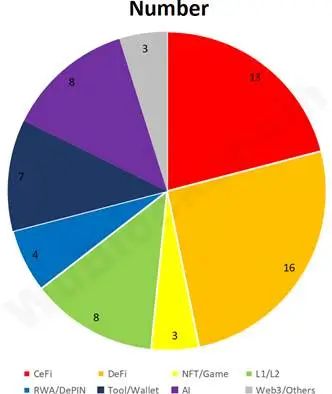
Core Insights - In September 2025, the number of publicly disclosed crypto VC investment projects decreased by 25.3% month-over-month and 37.4% year-over-year, totaling 62 projects [1][3] - Total funding in September 2025 reached $5.122 billion, marking a 5.2% increase from August 2025 and a staggering 739.7% increase from September 2024 [3] Investment Breakdown - The distribution of projects by category in September 2025 is as follows: CeFi 21%, DeFi 25.8%, NFT/GameFi 4.8%, L1/L2 12.9%, RWA/DePIN 6.5%, Tool/Wallet 11.3%, AI 12.9% [3] - The top 10 funding rounds included significant amounts such as $1.65 billion for Forward Industries in a post-IPO round and $787 million for Figure in its IPO [3][4] Notable Company Activities - Forward Industries completed a $1.65 billion PIPE financing to initiate a digital asset treasury strategy based on Solana, led by Galaxy Digital, Jump Crypto, and Multicoin Capital [4] - Figure Technology went public on NASDAQ under the ticker FIGR, raising $787 million with an initial share price of $25, resulting in a market cap exceeding $5 billion on its first day [4] - Helius Medical Technologies announced over $500 million in PIPE financing, with a share price of $6.881, aimed at launching a SOL treasury strategy [5] - Flying Tulip, a new project by Sonic co-founder Andre Cronje, raised $200 million in seed funding, with plans for further fundraising through public sales [6] - Fnality secured $136 million in Series C funding to expand its central bank digital currency settlement system, awaiting approval from the Federal Reserve and the European Central Bank [6] - Tron Inc. received a $110 million investment from its largest shareholder to expand its TRX treasury [7] - Zerohash completed a $104 million funding round, focusing on blockchain technology support for banks and fintech companies [7] - Bit Digital plans to raise $100 million through convertible notes primarily to increase its Ethereum holdings [8]

稳定币的发展历程、成败叙事及其对中国的启示
Sou Hu Cai Jing· 2025-10-02 22:52
Core Insights - The report discusses the evolution of stablecoins, highlighting their differences from traditional payment systems like Alipay and the regulatory landscape across various regions, particularly focusing on the implications for China [1][15][20]. Development Stages of Stablecoins - The first stage (2014-2017) saw the emergence of stablecoins like USDT, bitUSD, and bitCNY, aimed at addressing the volatility of cryptocurrencies [1][2][4]. - The second stage (2018-2022) marked significant developments, including the launch of USDC and the Libra project, which drew global regulatory attention [5][6]. - The third stage (2023-present) has seen a resurgence in market capitalization and trading volume, with USDT and USDC leading the recovery [6][7][23]. Regulatory Landscape - The U.S. has adopted a "muddled tolerance" approach to regulation, allowing for innovation while establishing a framework for compliance [20][23]. - The EU and Singapore have implemented strict regulations, which have limited the growth of local stablecoins [21][24]. - Hong Kong is positioned to create a "stablecoin corridor," leveraging its unique status to foster a vibrant stablecoin market [27][28]. Comparison with Alipay - Stablecoins and Alipay share similarities in value stability and transaction convenience, but differ fundamentally in their operational frameworks and regulatory environments [15][18]. - Stablecoins operate on blockchain technology, allowing for global transactions, while Alipay relies on traditional financial systems [18][19]. Strategic Insights for China - The report suggests a "three arrows" strategy for China to gain a competitive edge in the stablecoin market, including offshore RMB stablecoins, a Chinese version of USD stablecoins, and a "global currency" backed by multiple currencies [31][32]. - It emphasizes the need for innovative regulatory frameworks to support the development of stablecoins and their integration into the broader financial ecosystem [30][32].
帮主郑重:22万散户盯着跌停板?这“算力”变“算计”的坑,咱得这么躲
Sou Hu Cai Jing· 2025-10-02 20:47
Core Viewpoint - The article highlights the risks associated with speculative investments in companies that chase trends without solid fundamentals, using Hainan Huatie as a case study [1][3][4]. Company Overview - Hainan Huatie's main business involves renting engineering equipment such as aerial work platforms and forklifts, but it has recently shifted focus to speculative ventures like computing power contracts and NFTs [3][4]. Recent Developments - In March, Hainan Huatie signed a significant computing power contract worth 3.69 billion, but after seven months, no purchase orders were received, leading to the contract's cancellation [3][4]. - The company downplayed the cancellation, stating there were "no disagreements" and that it "does not affect operations," raising concerns about transparency [3]. Investment Risks - The article warns that retail investors often fall into traps by following trends and stories rather than focusing on a company's core business and actual performance [4][5]. - It emphasizes the importance of verifying the legitimacy of large orders and monitoring their progress, as many companies may announce contracts without real follow-through [6][7]. Recommendations for Investors - Investors should assess the alignment of a company's main business with its new ventures, ensuring that the core business remains robust [7]. - It is crucial to track the details of any announced orders, including formal contracts and payment statuses, to avoid high-risk situations [7]. - Observing the buying and selling patterns of significant shareholders can provide insights into the company's health and potential risks [7].