
数字货币

Search documents
新书 | 杜雨博士新书《货币新秩序》出版:美伊冲突升级、黄金破5000,谁改写全球财富规则?
未可知人工智能研究院· 2026-03-02 04:58
Core Viewpoint - The article discusses the transformation of the global financial landscape driven by the rise of stablecoins, the challenges faced by traditional financial systems, and the implications for individual wealth management in the digital age [2][21]. Group 1: Traditional Financial System Cracks - The current global financial market, despite its apparent prosperity, is experiencing significant underlying issues, highlighted by the surge in gold prices as a reflection of declining trust in existing monetary systems [4]. - The inefficiencies of the SWIFT system and the inflationary pressures on the US dollar are leading to a growing trend of "de-dollarization" among nations [4][5]. - The emergence of cryptocurrencies aimed to disrupt traditional finance but faced challenges such as volatility and operational limitations, paving the way for the rise of stablecoins [4][5]. Group 2: The Stablecoin Landscape - Stablecoins are not a monolithic entity; they represent a complex interplay of power dynamics, including centralization versus decentralization, and the competition between issuers and regulatory bodies [6][7]. - Different types of stablecoins, such as fiat-collateralized (e.g., USDT, USDC) and crypto-collateralized (e.g., DAI), exhibit varying degrees of stability and risk, with concerns over transparency and regulatory compliance [7][8]. - The competition among stablecoin issuers and the regulatory landscape is crucial for understanding the future of digital currencies and their role in the financial system [8]. Group 3: Impact on Global Financial Order - The growing scale of stablecoins is challenging sovereign currencies and reshaping global financial infrastructure, affecting every country and individual [10][11]. - Stablecoins are emerging as alternatives for smaller nations facing economic instability, while major economies like the US and China are navigating their own digital currency strategies [11][12]. - The rise of decentralized finance (DeFi) is heavily reliant on stablecoins, which serve as essential components for various financial services, although they also introduce new risks reminiscent of past financial crises [12]. Group 4: Opportunities and Risks for Individuals - The new monetary war presents both unprecedented wealth opportunities and significant financial risks for ordinary individuals, driven by market volatility and the emergence of stablecoins [14][15]. - The book provides a guide for individuals to identify arbitrage opportunities and understand the potential of stablecoins as a hedge against inflation [15]. - However, the digital financial landscape also harbors risks such as money laundering and fraud, necessitating awareness and understanding of the underlying rules to protect assets [15]. Group 5: Future of CBDC and Stablecoins - The competition between stablecoins and central bank digital currencies (CBDCs) will shape the future of the monetary landscape, with implications for global financial power dynamics [17][18]. - The book outlines three potential scenarios for the future of digital currencies, emphasizing the importance of technological integration and regulatory frameworks [18][19]. - The ultimate question remains: who holds the power to issue credit, a theme that has evolved with the advent of stablecoins and their role in the digital currency era [19].


“数字欧元”要来了!试点计划预计2027年启动
Zhong Guo Jing Ji Wang· 2026-02-28 00:30
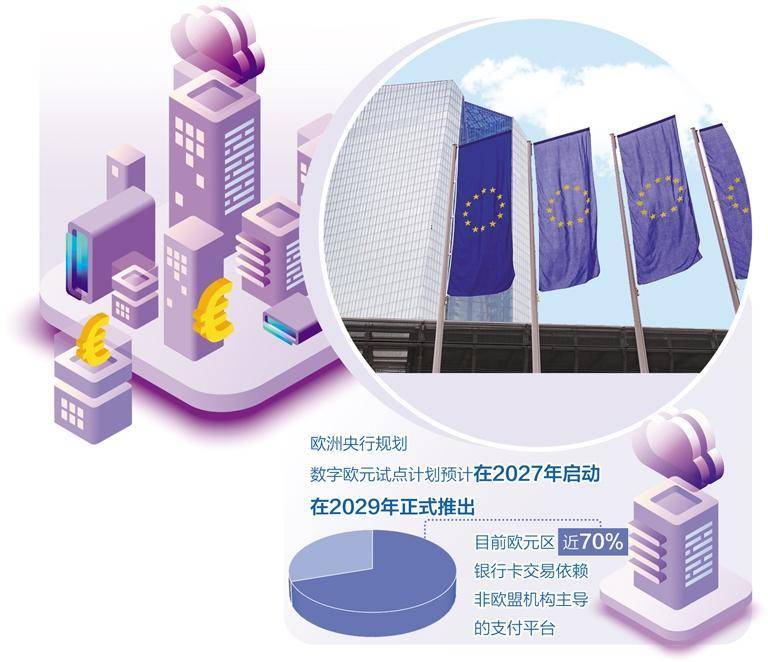
Core Viewpoint - The European Parliament's recent vote to support the introduction of a digital euro signifies a critical political signal in the digital currency space, accelerating the EU's digital currency strategy [1] Group 1: Digital Euro Introduction - The introduction of the digital euro is seen as a core measure to maintain the monetary sovereignty of the EU amidst the rapid growth of global digital payments [1] - The European Central Bank (ECB) emphasizes the need for central bank currency to remain relevant in the digital age to protect the euro's sovereignty and independence [2] - The ECB reports that nearly 70% of card transactions in the eurozone rely on payment platforms dominated by non-EU institutions [2] Group 2: Concerns and Criticism - Critics argue that the digital euro may not create new demand but rather redistribute existing retail payment markets, potentially undermining the role of commercial banks [3][4] - Concerns have been raised that if the digital euro replaces traditional banking functions, it could lead to a significant loss of income for commercial banks, estimated at 8% to 10% in extreme scenarios [4] - The German Banking Association states that the development of the digital euro requires time and may not address the issues posed by US stablecoins effectively [4] Group 3: Support and Potential Benefits - Supporters believe the digital euro could enhance the resilience of Europe's financial infrastructure and payment systems, providing secure and affordable payment options [5] - The successful launch of the digital euro could lay the groundwork for innovative financial services, positively impacting the long-term development of Europe's digital economy [6] - The digital euro is expected to allow Europe to gain a voice in the global central bank digital currency framework and standards, enhancing the euro's attractiveness as an international currency [6] Group 4: Legislative Process and Timeline - The recent vote by the European Parliament is a significant step forward for the digital euro project, although it does not equate to final approval [6] - The legislative process must be completed before the ECB can initiate pilot programs, with plans for a pilot expected to start in 2027 and a full launch in 2029 [6]
数字欧元项目迈出实质性步伐
Sou Hu Cai Jing· 2026-02-27 22:53
Core Viewpoint - The European Parliament's recent vote to support the digital euro signifies a critical political signal in the digital currency domain, accelerating the EU's digital currency strategy [2][7]. Group 1: Digital Euro Introduction - The introduction of the digital euro is seen as a technological innovation and a core measure to maintain the EU's monetary sovereignty, addressing the risks of dependency on non-EU tech and payment companies [2][4]. - Currently, nearly 70% of card transactions in the eurozone rely on payment platforms dominated by non-EU institutions, highlighting the need for a central bank digital currency to ensure the euro's relevance in the digital age [3]. Group 2: Privacy and Functionality - The digital euro will ensure user privacy, with offline functionality allowing transactions without internet connectivity, maintaining a level of privacy comparable to cash payments [3][4]. - For online transactions, only encrypted codes and transaction amounts will be visible to central banks, protecting user identities [4]. Group 3: Criticism and Concerns - Some experts criticize the digital euro initiative, arguing it may not create new demand but merely redistribute existing retail payment markets, potentially weakening commercial banks' funding capabilities [5][6]. - Concerns have been raised that if the digital euro replaces traditional banking functions, it could lead to a significant loss of income for commercial banks, estimated at 8% to 10% in extreme scenarios [5]. Group 4: Support and Potential Benefits - Supporters believe the digital euro could enhance the resilience of Europe's financial infrastructure and payment systems, providing secure and affordable payment options [6]. - The successful launch of the digital euro could foster innovation in financial services and enhance the euro's attractiveness as an international currency [6]. Group 5: Legislative Process - The recent vote by the European Parliament is a step forward but does not equate to final approval; further legislative processes are required before the European Central Bank can initiate pilot programs [7]. - The pilot plan for the digital euro is expected to start in 2027, with a full launch anticipated in 2029 [7].
Q4业绩超预期 Circle(CRCL.US)盘前大涨超20%
Zhi Tong Cai Jing· 2026-02-25 14:07
Core Insights - Circle (CRCL.US) shares surged over 20% pre-market, reaching $74.20 following strong Q4 FY2025 earnings report [1] Financial Performance - Q4 FY2025 earnings per share (EPS) was $0.56, exceeding analysts' expectations of $0.17 [1] - Quarterly sales amounted to $770.232 million, surpassing the forecast of $739.446 million, representing a 76.92% increase from $435.367 million in the same quarter last year [1] USDC Metrics - As of year-end, circulating USDC reached $75.3 billion, a year-over-year growth of 72% [1] - Q4 FY2025 on-chain transaction volume for USDC was $11.9 trillion, reflecting a 247% year-over-year increase [1] Future Projections - Management set a long-term compound annual growth rate (CAGR) target of 40% for USDC circulation [1] - Expected other revenues (including subscriptions, services, and transaction fees) for FY2026 are projected to be between $150 million and $170 million [1] - Anticipated RLDC profit margin (revenue minus distribution and transaction costs) for FY2026 is expected to remain high at 38%-40% [1] - Projected adjusted operating expenses for FY2026 are estimated to be between $570 million and $585 million [1]

数字货币概念掀炒作热潮!御银股份震荡拉升,央行发布数字人民币行动方案,香港下月将发首批稳定币牌照
Sou Hu Cai Jing· 2026-02-25 03:21
Core Viewpoint - The trading performance of Yuyin Co., Ltd. is influenced by speculation surrounding the digital currency concept, particularly following recent regulatory announcements from the People's Bank of China and the Hong Kong Monetary Authority [1] Group 1: Company Performance - Yuyin Co., Ltd. opened at a price of 8.45 and experienced a steady upward trend, with a significant price increase noted at 9:57, followed by a period of fluctuation between 9.0 and 9.1 [1] - A notable surge in price occurred at 11:02, where it quickly rose to 9.30 [1] Group 2: Industry Developments - The People's Bank of China has officially released an action plan to enhance the management and service system for digital RMB, with a new framework set to be implemented on January 1, 2026 [1] - The Chief Executive of the Hong Kong Special Administrative Region, John Lee, stated that the Monetary Authority is actively processing applications for stablecoin issuer licenses, with the first batch expected to be issued next month [1]


未知机构:非银对话计算机如何看待互联网金融的监管和估值2026021233分钟-20260224
未知机构· 2026-02-24 01:35
Summary of Conference Call on Internet Finance Regulation and Valuation Industry Overview - The discussion focused on the **internet finance industry**, particularly its **regulation and valuation** issues, as well as the application prospects of **artificial intelligence (AI)** in the financial sector [1] Core Insights and Arguments - The analysis included the performance and administrative penalty announcements of **Jiufang Zhitu**, highlighting the impact of the **regulatory cycle** on the internet finance industry [1] - A reasonable valuation center was assessed, emphasizing the importance of understanding the regulatory environment in determining company valuations [1] - The potential of AI to enhance **financial service efficiency** and **customer experience** was particularly noted, with examples provided of its application in both **internal management** and **external business empowerment** [1] Additional Important Points - The discussion also touched on the implications of **contract liabilities** and **performance forecasts** within the industry, indicating a need for careful monitoring of these factors [1] - The conversation included references to **administrative penalties** faced by companies, which could affect investor sentiment and market perception [1] - The role of **non-structural data** and **model capabilities** in improving valuation assessments was highlighted, suggesting a shift towards more data-driven approaches in the industry [1]

俄罗斯央行:境外加密交易所和兑换平台可通过在俄注册子公司形式,在俄市场依法开展业务
Xin Lang Cai Jing· 2026-02-21 01:51
Core Viewpoint - The Central Bank of Russia has announced that foreign cryptocurrency exchanges and trading platforms can operate legally in the Russian market by establishing subsidiaries in Russia, as part of upcoming regulatory changes [1] Group 1: Regulatory Framework - The new rules will be included in an upcoming cryptocurrency regulatory bill [1] - Digital currencies and stablecoins will be classified as "monetary value," allowing for trading but prohibiting their use as payment methods within Russia [1]
AB Xelerate 宣布对 Ubyx Inc. 进行战略投资
Xin Lang Cai Jing· 2026-02-19 10:43
Core Viewpoint - Arab Bank's fintech accelerator AB Xelerate has made a strategic investment in Ubyx Inc., a provider of clearing and acceptance infrastructure for tokenized deposits and regulated stablecoins, aiming to enhance cross-border financial infrastructure between the Middle East and global markets [1] Group 1: Investment Details - The specific investment amount in Ubyx Inc. has not been disclosed [1] - The investment is intended to support the next phase of development for cross-border financial infrastructure [1] Group 2: Company Overview - Ubyx is developing a shared network that allows regulated financial institutions to issue, accept, and redeem digital currencies at face value across multiple blockchains and jurisdictions [1] - The operations of Ubyx are designed to function within established regulatory and compliance frameworks [1]
比特币升破67000美元
Jin Rong Jie· 2026-02-19 04:30
Core Viewpoint - Bitcoin has surpassed $67,000, experiencing a daily increase of 0.82% [1] Group 1 - The price of Bitcoin has reached a significant milestone, indicating strong market interest and potential bullish sentiment among investors [1]
比特币升破68000美元,日内涨0.85%
Mei Ri Jing Ji Xin Wen· 2026-02-18 07:56
Core Viewpoint - Bitcoin has surpassed $68,000, experiencing a daily increase of 0.85% [1] Group 1 - Bitcoin price reached over $68,000 on February 18 [1] - The daily increase in Bitcoin's value was recorded at 0.85% [1]