Monetary Policy

Search documents
Fed Rate Decision And Dot Plot In Focus
Seeking Alpha· 2025-12-10 12:30
Listen on the go! A daily podcast of Wall Street Breakfast will be available by 8:00 a.m. on Seeking Alpha, iTunes, Spotify.Getty Images Good morning! Here is the latest in trending:New contracts: The U.S. Navy has enlisted Palantir (PLTR) to help build nuclear submarines faster, but does the company have 'improper ties' to the Trump administration?Precious metals: Closing above $60/oz for the first time, silver's gains are now outshining gold. See the top silver stocks ranked by SA Quant ratings.Healthcar ...


The Hawkish Risk Is in the US, Not Europe: 3-Minute MLIV
Bloomberg Television· 2025-12-10 11:37
THE FED. LET'S GET BACK TO THE FED. THE ONLY STORY WE NEED TO FOCUS ON TODAY.SKYLAR IS HERE. THE STORY HAS EVOLVED AND JOBS IS BETTER. THE LABOR MARKET DOESN'T LOOK AS CHALLENGING.IS THERE FOR MORE OF A CASE TODAY THAN YESTERDAY FOR THIS HAWKISH CUT THE MARKET IS LOOKING FOR. ON THE AGREGATE THE DATA HAS BEEN PRETTY GOOD FOR A WHILE NOW. ACTUALLY WE GOT MORE OF A SHIFT EARLIER IN THE WEEK AND WE ARE GETTING HAWKISH PREPOSITIONING THIS WEEK AS WE START TO THINK ABOUT HIKES NEXT YEAR.GUY: HIKES FROM THE FED. ...

NCE外汇:政策驱动下贵金属结构性强势逻辑
Xin Lang Cai Jing· 2025-12-10 11:29
Core Viewpoint - The metal market is experiencing a moderate upward trend as investors position themselves ahead of key policy meetings, with expectations around monetary policy direction being the main driver of gold and silver volatility [3] Group 1: Monetary Policy Expectations - There is a strong consensus among investors regarding an imminent moderate policy adjustment, with the probability of interest rate cuts elevated to a highly consistent range [4] - This near-certain expectation allows precious metals to react in advance of the actual announcement, while the market retains some observation space regarding the policy pace into 2025, particularly under a "gentle but cautious" communication backdrop [4] Group 2: Institutional Accumulation - Central banks worldwide are steadily increasing their gold reserves, providing deeper structural support to the market, alongside positive inflows into precious metal ETFs, reflecting stable demand for diversification and hedging [5] - This trend is closely linked to the long-term uncertainty of the global monetary environment, forming a substantial bottom support structure for gold prices [5] Group 3: Employment Data Resilience - Labor market indicators show "moderate fluctuations but overall stability," with job vacancies remaining high and layoffs not altering the fundamental resilience of the labor market [6] - This data structure offers policymakers ample flexibility, allowing for a gradual approach to easing without the need for aggressive or urgent policy changes [6] Group 4: Diverging Views on Future Momentum - Despite strong performance in precious metals, some analysts express caution regarding sustained momentum, suggesting that if the pace of easing slows next year, the market may reassess the short-term upside potential for precious metals [7] - The derivatives market has adjusted its forecasts for the number of rate cuts in the coming year, indicating a search for balance between inflation resilience and economic strength [7] Group 5: Structural Strength of Precious Metals - The rise in precious metals is driven by multiple structural factors: stable expectations for policy easing, long-term demand from official institutions, and the healthy performance of the labor market providing policy flexibility [8] - As long as policy communication does not significantly deviate from core market expectations, the overall trend for precious metals is likely to remain strong, with short-term fluctuations stemming from natural corrections of expectation differences [8]

Global Markets React to EU Energy Shift, Pharma Deal, and Central Bank Signals
Stock Market News· 2025-12-10 09:38
Energy Sector - The European Union has approved a plan to phase out Russian gas imports by late 2027, aiming to eliminate new contracts by January 2026 and terminate existing long-term agreements by January 2028, reducing reliance from 45% to about 12% [3] Pharmaceutical Sector - Pfizer has entered an exclusive global collaboration with YaoPharma for the development of YP05002, a GLP-1 receptor agonist for chronic weight management, involving an upfront payment of $150 million and potential milestone payments of up to $1.935 billion [4] Economic Indicators - Italy's industrial production fell by 1.0% month-over-month in October, significantly below the estimated -0.2%, indicating a negative trend in the manufacturing sector [5] - The European Central Bank is seeing increased bets on a potential interest rate hike in 2026, with traders pricing in a 50% chance as inflation stabilizes near the 2% target [6][7] Legal and Regulatory Developments - The EU General Court dismissed Ryanair's challenge against the €2.55 billion restructuring aid for TAP Air Portugal, affirming the aid's compliance with EU regulations [9]


Global Bond Yields Hit 16-Year High on Fading Rate-Cut Bets
Yahoo Finance· 2025-12-10 09:12
Group 1 - Global bond yields have reached levels not seen since 2009, indicating concerns that interest-rate cutting cycles may be nearing an end in various countries, including the US and Australia [1] - A Bloomberg gauge of long-dated government bonds has returned to 16-year highs, with market expectations reflecting no further rate cuts from the European Central Bank and anticipated rate hikes in Japan and Australia [2] - In the US, yields on 30-year Treasuries have risen to multi-month highs as investors adjust their outlook on monetary policy, inflation, and fiscal discipline [3] Group 2 - The Fed's price gauge increased to 2.8% in September, significantly above the central bank's target, raising concerns about the independence of the next Fed Chairman and contributing to a risk premium in the Treasuries curve [4] - A "disappointment trade" is emerging in developed markets as investors recognize that the central bank rate-cutting cycles may be concluding, impacting long-term US rates [5] - The market shift reflects a growing belief that the rate-cutting cycle, which was initiated to stimulate growth, is coming to an end, leading investors to reassess global growth and inflation risks amid rising government debt [6] Group 3 - Investors are demanding a higher risk premium due to increasing deficits, macroeconomic uncertainty, and a breakdown in the traditional negative correlation between equities and bonds, diminishing the diversification benefits of bonds [7] - Bond yields in Japan and Germany have also surged to multi-year highs, particularly affecting longer-dated debt due to expectations of increased debt issuance [7]
ETFs Blew Past $1.25T in Flows This Year. What’s Driving Growth?
Yahoo Finance· 2025-12-10 05:01
The word “record” gets thrown around a lot these days, but at least in the ETF industry, it’s for good reason. Inflows have already surpassed $1.25 trillion so far this year and are on track to top $1.4 trillion by year’s end, already exceeding last year’s record of $1.1 trillion. The growth was driven primarily by active fixed-income products, according to two recent reports from State Street and Janus Henderson. The reports predict high active fixed-income inflows next year following uncertainty around ...
'STAY OUT OF POLITICS': Kevin Hassett argues what the Fed should focus on
Youtube· 2025-12-10 02:15
Core Viewpoint - The Federal Reserve (Fed) must remain nonpartisan and focused on monetary policy, avoiding political influences and actions that could be perceived as favoring one party over another [1][3][9]. Group 1: Federal Reserve's Role and Conduct - The Fed's primary responsibility is to conduct monetary policy without engaging in political matters, as emphasized by past practices of former Chair Alan Greenspan [3][9]. - Recent actions by the Fed, such as interest rate cuts before elections, have raised concerns about perceived partisanship [1][9]. - The Fed's communication regarding non-monetary issues, like tariffs, has been criticized for straying from its core functions [1][4]. Group 2: Staffing and Research Focus - There is a need for the Fed to evaluate its staffing levels and ensure that research efforts are aligned with its core monetary policy functions [6][8]. - The effectiveness of the Fed's economic forecasting has been questioned, suggesting a potential need for new models and researchers to improve accuracy [15][14]. - The current number of economists at the Fed has been deemed excessive, indicating a need for downsizing to enhance focus and effectiveness [6][14]. Group 3: Economic Outlook and Inflation - The economy is experiencing a significant increase in aggregate supply, which is expected to exert downward pressure on prices, potentially allowing for further rate cuts [22][23]. - Industrial production and capital expenditures have shown a notable increase, with a reported 9.1% gain over the past year [25]. - Lower energy prices, particularly oil, have contributed to a decrease in grocery prices by 14% since March, indicating a broader deflationary trend [27][28]. Group 4: Impact of AI and Job Market - The introduction of AI is anticipated to enhance productivity without leading to massive job losses, as historical trends suggest that new technologies create new job opportunities [30][33]. - The current economic environment is characterized by growth, with expectations that AI will serve as a tool to improve worker efficiency rather than displace jobs [33][34].

固收-2026流动性:总量时代的转折?
2025-12-10 01:57
Summary of Key Points from Conference Call Industry Overview - The conference call discusses the transformation of the Chinese financial system, highlighting a significant shift in the structure of social financing (社融) where government bond issuance surpasses new credit growth. [1][2] Core Insights and Arguments - **Government Bond Issuance**: In 2025, net financing from government bonds is expected to reach 14.5 trillion RMB, potentially exceeding new credit issuance, which is projected at 16-17 trillion RMB. By 2026, net financing from government bonds may approach 16 trillion RMB, indicating a major structural change in social financing. [1][2][3] - **Monetary Policy Shift**: The concept of "moderate easing" is introduced, focusing on supporting social financing rather than merely expanding credit through traditional methods like interest rate cuts. This approach aims to stabilize social financing totals and support the transition from old to new economic drivers. [1][5] - **Long-term Capital Demand**: The new economy requires long-term patient capital, which contrasts with the traditional high-turnover debt funding model. This necessitates adjustments in monetary policy to accommodate the changing nature of capital demand. [4][5] - **Banking Sector Dynamics**: The asset-liability structure of banks is changing significantly, with government leverage becoming crucial for stabilizing social financing. Excluding government influence, the overall asset-liability scale is contracting. [6][7] - **Interest Rate Risk Management**: As the bond market expands, managing interest rate risk becomes increasingly important. The need for a tailored approach to interest rate risk management is emphasized, drawing on international experiences. [12][13] Additional Important Content - **"反内卷" (Anti-Competition)**: The policy aims to combat unreasonable competition practices, such as manual interest subsidies, to maintain a normal yield curve and optimize financial operations. [9] - **Direct Financing**: Increasing the proportion of direct financing is identified as an effective way to lower financing costs for the real economy, provided that pricing does not become inverted. [11] - **Challenges in the Bond Market**: The bond market faces challenges such as the rapid accumulation of interest rate risk and the mismatch between asset and liability growth rates. [18] - **2026 Asset Trends**: Key factors influencing asset trends in 2026 include credit growth shifts, deposit migration, and the importance of supporting the real economy. [19][20] - **Central Bank Actions**: The central bank's bond purchasing is primarily for liquidity management rather than addressing interest rate risk, with expectations of increased bond supply in 2026. [22][23] This summary encapsulates the critical insights and arguments presented during the conference call, providing a comprehensive overview of the current state and future outlook of the Chinese financial landscape.
Interest Rate Check: Latest From The Fed - 12/9/25 | Market Sense | Fidelity Investments
Fidelity Investments· 2025-12-09 22:14
On this episode of Market Sense, we are talking about interest rates and whether this rate cutting cycle could continue in 2026. We also delve into the end of quantitative tightening and how it may impact the bond market. Plus, what's next for Fed and monetary policy as Chair Powell's term ends in May. 02:12 Latest market news 05:03 Market Resiliency 06:54 AI 09:42 Tariffs 12:58 International stocks 14:54 Weaker dollar 17:49 Federal Reserve & interest rates 19:38 Gold rush 21:03 Bitcoin boom or bust? 22:21 ...

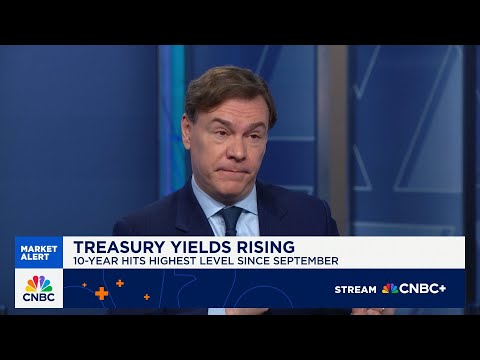
Weaker parts of the economy will rebound in 2026, says CIO Group's Steven Wieting
CNBC Television· 2025-12-09 19:03
Let's bring in Steve Whiting. He's the CIO of group of chief investment strategist. It's great to have you here. Good to see you again.Do you want to just top level address. I mean, do you favor the rate cut >> tomorrow. Well, look, if the Federal Reserve cuts as soon as possible, perhaps they can cut less.It really depends on how the economy evolves. And Steve Leeman's comment about, you know, a lot of the economy is just getting crumbs. Sub 1% industrial production growth, 2% drop in construction over the ...