Diversification

Search documents
coreweave comp
Bloomberg Television· 2025-10-23 03:03
The way the demand comes through the market right now is it's sort of bifurcated in a lot of ways, right. Like you've got one driver of demand that's coming from the most enormous companies in the world, the largest labs in the world. You know, and, you know, your opening ISE, your mistrials or all of them together.And they're they're they are very kind of tech forward kind of thinking about how they're going to do to address this. And then in addition to that, you've got a host of startups, you've got a ho ...


coreweave comp
Youtube· 2025-10-23 03:03
Core Insights - The current market demand is bifurcated, driven by both large companies and a growing number of startups looking to innovate in computing solutions [1][4] - The company has made strategic acquisitions, such as Monolith and Bias, to diversify its client base and enhance its service offerings [2][3] Market Dynamics - There is a significant focus on addressing the needs of both large-scale players and smaller consumers, with an emphasis on helping the latter manage their infrastructure challenges [4] - Diversification is a key priority for the company, as it stabilizes the business and provides valuable insights for product development [5][6] Strategic Partnerships - A notable deal with Metro, valued at a minimum of $14 billion, exemplifies the company's ongoing efforts to diversify its client relationships [7] - The company maintains strong partnerships with major hyperscalers, including Microsoft, which continue to expand [7][8] Financial Strategy - The company emphasizes a structured approach to financing its infrastructure through debt markets, allowing for profitable operations even before contracts with clients like Microsoft conclude [14][15] - The management believes that the current pricing structure for acquisitions is appropriate and is confident in the value of the transactions being pursued [10][13]


Market Meltdown Coming? These 2 ETFs Are Ready to Surge If Stocks Tank
Yahoo Finance· 2025-10-22 16:48
Core Insights - The U.S. stock market has shown significant gains over the past decade, but there are increasing signs of a potential downturn due to persistent inflation, high interest rates, and geopolitical tensions [1] - Analysts highlight overvalued tech stocks and slowing consumer spending as major concerns for the S&P 500 [1] Investment Strategies - In a scenario where U.S. indices drop by 20% or more, diversification is crucial, with opportunities outside the U.S. potentially offering better growth and lower valuations [2] - This strategy serves as a hedge against prolonged declines in U.S. markets, although it does not guarantee profits [2] Vanguard FTSE Developed Markets ETF (VEA) - VEA is a low-cost investment option for those seeking stability outside the U.S., tracking the FTSE Developed All Cap ex US Index and holding over 4,000 stocks from developed economies [3] - The ETF excludes emerging markets and focuses on established firms, with top holdings including ASML Holding, SAP, and Novo Nordisk, ensuring no single stock exceeds 1.5% of the fund [4] Performance Analysis - VEA's geographic diversification reduces its correlation to U.S. market events, evidenced by its smaller decline of 14% during the 2022 market dip compared to the S&P 500's 19% drop [5] - Over the past year, VEA achieved a total return of 22%, outperforming the Vanguard S&P 500 ETF's 15.5%, driven by strong performance in Japanese equities and steady gains in Europe [6] - However, over a three-year period, VEA's cumulative returns of 77% lag behind VOO's 87%, with VOO being more susceptible to risks due to its heavy reliance on tech giants [7]
How The S&P 500 Quietly Became An AI Fund
CNBC· 2025-10-22 16:01
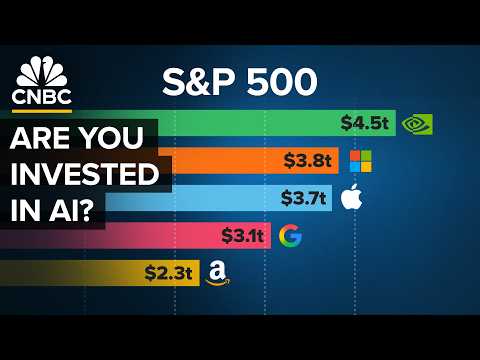
S&P 500 Concentration & AI Influence - Approximately 40% of funds tracking the S&P 500 are tied to the performance of ten companies, many heavily invested in AI [1] - Nvidia's significant growth, rising over 230% in 2023 and 170% in 2024, has made it over 7% of the S&P 500 [2] - One company now holds as much influence in the S&P 500 as the bottom 224 stocks combined [3] - Citigroup estimates nearly half of the S&P 500's market capitalization has medium to high exposure to AI [6] Investment Strategy & Diversification - The S&P 500's performance is increasingly driven by a few large tech stocks due to AI enthusiasm [8] - Investors may need to reevaluate diversification strategies as AI reshapes the economy [21] - Financial experts recommend spreading risk across different company sizes, sectors, and regions [23] - An equal-weighted S&P 500 index ETF can lessen exposure to tech and AI [28] Market Outlook & Tech Dominance - The majority of earnings and revenue growth in the S&P 500 has come from tech and AI [9] - Some view the concentration in tech and AI as a sign of strength, reflecting the importance of Silicon Valley and the AI "arms race" [9][10] - The top five companies in the S&P 500 represent nearly 30% of the index [15]

“October Effect” & ETF Investors' Insatiable Appetite for Risk
Etftrends· 2025-10-22 11:49
Core Insights - The "October Effect" is a psychological belief that stocks tend to decline in October, although historical data does not support this notion [1][8] - October 2025 has seen increased market volatility due to a government shutdown and economic uncertainty, yet the market is reaching new historic highs [2] - Investors are showing a strong preference for large-cap equity ETFs, particularly those tied to the S&P 500, despite concerns about economic growth [3][4] ETF Flows and Performance - Equity ETFs accounted for 50% of all ETF asset flows in October, with a notable focus on large-cap exposure [3] - The top three ETFs have captured approximately 37% of all equity ETF flows, with significant inflows into the Invesco QQQ Trust, Vanguard Total Stock Market ETF, and others [4][6] - Conversely, small-cap ETFs like the iShares Russell 2000 and Invesco S&P 500 Equal Weight ETF have experienced significant outflows, indicating a lack of diversification interest [4] Gold Investment Trends - Gold has emerged as a favored asset class, attracting substantial investment as a hedge against inflation and market volatility [7] - In October, gold ETFs have seen significant inflows, with the SPDR Gold Shares, SPDR Gold Minishares Trust, and iShares Gold Trust leading the way [9] - Gold's performance has been strong, with a 7% gain in October, reinforcing its status as a safe-haven asset [8]

These Single-Country ETFs Can Hedge Your U.S. Risk
Barrons· 2025-10-22 06:00
Core Viewpoint - Single-country funds can provide a means to reduce overall portfolio risk by behaving differently than the S&P 500, thus offering diversification beyond broad international indexes [1] Group 1 - Single-country funds act differently than the S&P 500, which can help in risk reduction [1] - These funds offer diversification benefits that are not available through broad international indexes [1]

2 Ways to Trade Qualcomm Ahead of November's Earnings
MarketBeat· 2025-10-21 22:35
Core Viewpoint - Qualcomm's stock has shown resilience, recovering to near the upper end of its recent range, with a 40% increase since April despite a brief pullback earlier this month [1][2] Group 1: Stock Performance - Qualcomm's shares closed at $168.83, marking a 1.07% increase [1] - The stock has been trading around the same levels as in 2021, indicating that the market has not fully rewarded its diversification and AI-driven products [2] - The stock has been stuck below a critical resistance zone near $180 for over a year, with a decisive break above this level being crucial for future momentum [6] Group 2: Technical Analysis - Qualcomm is maintaining an uptrend from the spring, with support around $155 reinforced by recent market rebounds [3] - The stock has a bullish reading of 55 on the RSI, suggesting that there is room for further gains [4] Group 3: Fundamental Analysis - Qualcomm's P/E ratio is approximately 16, significantly lower than peers like NVIDIA, indicating a compelling valuation [8] - The company has consistently beaten Wall Street expectations for earnings and revenue over the past two years [8] - Qualcomm is diversifying into connected vehicles, industrial IoT, and low-power edge computing, which are growing faster than its legacy handset business [7] Group 4: Investment Strategies - Option 1 suggests buying now, betting on Qualcomm's ability to beat expectations and capitalize on its expansion into automotive and IoT markets [9][10] - Option 2 recommends waiting for confirmation of strong earnings and a clean move above $180 to avoid potential volatility [11][12]

ETF investors eye small caps and international as they seek rebalancing, says ETF strategist
CNBC Television· 2025-10-21 14:38
Market Imbalance & Diversification - The technology sector holds an all-time high of approximately 35% weight within the S&P 500 index, while defensive sectors (staples, healthcare, energy, and utilities) are at an all-time low of just 19% [3] - Investors are seeking diversification beyond the S&P 500 index due to increasing concentration, exploring options like small caps (Russell 2000 IWM ETF) and international investments for value [6][9] ETF Trends & Strategies - There's significant interest in income-generating products, particularly those utilizing derivatives, to meet the needs of investors, especially retirees [11][13] - Innovation in income strategies involves moving beyond traditional covered calls to more sophisticated approaches like selling call spreads and active management to unlock more upside [14][15] - Thematic ETFs, particularly those related to AI, are experiencing a resurgence, attracting attention and growth in the ETF market [19][20] Future Outlook - The leveraged ETF space (3x and 5x products) is gaining attention, raising questions about its potential impact on financial markets [16][17] - Healthcare sector is considered an interesting area for potential investment, offering both growth and value opportunities [17][18]
X @Bloomberg
Bloomberg· 2025-10-21 10:13
RT Bloomberg Live (@BloombergLive)"Regardless of what the streets said about diversification - diversification has always been a priority for us,"@CoreWeave's Michael Intrator on why catering to a big consumer base is beneficial for business at #BloombergTech. https://t.co/wN0399CYyc ...
The Intimidating Mathematical Hurdle A Beaten-down Stock Market Always Clears
Benzinga· 2025-10-20 19:29
Core Insights - The article emphasizes the mathematical relationship between investment losses and the required gains to return to breakeven, illustrating that a 20% loss necessitates a 25% gain to recover [1][2] - Historical data shows that while the stock market faces challenges, it has consistently managed to recover from bear markets, with significant gains following declines [6][8] Investment Dynamics - A 33% loss requires a subsequent 50% gain to break even, while a 50% loss necessitates a 100% gain, highlighting the increasing difficulty of recovery as losses deepen [2] - The average bear market results in a 31% decline, requiring a 45% return to recover, whereas the average bull market yields a 254% return before the next bear market [8] Historical Performance - The 2022 bear market saw a 24% decline, requiring a 32% gain to break even, but the market achieved a 78% total return before the subsequent downturn [8] - The 2020 pandemic crash resulted in a 34% drop, necessitating a 52% return to recover, with the market ultimately achieving a 120% return [8] - The global financial crisis from 2007 led to a 55% decline, requiring a 122% return to break even, yet the following 11-year bull market delivered a remarkable 527% return [8] Market Characteristics - The article notes that while the stock market generally trends upward, most individual stocks underperform, with a select few driving overall market returns [5] - The concept of asymmetric upside in stocks is highlighted, indicating that significant returns can offset previous losses [5]