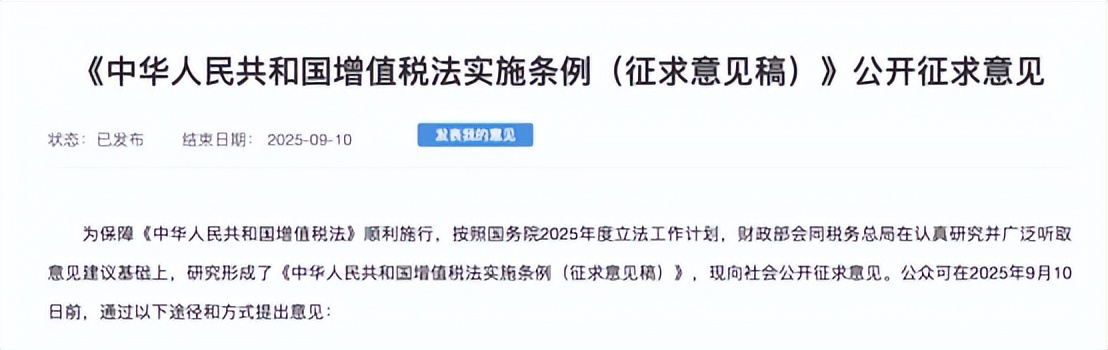
增值税法实施条例

Search documents
李强主持召开国务院常务会议,审议通过《中华人民共和国增值税法实施条例(草案)》和《商事调解条例(草案)》
Mei Ri Jing Ji Xin Wen· 2025-12-19 11:25
据央视新闻,李强主持召开国务院常务会议,审议通过《中华人民共和国增值税法实施条例(草案)》和 《商事调解条例(草案)》。 ...
中国第一大税种增值税法,2026年1月1日实施
第一财经· 2025-12-08 04:41
2025.12. 08 本文字数:1064,阅读时长大约2分钟 作者 | 第一 财经 陈益刊 增值税法落地实施一大关键配套文件是增值税法实施条例,增值税法实施条例会对增值税法有关规定 进一步细化、明确,对授权国务院规定的事项作出具体规定,有利于增强税制的确定性和可操作性。 今年8月,财政部 税务总局公开了《中华人民共和国增值税法实施条例(征求意见稿)》,在9月10 日前完成意见征集。此次增值税实施条例(意见稿)包括了总则、税率、应纳税额、税收优惠、征收 管理、附则等六章五十七条内容。 增值税法实施条例(意见稿)明确了政策细节问题。比如对混合销售行为如何确定具体适用税率方面 条款给予细化,强调主要业务判断更加注重交易实质和目的等。 目前增值税法实施条例尚未正式出台。 从过往部分税收立法情况来看,一些税种新法实施之前,其配套的实施条例也随之出台。比如, 2018年1月1日环保税法正式实施,环保税法实施条例在2017年12月底前公布,并与环保税法同步 实施。 中国第一大税种增值税法将于2026年1月1日实施,而其配套的重要法规增值税法实施条例尚未出 台,而这也引起市场关注。 中国政法大学财税法研究中心主任施正文告诉 ...


增值税法即将施行,实施条例有望尽快出台
Di Yi Cai Jing· 2025-12-08 03:54
Core Viewpoint - The implementation of the Value-Added Tax (VAT) Law in China is set for January 1, 2026, with the accompanying implementation regulations expected to be published in December 2023, which has garnered market attention [1][2]. Group 1: VAT Law Implementation - The VAT Law will maintain the overall framework and tax burden levels of the current VAT system, with some adjustments, such as the removal of tax exemptions for contraceptive products starting next year [2]. - The VAT Law consists of six chapters covering general principles, tax rates, taxable amounts, tax incentives, collection management, and appendices [2]. - The implementation regulations will further clarify and detail the provisions of the VAT Law, enhancing the certainty and operability of the tax system [2]. Group 2: Market Impact and Revenue - The VAT is the largest tax category in China, with projected revenues of approximately 6.57 trillion yuan in 2024, accounting for 38% of total tax revenue [1]. - The VAT covers all sectors of the national economy and has a broad impact, affecting a wide range of taxpayers [1].
梳理:增值税法实施条例征求意见稿的29项变化
Sou Hu Cai Jing· 2025-08-17 01:27
Group 1 - The draft regulation expands the definition of taxpayers to include a broader range of non-profit entities, aligning with the classification system in the Civil Code [3] - The draft combines modern services and life services into production and life services, and redefines real estate from property to assets [4][5] - The draft clarifies that services directly related to domestic goods or real estate are considered domestic consumption, reducing disputes over cross-border taxable transactions [8] Group 2 - The draft specifies that for foreign entities renting domestic real estate, they must appoint a domestic agent to declare and pay taxes [10] - The draft narrows the scope of small-scale taxpayers to non-enterprise units, allowing only administrative and military units to choose this status [13] - The draft states that loan services and related fees cannot be deducted from input tax [16] Group 3 - The draft introduces changes to the rules for paying taxes when exceeding the small-scale taxpayer threshold, requiring immediate registration as a general taxpayer [18] - The draft adjusts the zero tax rate for cross-border sales of services and intangible assets, removing certain blanket clauses [19] - The draft specifies that non-taxable transactions cannot deduct input tax unless they fall under specific exempt categories [25][26] Group 4 - The draft outlines that losses from fixed assets or real estate cannot deduct input tax based on their initial net value [28] - The draft introduces a new rule for long-term asset input tax allocation, simplifying treatment for assets under 5 million [30] - The draft emphasizes that tax incentives must be publicly disclosed in a timely manner [53]
增值税法实施条例四大细节需重视,藏着这些变化!
Di Yi Cai Jing· 2025-08-14 07:33
Group 1 - The draft regulations of the Value-Added Tax (VAT) Law will directly or indirectly impact millions of enterprises and individuals in China [1] - The new VAT regulations specify that services or intangible assets provided by foreign entities to domestic entities will be taxed based on the consumption location principle, with certain exceptions [2][3] - The regulations aim to enhance tax administration efficiency by clearly defining the taxable scope of services and intangible assets [3] Group 2 - The draft regulations clarify that mixed sales involving multiple tax rates will be determined based on the main business activity, focusing on the substance and purpose of the transaction rather than just sales volume [4][5] - A recent case regarding the taxation of courier services illustrates the complexities of determining applicable tax rates for mixed services [5][6] Group 3 - The draft regulations introduce stricter rules for the deduction of input tax on long-term assets used for both taxable and non-deductible projects, with a threshold of 5 million yuan [7][8] - The regulations maintain full input tax deduction for long-term assets valued below 5 million yuan, facilitating smoother tax administration for small assets [8] Group 4 - The draft regulations confirm that loan interest and related fees will not be deductible from output tax, maintaining consistency with current VAT policies [9] - This decision aims to preserve tax system stability while considering fiscal pressures and tax administration capabilities [9]
财政部、税务总局就增值税法实施条例公开征求意见
Sou Hu Cai Jing· 2025-08-12 22:57
Core Points - The Ministry of Finance and the State Taxation Administration have released a draft for public consultation regarding the implementation regulations of the Value-Added Tax (VAT) Law in China [1] - The draft clarifies definitions and scopes of taxable transactions, including goods, services, intangible assets, and real estate [1] - It provides detailed explanations for different types of taxpayers, including units, individuals, general taxpayers, and small-scale taxpayers [1] - The draft specifies the circumstances under which services and intangible assets are consumed domestically [1] - It mandates that VAT special invoices must separately indicate sales amounts and VAT amounts [1] - The draft outlines specific standards for VAT exemption projects and clarifies the applicable scope, standards, conditions, and tax administration measures for tax incentives [1] - It addresses illegal activities related to VAT incentives, such as failing to account for VAT exemptions separately or providing false materials [1] Tax Collection Management - The draft includes detailed regulations on tax collection management related to the VAT Law [2] - It specifies rules for taxpayers operating under special circumstances, such as contracting, leasing, and asset management product operations [2] Real Estate Rental Regulations - The draft states that foreign entities and individuals renting out real estate in China must appoint a domestic entity or individual as their agent [3] Tax Obligation Timing - The draft further clarifies the timing of VAT tax obligations [4] - It specifies the starting time for applying the general taxation method, conditions for consolidated tax declarations by headquarters and branches, and prepayment scenarios for taxpayers providing construction services across regions [4] Tax Refund and Exemption - The draft establishes regulations for the calculation methods of tax refunds and exemptions, as well as the deadlines for refund applications [5]
事关第一大税种! 增值税法实施条例征言
Mei Ri Jing Ji Xin Wen· 2025-08-12 14:19
Core Viewpoint - The implementation of the Value-Added Tax (VAT) Law and its accompanying regulations is expected to significantly impact taxpayers and enhance tax administration efficiency in China [1][2]. Group 1: Implementation and Structure of the VAT Law - The VAT Law will take effect on January 1, 2026, with an estimated revenue of approximately 6.57 trillion yuan in 2024, accounting for 38% of total tax revenue [1]. - The implementation regulations consist of six chapters and 57 articles, detailing aspects such as tax rates, taxable amounts, tax incentives, and collection management [2]. - The regulations aim to provide a stable tax framework, enhancing investor confidence and stabilizing investment expectations [2][3]. Group 2: Clarification of Taxpayer and Tax Scope - The regulations clarify definitions related to taxable transactions, including goods, services, intangible assets, and real estate, which helps avoid disputes between taxpayers and tax authorities [4]. - The classification of taxpayers, including individual businesses and natural persons, is explicitly defined to ensure fair tax burdens across similar transactions [4][5]. Group 3: Efficiency and Adaptability of Tax Administration - Maintaining a mature tax framework reduces compliance costs and operational difficulties for both tax authorities and taxpayers, thereby improving tax administration efficiency [3][5]. - The regulations allow for flexibility in adapting to economic developments and new business models, ensuring that tax administration remains relevant and effective [5][6]. Group 4: Addressing New Business Models and Cross-Border Transactions - The regulations provide clarity on the scope of export goods, cross-border services, and intangible assets, addressing challenges in tax administration related to new business models [6]. - Specific rules for transactions involving multiple tax rates are established, which helps reduce uncertainty for tax authorities and taxpayers alike [6][7]. Group 5: Digital Transformation and Modern Tax Governance - The regulations reinforce the VAT's position as a primary tax source, ensuring stable funding for the government while enhancing tax fairness and governance [7]. - The recognition of electronic invoices as having equal legal status to paper invoices promotes a digital approach to tax management, addressing issues of fraud and traceability [7].
两部门就增值税法实施条例公开征求意见
Chang Jiang Shang Bao· 2025-08-12 06:17
Core Points - The implementation of the Value-Added Tax (VAT) Law in China is set to begin on January 1, 2026, following its approval at the 13th meeting of the 14th National People's Congress Standing Committee in late 2024 [1][3] - The Ministry of Finance and the State Taxation Administration have drafted the "Implementation Regulations of the Value-Added Tax Law (Draft for Comments)" to ensure smooth implementation [1][2] Group 1 - The VAT is the largest tax in China, with an estimated revenue of approximately 6.57 trillion yuan in 2024, accounting for 38% of total tax revenue [1] - The draft regulations consist of six chapters and fifty-seven articles, aimed at clarifying and detailing the provisions of the VAT Law, enhancing the certainty and operability of the tax system [2] - The regulations specify definitions for taxable transactions, including goods, services, intangible assets, and real estate, as well as clarifying the categories of taxpayers [2] Group 2 - The tax rate section of the draft clarifies the scope of zero-rated exports and cross-border sales of services and intangible assets, along with rules for transactions involving multiple tax rates [2] - The tax exemption section outlines specific standards for VAT exemption projects and the conditions under which tax incentives can be applied, emphasizing the need for transparency in tax policy [2] - The progress in tax legislation is notable, with 14 out of 18 tax types in China having completed the legislative process, reflecting significant advancements in tax rule of law [3]
增值税法实施条例公开征求意见,专家解析将如何影响纳税人
Mei Ri Jing Ji Xin Wen· 2025-08-12 04:13
Core Viewpoint - The implementation of the VAT Law and its accompanying regulations is expected to significantly impact taxpayers and enhance the efficiency of tax administration in China [1][2][8]. Group 1: Overview of the VAT Law Implementation Regulations - The Ministry of Finance and the State Taxation Administration have released a draft of the VAT Law Implementation Regulations for public consultation, which will take effect on January 1, 2026 [1]. - The VAT is the largest tax category in China, with an estimated revenue of approximately 6.57 trillion yuan in 2024, accounting for 38% of total tax revenue [1]. Group 2: Impact on Taxpayers - The new regulations aim to provide clear legal frameworks for taxpayers, enhancing their rights and ensuring that tax authorities have a basis for enforcement, thereby improving tax collection efficiency [1][2]. - The regulations will clarify definitions related to taxable transactions, including goods, services, intangible assets, and real estate, which will help reduce disputes between taxpayers and tax authorities [4][5]. Group 3: Stability and Investor Confidence - A stable tax system is crucial for boosting investor confidence and stabilizing investment expectations, which is essential for attracting investment and achieving sustainable business operations [2]. - The regulations maintain the existing VAT framework while enhancing its clarity and operability, which is expected to stabilize social expectations and improve the business environment [2][3]. Group 4: Efficiency and Compliance - The continuity of the tax framework will reduce the costs associated with transitioning to new systems, allowing tax authorities to avoid redesigning tax collection processes and minimizing compliance burdens for taxpayers [3][5]. - The regulations will allow for flexible adaptation to economic developments and new business models, ensuring that tax administration remains relevant and efficient [5][8]. Group 5: Addressing New Business Models - The draft regulations specifically address the taxation of export goods, cross-border services, and intangible assets, providing clarity on applicable tax rates and rules [7]. - There is a call for further refinement of definitions related to new business models, particularly in the digital economy, to prevent disputes arising from ambiguous concepts [6][8].
两部门就增值税法实施条例公开征求意见 明确税制要素助力税收征管
Huan Qiu Wang· 2025-08-12 02:22
Core Viewpoint - The implementation of the "Regulations on the Implementation of the Value-Added Tax Law of the People's Republic of China" aims to enhance tax system certainty and standardize tax collection behaviors, providing a solid foundation for the smooth implementation of the Value-Added Tax Law starting January 1, 2026 [1][3]. Group 1: Tax System Framework - The Value-Added Tax (VAT) is China's largest tax category, with an estimated revenue of approximately 6.57 trillion yuan in 2024, accounting for 38% of the national tax revenue [3]. - The new regulations are designed to clarify and detail the provisions of the VAT Law, enhancing the certainty and operability of the tax system, which is expected to positively impact the business environment and promote high-quality economic development [3][4]. Group 2: Key Provisions of the Regulations - The regulations consist of six chapters and fifty-seven articles, covering general principles, tax rates, taxable amounts, tax incentives, collection management, and supplementary provisions [1][4]. - In terms of general principles, the regulations specify definitions for taxable transactions involving goods, services, intangible assets, and real estate, as well as clarifying the categories of taxpayers [1][4]. - The tax rates section details the scope of zero-rated exports and cross-border sales of services and intangible assets, along with applicable rules for transactions involving multiple tax rates [4]. - The taxable amounts section elaborates on the methods for deducting input VAT, including rules for non-deductible input VAT and adjustments for sales discounts or returns [4]. - The tax incentives section outlines specific standards for VAT exemption projects and the conditions for applying tax incentive policies, ensuring transparency in tax administration [4].