避孕药品和用具

Search documents
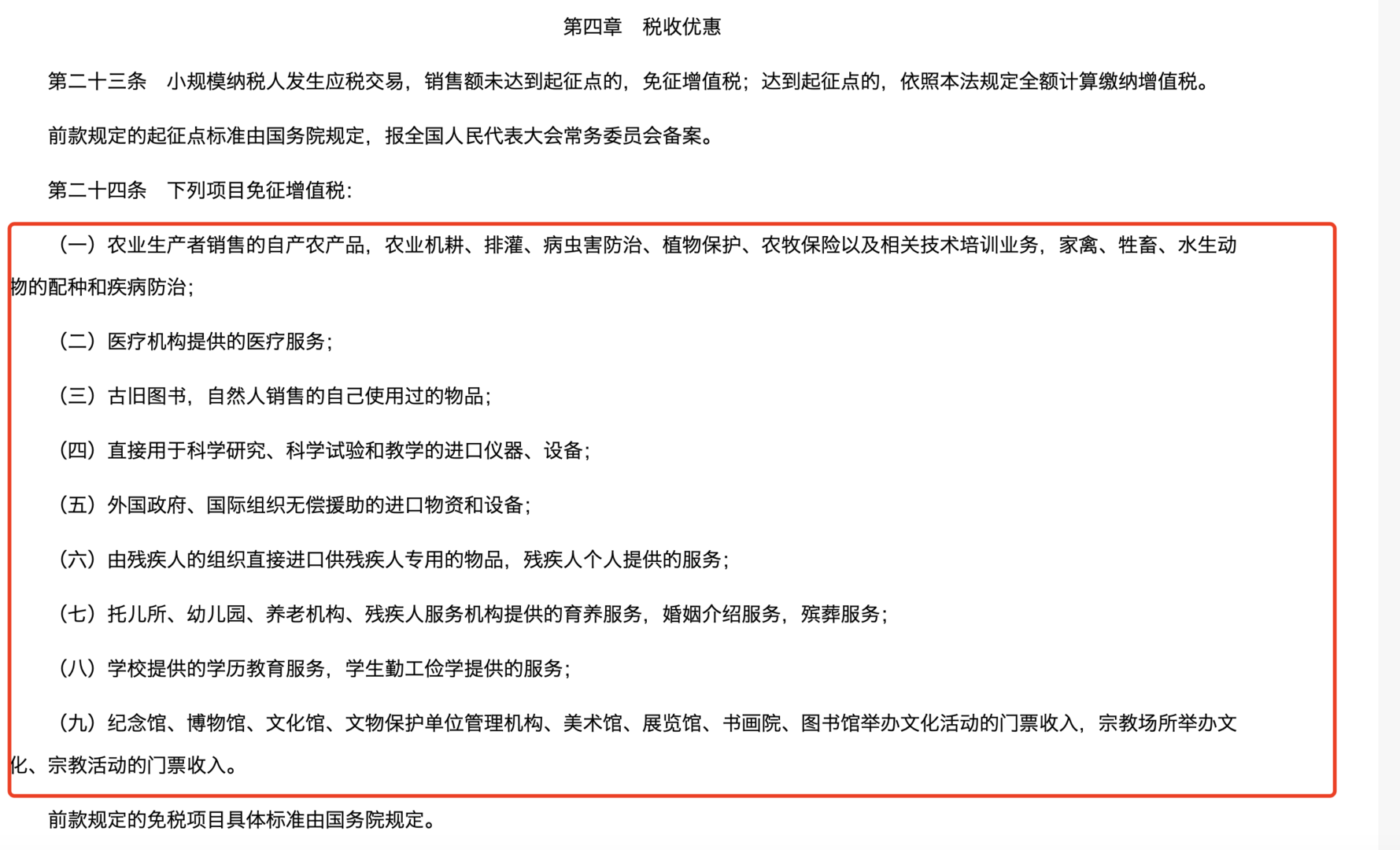
增值税法即将施行,实施条例有望尽快出台
Di Yi Cai Jing· 2025-12-08 03:54
Core Viewpoint - The implementation of the Value-Added Tax (VAT) Law in China is set for January 1, 2026, with the accompanying implementation regulations expected to be published in December 2023, which has garnered market attention [1][2]. Group 1: VAT Law Implementation - The VAT Law will maintain the overall framework and tax burden levels of the current VAT system, with some adjustments, such as the removal of tax exemptions for contraceptive products starting next year [2]. - The VAT Law consists of six chapters covering general principles, tax rates, taxable amounts, tax incentives, collection management, and appendices [2]. - The implementation regulations will further clarify and detail the provisions of the VAT Law, enhancing the certainty and operability of the tax system [2]. Group 2: Market Impact and Revenue - The VAT is the largest tax category in China, with projected revenues of approximately 6.57 trillion yuan in 2024, accounting for 38% of total tax revenue [1]. - The VAT covers all sectors of the national economy and has a broad impact, affecting a wide range of taxpayers [1].
中国财税专家分析避孕药品和用具特殊免税政策调整
Zhong Guo Xin Wen Wang· 2025-12-05 13:41
Core Viewpoint - The cancellation of the VAT exemption for contraceptive drugs and devices aims to standardize tax incentives and promote tax fairness [1][2] Group 1: Tax Policy Changes - The removal of the VAT exemption means that contraceptive products will now be subject to the same VAT rates and deduction mechanisms as other ordinary goods, promoting a unified tax system and fair tax burden [1] - The adjustment reflects a response to the evolving needs of the economy and aims to support high-quality development by reassessing and regulating specific historical tax incentives [1] Group 2: Market Impact - The reintroduction of VAT on contraceptive products is expected to have a limited impact on market supply and will not significantly disrupt the industry chain or alter the basic supply-demand balance [2] - Although companies will incur a 13% VAT on sales, they will also gain the right to deduct input VAT, leading to a relatively minor increase in actual tax burden and minimal effect on final market prices [2] - A unified and standardized VAT system is anticipated to enhance fair competition in the market and ensure the quality and stability of market supply in the long term [2]
避孕药明年收税,30年免税终结,一个时代结束了
Sou Hu Cai Jing· 2025-12-03 11:44
Core Viewpoint - The cancellation of the VAT exemption on contraceptives, effective January 1, 2026, marks the end of a 30-year policy aimed at controlling population growth, reflecting a significant shift in national population policy from control to encouragement of childbirth [1][4][8]. Group 1: Historical Context - The policy of family planning emerged in the 1970s due to rapid population growth, with contraceptives included in the public health service system to ensure accessibility [3]. - In 1994, contraceptives were officially exempted from VAT, further reducing costs for the public and supporting the goal of controlling population numbers while improving population quality [3][4]. - Over the past 30 years, the exemption has been closely tied to family planning efforts, with over 500 million yuan allocated annually for the procurement and distribution of contraceptives [3]. Group 2: Policy Shift - The gradual relaxation of birth restrictions, including the introduction of the two-child and three-child policies, indicates a shift from population control to encouraging childbirth [4][5]. - The decision to cancel the VAT exemption is seen as a response to the declining birth rate, which fell to 1.07 in 2022, significantly below the replacement level of 2.1 [4][5]. Group 3: Economic Implications - The removal of the VAT exemption will require manufacturers and sellers of contraceptives to pay a 6% VAT, potentially increasing government revenue [7]. - The change in policy is expected to signal a reduction in reliance on contraceptives and promote a more supportive environment for childbirth, aligning with broader strategies such as birth subsidies and extended maternity leave [5][7]. Group 4: Societal Impact - The end of the VAT exemption reflects a fundamental change in public attitudes towards family size, moving from a focus on quantity to a more rational and diverse approach to family planning [7]. - The cancellation of the exemption symbolizes a transition in population governance, emphasizing the need for a focus on population quality, structure, and distribution in response to new demographic challenges [7][8].


避孕品将征增值税 有安全套代工厂称影响不大,商超人员称或略影响高端品牌但“平替”很多
Sou Hu Cai Jing· 2025-12-03 06:39
Core Points - The transition from the "Interim Regulations on Value-Added Tax" to the "Value-Added Tax Law" reflects a significant legal upgrade and increased emphasis on tax collection by the state [4] - The new VAT law will come into effect on January 1, 2026, and will expand the list of items exempt from VAT from 7 to 9, including services related to elderly and child care, marriage introduction, and funeral services [2][11] - The removal of VAT exemption for contraceptive products indicates a shift in tax policy in response to changing population policies, with the aim of not encouraging low birth rates [11][12] Tax Policy Changes - The new VAT law will impose a 13% VAT on contraceptive products, meaning a product priced at 100 yuan will incur an additional 13 yuan in tax [6][10] - The previous exemption for contraceptive products is expected to have minimal impact on the market, as these products are considered necessities [10][12] - Experts suggest that the tax changes reflect a welfare-oriented approach to support families in light of demographic shifts, such as aging and declining birth rates [11][12] Market Reactions - Retailers and manufacturers of contraceptive products report that current prices have not yet changed significantly, indicating a potential delay in market adjustments [7][10] - The price sensitivity of consumers towards contraceptive products may lead to a preference for more affordable options if high-end brands increase prices due to the new tax [10][12] - The overall impact on production costs for manufacturers is expected to be limited, as demand for contraceptive products remains stable [10]
明年起,恢复对避孕药品和用具征收增值税,原因何在?
Sou Hu Cai Jing· 2025-12-03 03:19
Group 1 - The new VAT law will come into effect on January 1, 2026, removing the exemption for contraceptive drugs and devices, which will now be subject to a 13% VAT rate [2] - The removal of the VAT exemption for contraceptive products aligns with China's changing population policies, which now encourage childbirth rather than limiting it [3] - The decision to impose VAT on contraceptive products is part of a broader effort to standardize tax treatment across various goods and services, reflecting the current demographic strategy of the government [2][3] Group 2 - The Ministry of Finance reported that the domestic VAT revenue reached 58.58 billion yuan in the first ten months of the year, showing a year-on-year growth of 4% [3] - The adjustment in tax policy is expected to generate additional fiscal resources that can be redirected to support pro-natalist measures, such as child-rearing subsidies and the removal of certain fees [3] - Experts suggest that outdated and unreasonable tax incentives should gradually be phased out as part of the ongoing tax reform efforts [3]
明年起恢复对避孕药品和用具征收增值税,原因何在
第一财经· 2025-12-01 12:54
Core Viewpoint - The implementation of the new VAT law on January 1, 2026, will remove the exemption for contraceptive drugs and devices, leading to increased costs for consumers as they will now bear the VAT burden [3][4]. Group 1: Changes in Tax Policy - The new VAT law will no longer exempt contraceptive drugs and devices, which were previously included in the tax exemption list since the 1993 interim VAT regulations [3][5]. - The removal of the exemption aligns with China's current population policy, which encourages childbirth, thus necessitating a change in tax treatment for contraceptive products [4][5]. Group 2: Rationale Behind the Change - Experts suggest that the adjustment in tax policy reflects the significant changes in China's population policy, which now supports larger families [4][5]. - The government aims to phase out outdated tax incentives and redirect financial resources to support policies that lower the cost of childbirth and child-rearing, such as the introduction of child subsidies and the removal of certain fees [5]. Group 3: Financial Implications - VAT is the largest tax category in China, with the Ministry of Finance reporting a VAT revenue of 58.858 billion yuan in the first ten months of the year, representing a 4% year-on-year increase [6].

明年起恢复对避孕药品和用具征收增值税,原因何在
Di Yi Cai Jing· 2025-12-01 11:07
Core Viewpoint - The upcoming implementation of the VAT law on January 1, 2026, will remove the exemption for contraceptive drugs and devices, leading to a 13% VAT rate that will ultimately be borne by consumers [1][2]. Group 1: Tax Policy Changes - The VAT law will officially take effect on January 1, 2026, and will no longer include contraceptive drugs and devices in the exempt category [1]. - The removal of the exemption aligns with China's current population policy, which encourages childbirth, thus necessitating a change in tax treatment for contraceptive products [2]. Group 2: Historical Context - Contraceptive drugs and devices were exempt from VAT since the provisional regulations were first published in 1993, aimed at reducing costs associated with family planning [1]. - The shift in tax policy reflects a broader change in China's demographic strategy, moving from population control to encouraging higher birth rates [2]. Group 3: Financial Implications - The VAT is the largest tax category in China, with the Ministry of Finance reporting a VAT revenue of 58.858 billion yuan in the first ten months of the year, representing a 4% year-on-year increase [3].
早报 | 特朗普与委总统通话要其下台;香港大埔火灾已致146人遇难;罗永浩回应为何没发录音;中国电建回应偷工减料
虎嗅APP· 2025-11-30 23:48
Group 1 - The U.S. Secretary of State described the recent U.S.-Ukraine negotiations as "productive," emphasizing the significant role Russia will play in any agreement to end the conflict with Ukraine [2] - Trump threatened Venezuelan President Maduro during a phone call, stating that if Maduro does not step down, the U.S. may consider military options [3] - Goldman Sachs analysts predict that the Federal Reserve is likely to cut interest rates in December, with market expectations reflecting an 85% probability of this move [5][6] Group 2 - Gao Xin Retail announced a leadership change, appointing Li Weiping as the new CEO, effective December 1, 2025 [7][8] - The company operates over 500 stores under major brands including RT-Mart and Hema [8] Group 3 - The manufacturing Purchasing Managers' Index (PMI) in China rose slightly to 49.2% in November, while the non-manufacturing business activity index fell to 49.5% [10] Group 4 - Intel may return to Apple's supply chain for M-series chips by 2027, which would be significant for Intel after missing the opportunity to supply processors for the first iPhone [11] Group 5 - The Chinese government will impose value-added tax on contraceptive drugs and devices starting January 1, 2026, which may lead to increased market prices and affect production and sales strategies [17][18]

图解税收之免征增值税优惠
蓝色柳林财税室· 2025-10-25 01:13
Core Viewpoint - The article discusses various tax exemptions and regulations related to value-added tax (VAT) for different sectors and types of income, highlighting specific categories that are exempt from VAT. Group 1: VAT Exemptions for Individuals and Businesses - Individuals with sales revenue not exceeding 100,000 yuan from goods, services, or intangible assets are exempt from VAT [3] - Rental income from real estate, if received in a lump sum and averaged over the lease term, is exempt from VAT if the monthly income does not exceed 100,000 yuan [3] - Agricultural producers selling their own primary agricultural products are exempt from VAT [3] Group 2: Specific Exemptions in Various Sectors - Exemptions include sales of agricultural films, seeds, pesticides, and agricultural machinery [4] - Certain medical services and funeral services are also exempt from VAT [4] - Income from the transfer of copyright and technical services related to family property division is exempt from VAT [4] Group 3: Exemptions for Specific Products and Services - Feed products such as mixed feed, compound feed, and concentrated feed are exempt from VAT [4] - Non-powered hand tractors and three-wheeled agricultural transport vehicles are included in the VAT exemption list [4] - Exemptions also apply to imported goods and equipment donated by foreign governments and international organizations [4]

跨境税收热点问答之出口退税篇(一)
蓝色柳林财税室· 2025-09-16 14:54
Core Viewpoint - The article discusses the policies and regulations regarding the export of goods and services under the Value-Added Tax (VAT) exemption, detailing the specific categories of goods and services eligible for such exemptions and the necessary documentation required for compliance [4][5][6]. Group 1: Eligible Export Goods and Services - Export goods eligible for VAT exemption include small-scale taxpayer exports, contraceptives, antiquarian books, software products, goods containing gold or platinum, state-planned cigarette exports, used equipment, and agricultural products [4][5]. - Specific categories of goods that can be treated as self-produced for VAT exemption include purchased goods that are the same type as the company's own products, goods used for repair of self-produced goods, and goods exported to foreign entities that import the company's self-produced goods [8][9][10]. Group 2: Documentation and Compliance - Export enterprises must ensure that the names and measurement units on export declarations and VAT invoices match; otherwise, they cannot apply for tax refunds [3]. - Export enterprises must report any discrepancies in product names or measurement units to the tax authorities for confirmation before applying for VAT refunds [3]. - Companies must maintain proper documentation, including customs declarations and VAT invoices, to qualify for VAT exemptions and refunds [6][7]. Group 3: Special Cases and Conditions - Enterprises that have not complied with documentation requirements or have failed to submit VAT refund applications within the stipulated time frame are ineligible for VAT exemptions [5][6]. - Export enterprises that sell goods to foreign entities through bonded warehouses must provide additional documentation, including a list of exported goods, to apply for VAT refunds [7]. - Companies involved in processing trade must adhere to specific guidelines for VAT exemption claims related to processing exports [11].