开源模式

Search documents
华为终端BG软件部总裁龚体:超过1100款软硬件产品通过开源鸿蒙兼容性测评
Mei Ri Jing Ji Xin Wen· 2025-05-24 11:15
Core Insights - The open-source HarmonyOS has grown to over 130 million lines of code with more than 8,600 contributors, and over 1,100 software and hardware products have passed compatibility testing across various industries [1] - Counterpoint data indicates that by Q4 2024, HarmonyOS is projected to capture 19% of the smartphone operating system market share in China, surpassing iOS at 17% [1] - The development of HarmonyOS was accelerated in response to Huawei's "backup plan" after being forced to create a smart terminal operating system in August 2019, leading to its code being donated to the OpenAtom Open Source Foundation [1] Group 1 - Open-source has become a new development and innovation model in the software and digital fields, with 97% of global software developers and 99% of enterprises using open-source software [2] - The release of the HarmonyOS 5.1 version focuses on enhancing multi-scenario interaction experiences, system stability, and developer experience, optimizing the ArkUI framework for better interface development [2] - Huawei has launched its first HarmonyOS PC and foldable PC, with all devices set to feature the open-source HarmonyOS this year [2]
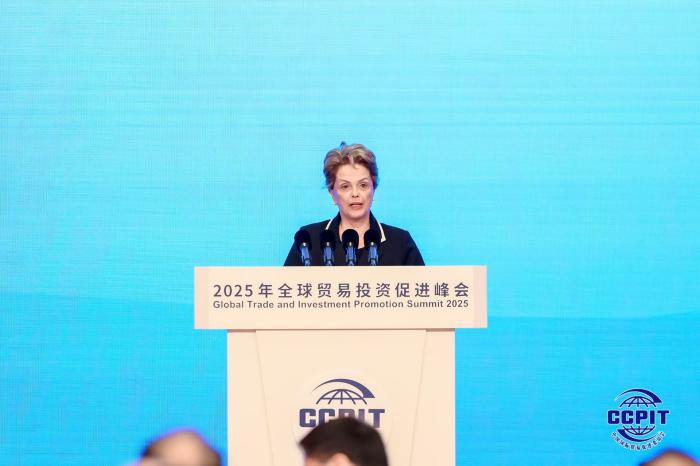
巴西前总统罗塞芙:中国共享创新成果,为发展中国家带来希望 | 世界观
Zhong Guo Xin Wen Wang· 2025-05-23 11:08
Core Viewpoint - The global economy is under significant pressure due to the United States' large-scale trade protectionism policies, which exacerbate global economic vulnerabilities and limit the development and technological access of various countries [1][3]. Group 1: Impact of U.S. Trade Policies - The U.S. has been using tariffs as a tool to exert pressure on other countries, leading to great uncertainty in the global economy [3]. - The "beggar-thy-neighbor" policy initiated by the U.S. is disrupting normal international trade order [3]. - The consequences of the trade war are evident, with significant fluctuations in financial markets, sharp declines in stock indices, and a notable drop in the U.S. dollar index, indicating deeper systemic changes [3]. Group 2: Technological Cooperation and Innovation - China is actively promoting global technological progress and deepening cooperation with developing countries, which is praised by the president of the New Development Bank [5]. - There is a call to strengthen international cooperation and oppose the establishment of technological barriers that hinder developing countries from accessing new technologies [5][6]. - The initiatives such as the BRICS cooperation mechanism and the Belt and Road Initiative play a crucial role in expanding access to capital, technology, and infrastructure for many developing countries [5][6].

中国人工智能强势逆袭
财富FORTUNE· 2025-05-13 13:09
Core Viewpoint - The article discusses the shift in perception regarding China's capabilities in artificial intelligence (AI), highlighting the emergence of DeepSeek as a significant player that challenges the traditional view of China as merely a follower in technology innovation [1][2]. Group 1: DeepSeek's Impact - DeepSeek, a startup from Hangzhou, China, has developed a reasoning-based large language model (LLM) R1, which matches the performance of OpenAI's models while having a significantly lower training cost of $6 million compared to hundreds of millions for similar U.S. models [1][2]. - The rapid rise of R1 has led to a significant market reaction, with major tech companies like Nvidia and Microsoft losing over $1 trillion in market value, and OpenAI's CEO expressing concerns about the competitive landscape [2][3]. - DeepSeek's success has sparked a renewed interest in Chinese tech stocks, with the Hang Seng Tech Index rising 35% year-to-date, driven by companies like Alibaba and Kuaishou integrating AI models into their products [3][4]. Group 2: China's AI Ecosystem - DeepSeek represents just a part of China's burgeoning AI ecosystem, with other major players like Alibaba and ByteDance also releasing competitive AI models that surpass Western products in reasoning benchmarks [3][4]. - The article emphasizes that China's AI industry is experiencing a wave of new startups, with DeepSeek being one of several emerging companies that are gaining traction in the market [5][6]. - The city of Hangzhou is highlighted as a hub for AI innovation, benefiting from its proximity to major tech firms and a strong talent pool [6][7]. Group 3: Government Role and Market Dynamics - The Chinese government plays a crucial role in fostering innovation through policies, regulations, and financial support, creating a "state-led" innovation system that encourages private sector alignment with national priorities [7][8]. - The U.S. export controls on chips have inadvertently accelerated China's innovation efforts, as companies like Huawei step up to fill the gap in high-end chip supply [8][9]. - Despite challenges in funding and market access, DeepSeek's achievements suggest that Chinese startups can compete globally without relying on massive capital investments [12][13]. Group 4: Future Prospects - The article posits that if Chinese companies like DeepSeek can continue to reduce reliance on expensive computing power, they may capture significant market share in developing regions, offering cost-effective AI solutions [14]. - The shift in mindset among younger Chinese entrepreneurs towards genuine innovation rather than mere imitation is noted as a potential driver for future advancements in the AI sector [9][12].

【高端访谈·数字经济】相信AI大模型开源的力量——访值得买科技CTO王云峰
Xin Hua Cai Jing· 2025-04-14 09:03
Core Viewpoint - The rise of open-source AI models in China, initiated by DeepSeek, is significantly impacting the AI industry, fostering innovation and collaboration among companies [2][3] Group 1: Open Source Impact on AI Industry - Open-source models are believed to gather global talent and enhance the richness and flexibility of the AI ecosystem, allowing companies to develop applications tailored to industry needs [3][4] - The shift from a capital-intensive model to a collaborative platform is facilitated by open-source, enabling companies to build upon existing models rather than starting from scratch [4] - Open-source models, such as those from DeepSeek, provide substantial cost advantages, being significantly cheaper than many advanced closed-source models while maintaining comparable capabilities [5] Group 2: AI Efficiency and Application - AI is enhancing efficiency across the entire value chain, with approximately 20% of the code generated by AI, leading to improved productivity in research and development [6] - AI's ability to assess product appeal has shown a 20% higher accuracy in predicting "hit products" compared to experienced editors, improving recommendation efficiency [6] - The use of AI to summarize and organize content has increased user engagement, indicating a preference for AI-curated information [6] Group 3: Company Strategy and Future Plans - The company views AI as a pervasive technology that enhances understanding of consumer information, aiming to improve decision-making efficiency for consumers and help producers identify product pain points [7] - The launch of the AI shopping assistant "Xiao Zhi" aims to serve as a consumer guide, enhancing the quality and efficiency of purchasing decisions [7] - The company is collaborating with various partners to build a new AI ecosystem, emphasizing the importance of each company's unique position within this ecosystem [8]
速递丨智谱完成新一轮超10亿元融资,京杭联手重仓押注下一个Deepseek!
Z Finance· 2025-03-03 01:41
Core Viewpoint - The article highlights the strategic investment in Zhipu AI, marking a significant move in the generative AI sector in Hangzhou, with over 1 billion yuan raised from local investment funds, indicating a strong governmental push towards AI development [1]. Group 1: Zhipu AI's Strategic Positioning - Zhipu AI's open-source model is reshaping the global AI innovation landscape, showcasing two main paths for domestic AI breakthroughs: algorithm innovation reducing computational power dependency and building an open-source ecosystem that attracts global developers [2]. - The DeepSeek-R1 model demonstrates a cost-effective approach, achieving performance comparable to billion-dollar models at a cost of $5.6 million, challenging the traditional paradigm of "computational power equals competitiveness" [2]. - Zhipu AI's ChatGLM series has gained significant traction, with over 50,000 stars on GitHub and 30 million downloads, reflecting the value of open-source models as a technological foundation [3]. Group 2: Technological Advancements and Market Trends - The shift towards multi-modal interaction and physical world manipulation is evident, with Zhipu's GLM series models capable of understanding various inputs and executing complex tasks, enhancing efficiency in sectors like finance and education [6]. - The anticipated "open-source week" by DeepSeek and Zhipu's upcoming AutoGLM framework signify a transition from single-model to toolchain open-sourcing, potentially transforming development paradigms and innovation focus [3]. - The AI Agent technology is expected to see significant advancements by 2025, with applications in both enterprise efficiency and personalized consumer services, indicating a structural shift in organizational roles and decision-making processes [5]. Group 3: Regional Economic Impact - Hangzhou's digital economy now accounts for over 28.8% of its GDP, transitioning from e-commerce to hard technology, with strategic goals to become a hub for computational power and AI industry development [7]. - The collaboration between Zhipu AI and local industries is set to enhance the integration of large model technology into various sectors, driving intelligent upgrades across manufacturing, healthcare, finance, and government [8].