
现代化人民城市

Search documents
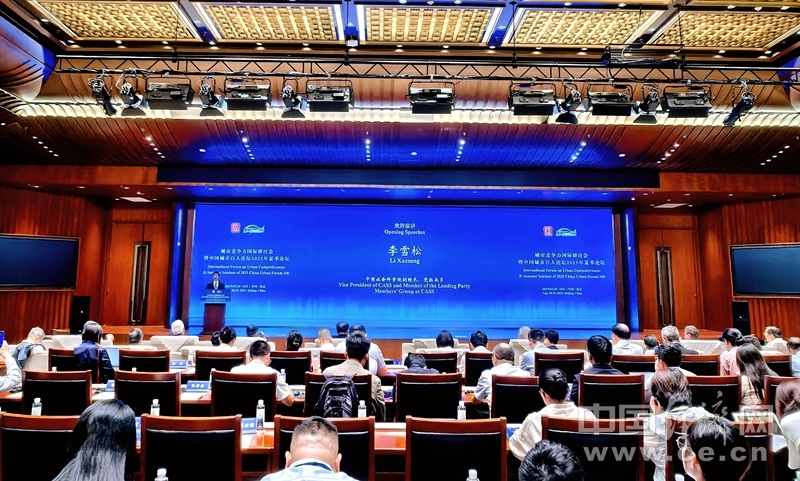
城市竞争力国际研讨会暨中国城市百人论坛2025年夏季论坛在京举行
Zhong Guo Jing Ji Wang· 2025-08-29 08:55
Group 1 - The conference focused on the theme of "diversified development of global cities in the intelligent era" and aimed to provide innovative ideas for urban development globally [1][3] - The Chinese government aims to build a "modernized people-oriented city," contributing unique Chinese solutions to global urban development [3][4] - Experts discussed various topics including the construction of a modern urban system for common prosperity, urban renewal, and the role of key cities in leading high-quality urban development [3][4] Group 2 - The construction of a common prosperity-oriented modern urban system is seen as a necessary requirement for Chinese modernization and requires a combination of government and market forces [4] - Urbanization in China is shifting from rapid growth to a more moderate pace, necessitating a focus on urban renewal as a means of achieving high-quality development [4] - The development of new technologies and industries in cities is crucial, but there is a need to avoid blind competition and promote differentiated industrial layouts based on city characteristics [5] Group 3 - The conference included discussions on building a Chinese school of urban research, innovation and growth in the intelligent era, and sustainable urban governance [6]

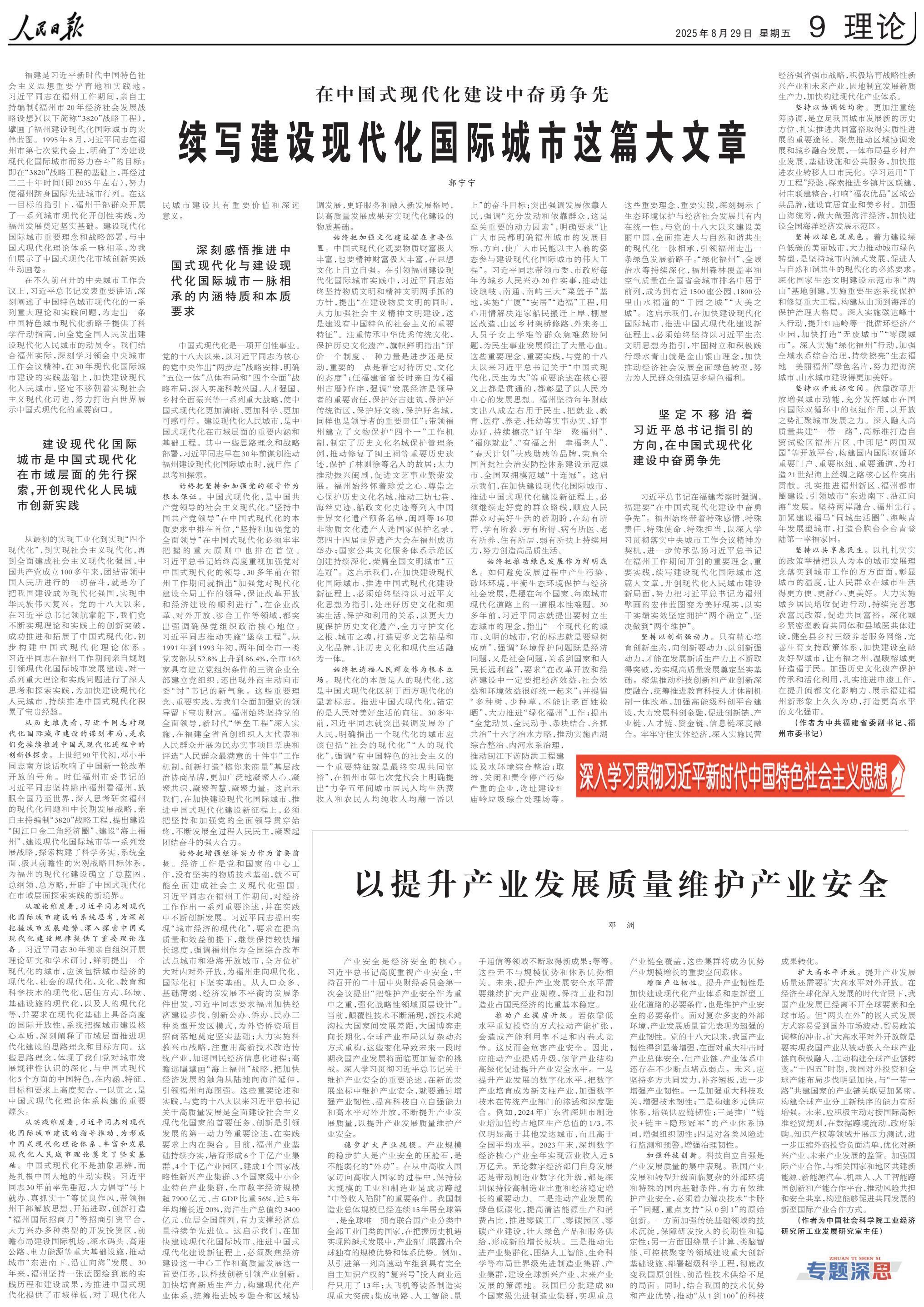
《人民日报》刊发郭宁宁署名文章:在中国式现代化建设中奋勇争先 续写建设现代化国际城市这篇大文章
Ren Min Ri Bao· 2025-08-28 23:56
Core Viewpoint - The construction of a modern international city in Fuzhou is a pioneering exploration of Chinese-style modernization at the municipal level, aiming to create a vibrant practice of modern urban development that aligns with the theoretical framework of Chinese-style modernization [3][12][16]. Group 1: Historical Context - Fuzhou's development strategy, known as the "3820" strategic project, was personally overseen by Xi Jinping during his tenure in the city, aiming to elevate Fuzhou to the ranks of advanced international cities by around 2035 [10][12]. - The strategic planning initiated by Xi Jinping in the 1990s laid a comprehensive foundation for Fuzhou's modernization, incorporating economic, social, and cultural dimensions [13][14]. Group 2: Theoretical Framework - The modernization of cities in China is characterized by a "two-step" strategic arrangement and a "five-in-one" overall layout, emphasizing the importance of cultural and educational advancements alongside economic growth [4][16]. - Xi Jinping's early insights into urban modernization included the necessity for economic, social, cultural, and environmental advancements, which are now integral to the Chinese-style modernization theory [14][15]. Group 3: Practical Implementation - Fuzhou has implemented various innovative practices, such as the "Fuzhou International Investment Month" and the establishment of multiple development zones, to attract investment and enhance infrastructure [15][18]. - The city has achieved significant economic milestones, including the formation of six trillion-yuan industrial clusters and a digital economy scale exceeding 790 billion yuan, demonstrating robust economic growth [18][20]. Group 4: Cultural and Social Aspects - The emphasis on cultural heritage preservation and the promotion of traditional arts, such as Min opera, reflects a commitment to enriching both material and spiritual wealth in the context of modernization [19][20]. - Fuzhou's development strategy prioritizes the well-being of its citizens, with initiatives aimed at improving living standards and ensuring that economic growth translates into tangible benefits for the population [20][21]. Group 5: Environmental Considerations - The city has adopted a green development approach, focusing on ecological preservation and sustainable urban planning, which includes extensive afforestation and water management projects [21][22]. - Fuzhou's commitment to environmental sustainability is evident in its initiatives to enhance urban green spaces and improve air quality, positioning it as a model for other cities [22][23]. Group 6: Future Directions - The ongoing efforts to integrate innovation, coordination, and openness into Fuzhou's development strategy are aimed at fostering a balanced and inclusive urban environment [23][24]. - The city is focused on enhancing its role in the dual circulation economy, leveraging its geographical advantages to strengthen both domestic and international economic ties [25].
中共中央、国务院印发《关于推动城市高质量发展的意见》——到2035年,现代化人民城市基本建成
Zheng Quan Shi Bao Wang· 2025-08-28 23:26
Core Viewpoint - The central government of China has issued the "Opinions on Promoting High-Quality Urban Development," aiming to transform urban development methods and build modern, innovative, livable, beautiful, resilient, civilized, and smart cities by 2035 [1][2]. Group 1: Urban Development Goals - By 2030, significant progress in building modern cities is expected, with improvements in policy systems, quality of living, green transformation, safety foundations, cultural charm, and governance levels [2][3]. - The ultimate goal is to have modern cities fundamentally established by 2035 [2]. Group 2: Urban Development Strategies - The "Opinions" emphasize a shift in urban development philosophy to be more people-centered, efficient, and focused on unique characteristics [2][3]. - It advocates for the integration of urban clusters and the enhancement of the competitiveness of mega-cities while controlling their scale and promoting the capacity of smaller cities [3][4]. Group 3: Urban Renewal and Infrastructure - The aim of urban renewal is to revitalize underutilized resources to stimulate economic growth, with a focus on establishing a flexible growth management mechanism [4]. - The "Opinions" call for the construction of high-quality living spaces, improved infrastructure, and balanced public service systems [4][5]. Group 4: Digital Transformation and Technology - A push for comprehensive digital transformation of cities is highlighted, aiming to create a unified, data-integrated, and efficient urban digital foundation [5]. - The importance of technological innovation as a core driver of urban development is emphasized, alongside the need to address potential risks associated with artificial intelligence [6].
中共中央、国务院印发《关于推动城市高质量发展的意见》 到2035年现代化人民城市基本建成
Zhong Guo Jin Rong Xin Xi Wang· 2025-08-28 23:12
Core Viewpoint - The article discusses the issuance of the "Opinions on Promoting High-Quality Urban Development" by the Central Committee of the Communist Party of China and the State Council, aiming to transform urban development towards a more human-centered, efficient, and sustainable model [1][2]. Group 1: Urban Development Goals - By 2030, significant progress is expected in the construction of modern urban areas, with improvements in policies, quality of living, green transformation, safety, cultural appeal, and governance levels [2] - By 2035, the basic establishment of modern urban areas is anticipated [2]. Group 2: Urban System Optimization - The Opinions propose promoting the integration of urban clusters and the development of metropolitan areas, supporting world-class urban clusters in regions like Beijing-Tianjin-Hebei, Yangtze River Delta, and Guangdong-Hong Kong-Macau Greater Bay Area [2] - There is a focus on enhancing the competitiveness of mega cities while controlling their scale and improving the capacity of small and medium-sized cities [2]. Group 3: New Urban Development Dynamics - The Opinions emphasize the need for tailored policies to enhance urban development dynamics, focusing on original innovation, key technology breakthroughs, and the cultivation of advanced manufacturing clusters [3] - It is essential to activate existing urban resources and establish a sustainable urban construction and operation financing system [3]. Group 4: Quality Urban Living Spaces - The Opinions advocate for systematic promotion of quality housing and complete community construction, improving the real estate development model and urban infrastructure [3] - Enhancements in public services, including employment, social security, education, and healthcare, are also highlighted [3]. Group 5: Digital Transformation - The Opinions call for a comprehensive digital transformation of cities, creating a unified, data-integrated, and efficient urban digital foundation [4] - The importance of leveraging technological innovation as a core driver for urban development is emphasized, while also addressing potential risks associated with artificial intelligence [4].
续写建设现代化国际城市这篇大文章(深入学习贯彻习近平新时代中国特色社会主义思想)
Ren Min Wang· 2025-08-28 22:36
Core Viewpoint - The article emphasizes the importance of Fuzhou as a significant site for the development and practice of Xi Jinping's Thought on Socialism with Chinese Characteristics for a New Era, highlighting the city's strategic plans for modernization and internationalization [1][2][3]. Group 1: Historical Context - Xi Jinping's planning for the modernization of Fuzhou, particularly the "3820" strategic plan, laid a comprehensive framework for the city's development, aiming to position it among advanced international cities by around 2035 [1][3]. - The strategic initiatives proposed by Xi during his tenure as Fuzhou's mayor included the establishment of the "Minjiang River Golden Triangle Economic Zone" and the concept of "Maritime Fuzhou," which are pivotal for the city's modernization [3]. Group 2: Theoretical Insights - Xi's systematic thinking on urban modernization provides essential theoretical groundwork for understanding urban development trends and exploring the laws of Chinese-style modernization [4]. - The modern city should encompass economic, social, cultural, educational, and environmental modernization, reflecting a comprehensive approach to urban development [4]. Group 3: Practical Implementation - The practical efforts led by Xi in Fuzhou, such as the "Fuzhou International Investment Month" and the establishment of various development zones, have set a precedent for the implementation of Chinese-style modernization [5]. - Fuzhou's commitment to a consistent development blueprint over the past 30 years serves as a model for advancing Chinese-style modernization at the municipal level [5]. Group 4: Economic Development - Economic modernization is highlighted as a central task, with Fuzhou focusing on maintaining rapid growth while enhancing quality and efficiency, supported by the establishment of six trillion-yuan industrial clusters and a digital economy exceeding 790 billion yuan [8]. - The city has also prioritized the development of marine economy and high-tech industries, aligning with national strategies for high-quality development [8]. Group 5: Cultural and Social Aspects - The article underscores the dual focus on material and spiritual wealth, advocating for the protection of cultural heritage while promoting economic development [9][10]. - Fuzhou's initiatives in cultural preservation and promotion of traditional arts, such as the revitalization of Min Opera, reflect a commitment to enriching both material and spiritual aspects of modernization [9]. Group 6: Environmental Considerations - The importance of ecological development is emphasized, with Xi advocating for green urbanization and the integration of environmental protection into economic planning [12]. - Fuzhou's efforts in afforestation and water management have positioned it as a model for sustainable urban development, with significant improvements in air quality and green space [12]. Group 7: People's Welfare - The article stresses that modernization should ultimately benefit the people, with a focus on improving living standards and ensuring social equity [11]. - Fuzhou's initiatives to address housing, education, and healthcare reflect a commitment to enhancing the quality of life for its residents [11].
中共中央、国务院印发《关于推动城市高质量发展的意见》—— 到2035年,现代化人民城市基本建成
Zheng Quan Shi Bao· 2025-08-28 17:59
Core Viewpoint - The article discusses the issuance of the "Opinions on Promoting High-Quality Urban Development" by the Central Committee of the Communist Party of China and the State Council, aiming to transform urban development towards a more human-centered, efficient, and sustainable model [1][2]. Group 1: Urban Development Goals - By 2030, significant progress is expected in the construction of modern urban areas, with improvements in policy systems, quality of living, green transformation, safety foundations, cultural appeal, and governance levels [2] - By 2035, the basic establishment of modern urban areas is anticipated [2]. Group 2: Urban System Optimization - The "Opinions" propose promoting the integration of urban clusters and the development of metropolitan areas, supporting world-class urban clusters in regions like Beijing-Tianjin-Hebei, Yangtze River Delta, and Guangdong-Hong Kong-Macau Greater Bay Area [2] - There is a focus on enhancing the competitiveness of mega cities while controlling their scale and improving the capacity of small and medium-sized cities [2]. Group 3: New Urban Development Dynamics - The "Opinions" emphasize the need for tailored policies to enhance urban development dynamics, focusing on original innovation, key technology breakthroughs, and the cultivation of advanced manufacturing clusters [3] - It is essential to activate existing urban resources and establish a sustainable urban construction and operation financing system [3]. Group 4: Quality Urban Living Spaces - The "Opinions" call for systematic promotion of quality housing and complete community construction, improving real estate development models and urban infrastructure [3] - Enhancements in public services, including employment, social security, education, and healthcare, are also highlighted [3]. Group 5: Digital Transformation - The "Opinions" advocate for a comprehensive digital transformation of cities, aiming to create a unified, data-integrated, and efficient urban digital foundation [4] - The importance of technological innovation as a core driver for urban development in the smart era is emphasized [4]. Group 6: Addressing Technological Risks - There is a recognition of the potential risks associated with artificial intelligence and the need to address the widening technological gap between different cities [5].
中共中央、国务院印发《关于推动城市高质量发展的意见》—— 到2035年, 现代化人民城市基本建成
Zheng Quan Shi Bao· 2025-08-28 17:53
Core Viewpoint - The article discusses the issuance of the "Opinions on Promoting High-Quality Urban Development" by the Central Committee of the Communist Party of China and the State Council, aiming to transform urban development towards a more human-centered, efficient, and sustainable model [1][2]. Group 1: Urban Development Goals - By 2030, significant progress is expected in the construction of modern urban areas, with improvements in policy systems, quality of living, green transformation, safety foundations, cultural appeal, and governance levels [2]. - By 2035, the basic establishment of modern urban areas is anticipated [2]. Group 2: Urban System Optimization - The "Opinions" propose promoting the integration of urban clusters and the development of metropolitan areas, supporting the creation of world-class urban clusters in regions like Beijing-Tianjin-Hebei, the Yangtze River Delta, and the Guangdong-Hong Kong-Macau Greater Bay Area [2]. - There is a focus on enhancing the competitiveness of mega cities while controlling their scale and improving the capacity of small and medium-sized cities [2]. Group 3: New Urban Development Dynamics - The "Opinions" emphasize the need for tailored policies to enhance urban development dynamics, focusing on original innovation, key technology breakthroughs, and the cultivation of advanced manufacturing clusters [3]. - The importance of activating existing urban resources and establishing a sustainable urban construction and operation financing system is highlighted [3]. Group 4: Quality Urban Living Spaces - The "Opinions" advocate for systematic promotion of quality housing and complete community construction, along with improvements in urban infrastructure and public services [3]. - There is a call for enhancing the balance of public resource allocation and welfare between urban areas [3]. Group 5: Digital Transformation - The "Opinions" propose advancing comprehensive digital transformation in cities, creating a unified, data-integrated, and efficient urban digital foundation [4]. - The article notes the significance of technological innovation as a core driver of urban development, while also addressing potential risks associated with artificial intelligence and the widening development gap between cities [4].
广州市召开城市更新和城市品质提升工作推进会
Guang Zhou Ri Bao· 2025-08-28 01:52
Core Viewpoint - The meeting in Guangzhou emphasizes the importance of urban renewal and quality improvement as essential measures to achieve high-quality development in super-large cities, aligning with the directives of Xi Jinping and the central government [2][3]. Urban Renewal and Quality Improvement - The city aims to advance urban renewal and enhance urban quality to better meet the needs of the people for a better life, focusing on building an innovative, livable, beautiful, resilient, civilized, and smart modern city [3]. - Key strategies include the renovation of urban villages and old residential areas, improving urban capabilities and quality, and revitalizing old cities while maintaining their classic charm and modern vitality [3]. Implementation Strategies - The city will adopt a "retain, modify, and demolish" approach in urban village renovations, utilizing legal land acquisition and land transfer models, and exploring a mechanism linking housing, land, and financial elements [3]. - Emphasis will be placed on categorizing and processing "three old" renovation projects, enhancing infrastructure and public services, and preserving historical and cultural heritage [3]. Community and Public Engagement - The city plans to enhance community engagement by exploring new models for community management and focusing on improving living conditions and service functions in neighborhoods [3]. - The goal is to eliminate safety hazards, improve living environments, and increase the sense of security and happiness among residents [3]. Quality Enhancement Actions - The city will implement quality improvement actions in conjunction with major events like the 15th National Games and the Special Olympics, focusing on urban aesthetics, ecological construction, and comprehensive traffic management [3][4]. - Continuous efforts will be made to enhance the quality of historical and cultural districts and promote urban governance and civilization [3]. Organizational Leadership and Funding - Strong organizational leadership will be emphasized, with a focus on collaboration across city, district, and town levels, and the importance of community participation [3]. - The city will leverage various funding sources, including long-term special bonds and market financing, to support key projects and infrastructure development [4][5].
从“一个尊重、五个统筹”到“一个优化、六个建设”
Ren Min Ri Bao· 2025-08-24 22:21
Core Viewpoint - The article emphasizes the goal of building a modernized people-oriented city in China, highlighting the transition from rapid urbanization to stable development, and the need for a more refined approach to urban planning and management [2][12]. Group 1: Urban Development Goals - The Central Urban Work Conference proposed "one optimization and six constructions" to enhance urban systems, innovation, livability, environmental sustainability, resilience, civilization, and smart city features [2][6]. - The urbanization rate in China is projected to rise from 53.1% in 2012 to 67% by 2024, indicating significant progress in urban development [6]. Group 2: Historical Context and Evolution - The shift from "one respect and five coordinations" to "one optimization and six constructions" reflects a deepening understanding of urban development principles and a leap in objectives [3][11]. - The article notes that the urban development strategy has evolved to address new challenges and opportunities, emphasizing the importance of adapting to changing circumstances [12][21]. Group 3: People-Centric Approach - The concept of a people-oriented city is central to urban development, with a focus on improving the quality of life for residents and ensuring that urban construction serves the needs of the people [4][26]. - The article highlights the importance of providing quality public services and enhancing community engagement in urban management [16][17]. Group 4: Balancing Growth and Sustainability - The article discusses the need to balance urban expansion with the preservation of rural areas, advocating for integrated development that combines urban and rural revitalization [9][10]. - It emphasizes the importance of sustainable practices in urban planning, such as reducing non-essential urban sprawl and enhancing green spaces [18][20]. Group 5: Governance and Management - The article stresses the increasing importance of urban governance, noting that effective management is crucial for addressing urban challenges and improving living conditions [19][21]. - It calls for a strategic approach to urban governance that prioritizes long-term planning and community involvement, rather than short-term gains [25][26].
王浩专题调研推动城市高质量发展工作并赴省建设厅调度
Hang Zhou Ri Bao· 2025-08-22 02:45
Group 1 - The core viewpoint emphasizes the need for high-quality urban development in Zhejiang, aligning with Xi Jinping's important speeches and the central urban work conference requirements [1][3] - The focus is on the transformation of old residential areas, highlighting the importance of improving living conditions and urban safety while avoiding large-scale demolitions [1][2] - The strategy includes revitalizing low-efficiency land in industrial zones, integrating ecological protection with traditional industry upgrades, and promoting green and low-carbon development [2][3] Group 2 - The provincial construction department is tasked with leading the modernization of urban development, emphasizing the need for innovative urban governance and management [3] - Key principles include promoting common prosperity, ensuring urban modernization meets public satisfaction, and fostering a resilient and beautiful urban environment [3] - The importance of cultivating a skilled workforce that understands urban management is highlighted, along with the need for detailed planning in the "14th Five-Year Plan" [3]