行业周期波动

Search documents
太突然!“85”后女儿接班首年,巨头大亏79亿元!70岁父亲声援女儿:充满了信任
新浪财经· 2025-03-28 01:06
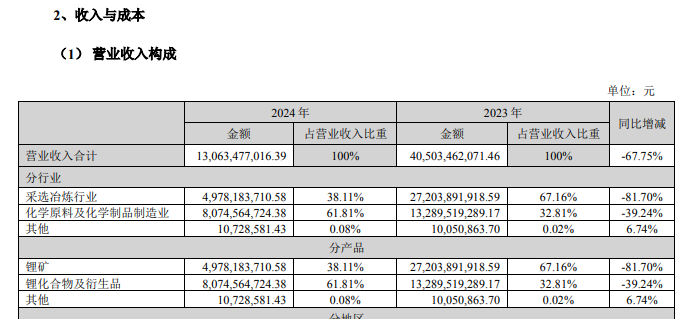
Core Viewpoint - Tianqi Lithium Industries reported a significant decline in revenue and a net loss for 2024, marking a challenging year for the company under the new leadership of Jiang Anqi, who took over as chairperson in April 2024 [1][10]. Financial Performance - The company’s revenue for 2024 was 13.063 billion yuan, a decrease of 67.75% year-on-year [1]. - The net loss attributable to shareholders was 7.905 billion yuan, a stark contrast to a profit of 7.297 billion yuan in 2023 [5]. - The majority of the losses occurred in the first half of 2024, with losses exceeding 5 billion yuan during that period [5]. Market Context - The losses were attributed to a global downturn in lithium prices, which saw a significant drop due to decreased demand and increased inventory [6][8]. - Lithium carbonate prices experienced fluctuations, rebounding to around 110,000 yuan per ton in early 2024 before entering a downward trend [8]. Resource and Production Capacity - Despite the price decline, the company maintains a strong resource advantage with five lithium chemical product production bases in China and Australia, totaling a combined capacity of 91,600 tons per year [9]. - Ongoing projects include a 30,000-ton lithium hydroxide project in Jiangsu and a 1,000-ton lithium metal project in Chongqing [9]. Leadership Transition - Jiang Anqi's leadership was supported by her father, Jiang Weiping, who emphasized the importance of her experience and understanding of the company’s culture and governance [10]. - Jiang Weiping expressed confidence in the transition, citing the challenges faced by the company and the broader industry as significant factors [10]. Strategic Directions - Jiang Anqi outlined strategies to mitigate industry cyclicality, including securing stable lithium ore sources and expanding basic lithium salt production capacity [11]. - The company aims to enhance its global business presence and strengthen its competitive edge in the lithium industry [11]. Future Plans - Tianqi Lithium plans to maintain an open and cooperative approach to explore high-quality lithium resource projects globally [17].


太突然!巨亏79亿,29万人踩雷!85后女儿接班仅1年
21世纪经济报道· 2025-03-27 12:25
Core Viewpoint - Tianqi Lithium Industries reported a significant loss of 7.9 billion yuan in 2024, highlighting the severe impact of market fluctuations and operational challenges in the lithium industry [2][6][10]. Financial Performance - In 2024, the company's revenue was 13.06 billion yuan, a decrease of 67.75% compared to 2023 [5][9]. - The net profit attributable to shareholders was a loss of 7.9 billion yuan, marking a decline of 208.32% from a profit of 7.3 billion yuan in 2023 [5][10]. - The gross profit margins for lithium ore and lithium compounds were 63.71% and 35.21%, respectively, down by 26.73 and 38.64 percentage points year-on-year [8]. Operational Challenges - The decline in lithium product prices led to a significant drop in the company's overall gross margin, exacerbating the losses [6][10]. - The company faced additional pressures from its subsidiary, Talison, which affected the pricing mechanism for lithium salt products, resulting in cost overruns [6][10]. Investment Losses - Tianqi Lithium's investment in SQM resulted in a loss of 8.85 billion yuan, contributing to an overall investment loss of 8.4 billion yuan for the year [10][12]. - The company recorded substantial asset impairment losses totaling 2.11 billion yuan, significantly higher than the previous year's losses [12][13]. Market Position and Future Outlook - The company's market capitalization has drastically decreased from nearly 220 billion yuan in July 2022 to approximately 50.9 billion yuan by March 2025, reflecting an evaporation of nearly 169.1 billion yuan [15][16][17]. - The management acknowledged the cyclical nature of the lithium industry and emphasized the need for strategies to mitigate the impact of price volatility on performance [18][20]. - The new chairperson, Jiang Anqi, outlined plans to enhance resource supply stability and expand production capacity, aiming to strengthen the company's competitive position in the lithium market [20][21][22].

天齐锂业79亿元大额亏损后 蒋卫平反思“如何不让公司伤筋动骨”
2 1 Shi Ji Jing Ji Bao Dao· 2025-03-27 11:37
Core Viewpoint - The lithium industry is experiencing significant cyclical fluctuations, which have severely impacted Tianqi Lithium's performance in 2024, leading to a substantial revenue decline and a notable net loss [1][3][15]. Financial Performance - Tianqi Lithium reported a revenue of 13.06 billion yuan in 2024, a year-on-year decrease of 67.8% [1][6]. - The company incurred a net loss of 79.05 billion yuan in 2024, attributed to both core business performance and non-recurring losses [5][14]. - The gross profit margins for lithium ore and lithium compounds were 63.71% and 35.21%, respectively, down by 26.73 percentage points and 38.64 percentage points compared to the previous year [5]. Operational Challenges - The cyclical downturn in the industry has affected not only the main business but also investment income and asset impairment, with total asset impairment losses reaching 2.11 billion yuan, a significant increase from the previous year [3][10]. - The company faced a substantial increase in financial expenses, which rose to 899 million yuan in 2024, a 5503.69% increase year-on-year [11]. Strategic Responses - The management is focused on stabilizing operations amidst cyclical fluctuations, with plans to enhance raw material sourcing and expand lithium salt production capacity [19]. - The company aims to strengthen its competitive advantage in the lithium industry by exploring opportunities across the supply chain and expanding its global business footprint [19][20]. Market Context - The lithium market has transitioned from a niche to a bulk commodity, with international market changes impacting company performance unexpectedly [17]. - Tianqi Lithium's stock price has seen a dramatic decline from over 130 yuan in July 2022 to 30.99 yuan as of March 27, 2024, reflecting the volatility in the industry [14].