金融制裁

Search documents
金融制裁:您需要了解的几大关键问题
Refinitiv路孚特· 2025-06-27 04:59
Group 1 - Financial sanctions are key measures implemented against specific foreign jurisdictions and regimes to limit or prohibit transactions, aiming to pressure parties to change negative behaviors such as terrorism, money laundering, and human rights violations [6][7] - The global sanctions environment is complex, with various governments including the US, EU, UN, Canada, Australia, and the UK having established specific sanctions measures [3][9] - The importance of financial sanctions lies in their potential to trigger significant economic and geopolitical repercussions, impacting global stability [9][10] Group 2 - Non-compliance with global sanctions can lead to severe consequences, including reputational damage, operational disruptions, and criminal charges [11][14] - The challenges in sanctions compliance include the complexity of sanctions, inaccurate data, and the risk of indirect associations with sanctioned entities [15][16] - Improving compliance involves utilizing accurate data, appropriate tools, and professional knowledge to navigate the complexities of sanctions [16][24] Group 3 - Common types of sanctions include asset freezes, trade embargoes, investment bans, and restrictions on financial assistance [8][13] - The OFAC's Compliance Commitment Framework provides practical guidelines for organizations subject to US jurisdiction and foreign entities doing business with the US [12][24] - Continuous monitoring and enhanced due diligence (EDD) are essential for identifying potential risks associated with sanctioned individuals or entities [21][22]


七国集团领导人探讨向俄罗斯施压的所有选项,考虑对俄罗斯实施金融制裁。
news flash· 2025-06-18 00:42
Core Viewpoint - The G7 leaders are exploring all options to pressure Russia, including the consideration of financial sanctions against the country [1] Group 1 - The G7 is focused on discussing various strategies to exert pressure on Russia [1] - Financial sanctions are being considered as a potential measure against Russia [1]
加拿大总理卡尼:加拿大将对俄罗斯实施新一轮的金融制裁。
news flash· 2025-06-17 15:21
Core Viewpoint - Canada will implement a new round of financial sanctions against Russia, indicating a continued commitment to addressing geopolitical tensions and supporting international norms [1] Group 1 - The Canadian government, led by Prime Minister Carney, is taking decisive action against Russia through financial sanctions [1] - These sanctions are part of a broader strategy to respond to Russia's actions on the global stage [1] - The announcement reflects Canada's ongoing efforts to align with international partners in imposing economic pressure on Russia [1]
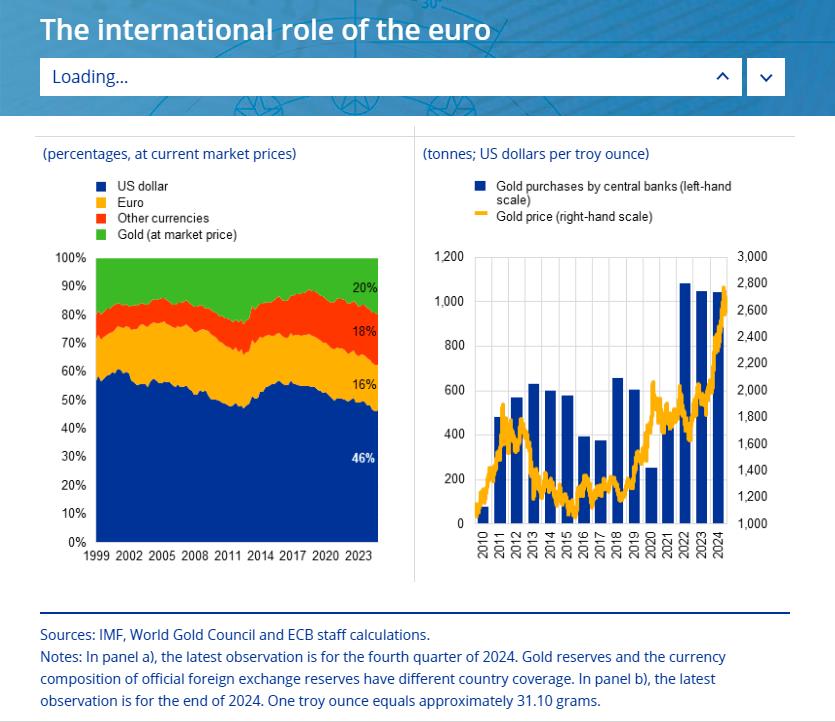
超越欧元!黄金成为全球第二大储备资产
Di Yi Cai Jing· 2025-06-11 23:08
Group 1 - The European Central Bank (ECB) report indicates that gold has surpassed the euro to become the world's second-largest reserve asset, highlighting a trend of diversification in central bank assets [1][2] - As of the end of 2024, gold is projected to account for 20% of global official reserves, compared to the euro's 16%, driven by central bank purchases and record gold prices [2] - In 2024, central banks are expected to purchase over 1,000 tons of gold for the third consecutive year, with demand significantly influenced by geopolitical uncertainties and market volatility [2][3] Group 2 - The report reveals that approximately two-thirds of central banks invest in gold for asset diversification, while about 40% do so to hedge against geopolitical risks [3] - Countries affected by Western sanctions have seen a notable increase in gold's share of their official reserves, with these economies contributing to 50% of the largest annual growth in gold holdings since 1999 [3] - Several African nations are actively seeking to reduce reliance on the dollar by increasing gold purchases, with Tanzania investing $400 million in 6 tons of gold to stabilize its currency [3] Group 3 - The dollar's share of global foreign exchange reserves has declined by 2 percentage points in 2024, despite a slight increase in the euro's share, with the dollar now holding 46% of the market [4] - Over the past decade, the dollar's market share has decreased by 10 percentage points, indicating a sustained trend of de-dollarization [4] Group 4 - The ECB notes that since April, there are signs that euro assets may benefit from the declining confidence in the dollar, as U.S. Treasury yields rise while the dollar depreciates against the euro [9] - The instability of U.S. economic policy has led to accelerated sales of dollar assets, providing an opportunity for the euro, contingent on further integration steps within the Eurozone [9]