
Semiconductor Localization

Search documents
基金扎堆调研电子、医药生物行业 背后有何玄机?
2 1 Shi Ji Jing Ji Bao Dao· 2025-05-07 12:31
Group 1 - In April, there was a significant increase in the number of fund institutions conducting research on A-share listed companies, with public funds conducting 9,796 research instances, a 129.47% increase from March, and private funds conducting 7,647 instances, a 117.68% increase [1][3] - The electronic and pharmaceutical industries were the most favored sectors for research, with leading companies like Luxshare Precision being researched 368 times and Lanke Technology 179 times [1][4] - The electronic sector is driven by AI technology breakthroughs, increased computing power demand, and continuous iteration of consumer electronics, while the pharmaceutical sector benefits from the advancement of innovative drug development and high-end medical device localization [3][4] Group 2 - Despite the overall market adjustment in April, only four sectors, including beauty care and agriculture, saw an increase, while the electronic and pharmaceutical indices fell by 4.79% and 2.07%, respectively [3] - Public funds focused their research on 20 major industries, with the electronic industry being the most researched at 1,754 instances, followed by pharmaceuticals at 1,400 instances [3][4] - The characteristics of companies that attract significant research attention include strong performance, prominent industry position, and high growth potential, often supported by market and policy [4][5] Group 3 - Top fund institutions showed the highest frequency of research activities, with 29 institutions conducting over 100 research instances in April [8] - Leading public funds such as Bosera Fund and Huaxia Fund showed strong interest in Luxshare Precision, with research instances reaching 241 and 192, respectively [8][9] - The focus on AI and self-sufficiency in the electronic sector is expected to drive investment opportunities, with a strong emphasis on domestic semiconductor independence and the growth of AI-related hardware [10][11]
芯片股强势拉升,科创芯片ETF国泰(589100)涨超1%,20cm标的领涨芯片类ETF
Mei Ri Jing Ji Xin Wen· 2025-04-28 04:09
Group 1 - The Shanghai Composite Index turned positive during the trading session, with AI hardware and software concept stocks rising, and the Guotai Semiconductor ETF (589100) increasing by over 1%, leading the chip-related ETFs [1] - According to Huafu Securities, the global semiconductor equipment market is expected to grow by 10% year-on-year in 2024, reaching a historical high of $117.1 billion in annual sales. Domestic investment in semiconductor equipment is projected to increase by 35% year-on-year, reaching $49.6 billion [1] - Domestic semiconductor equipment manufacturers and material companies have developed a rich product line, with continuous improvement in technological advancement, indicating that localization replacement is likely to accelerate [1] Group 2 - The Guotai Semiconductor ETF (589100) tracks the Shanghai Stock Exchange Science and Technology Innovation Board Chip Index (000685.SH), which selects securities related to semiconductor materials and equipment, chip design, manufacturing, packaging, and testing from listed companies on the Science and Technology Innovation Board [1] - It is noteworthy that this ETF has a 20% limit on daily price fluctuations, providing greater volatility potential [1]
中国半导体产业自主率逐年攀升,科创芯片ETF(588200)交投活跃,最新资金净流入1.77亿元
Sou Hu Cai Jing· 2025-04-25 05:17
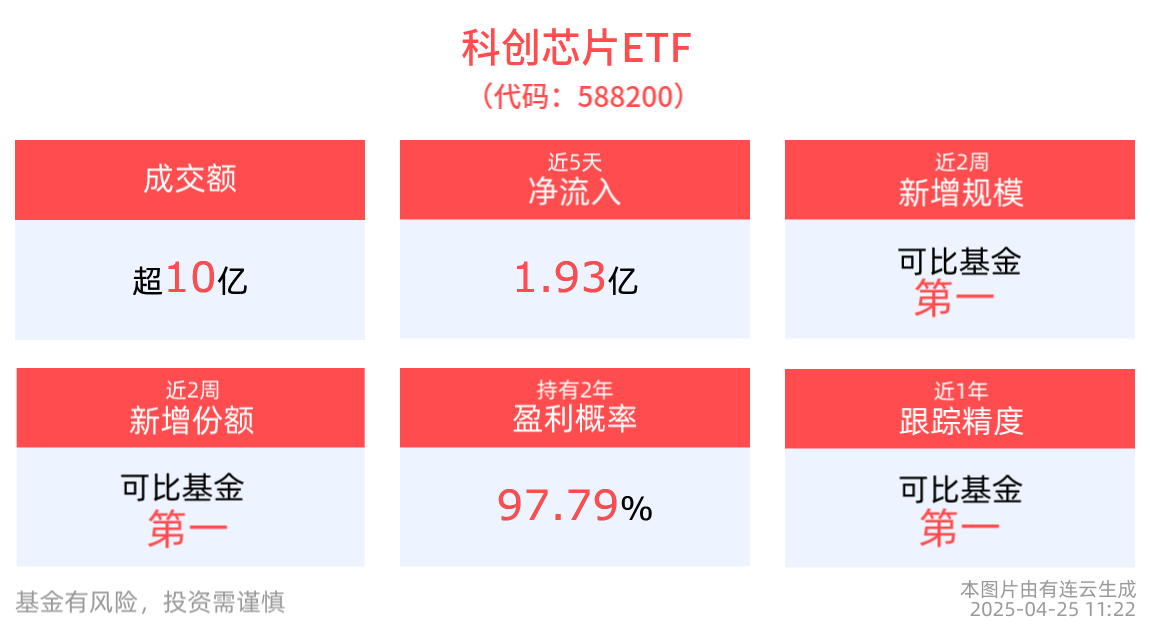
Group 1 - The core viewpoint highlights significant growth in the Sci-Tech Chip ETF, with a turnover rate of 4.33% and a transaction volume of 1.031 billion yuan [2] - Over the past two weeks, the Sci-Tech Chip ETF has seen an increase in scale by 125 million yuan and a growth in shares by 192 million [2] - The latest net inflow of funds into the Sci-Tech Chip ETF is 177 million yuan, with a total of 193 million yuan net inflow over three out of the last five trading days [2] Group 2 - Leveraged funds are increasingly investing in the Sci-Tech Chip ETF, with the latest margin buying amount reaching 105 million yuan and a margin balance of 1.333 billion yuan [2] - The domestic semiconductor industry's self-sufficiency rate has increased from 14% in 2012 to 18% in 2022, with expectations to reach 26.6% by 2027 [2] - The top ten weighted stocks in the Shanghai Stock Exchange Sci-Tech Chip Index account for 57.96% of the index, including major companies like SMIC and Cambrian [2]

平安证券晨会纪要-20250414
Ping An Securities· 2025-04-14 00:43
Group 1: Semiconductor Industry - The implementation of the integrated circuit origin recognition standard is a significant policy response to the escalation of US-China trade tensions, which is expected to accelerate the domestic semiconductor industry's localization process [2][8][11] - The origin recognition standard states that the origin of integrated circuits will be determined based on the location of the wafer fabrication plant, emphasizing wafer manufacturing over packaging and testing [8][9] - Domestic wafer foundries like SMIC and Hua Hong Semiconductor are expected to benefit from the return of overseas foundry orders as design companies may shift production to China to avoid US tariffs [10][11] Group 2: Investment Recommendations - Investment opportunities are suggested in areas with low localization rates and significant market shares held by US companies, particularly in the design segment, with recommendations for companies like Sanan Optoelectronics and Zhaoyi Innovation [2][11] - In the manufacturing segment, SMIC and Hua Hong are highlighted as key players to watch [11] - For CPU and GPU sectors, companies such as Haiguang Information and Loongson Technology are recommended, with a note to monitor Cambrian [11] Group 3: Bond Market Insights - The US bond market has seen a decline in 2Y and 10Y Treasury yields by 34 basis points and 24 basis points respectively, indicating a steepening yield curve amid rising recessionary trades [3][12][13] - High-yield Chinese dollar bonds have performed well, outpacing both domestic and foreign credit bonds due to favorable supply-demand dynamics and a decrease in real estate default risks [3][12][13] Group 4: Fund Strategies - In a low-interest-rate environment, there is an expectation for the development of fixed-income enhancement strategies, particularly focusing on medium-volatility strategies that can adapt to market changes while controlling drawdowns [4][16][19] - The report emphasizes the importance of selecting funds with strong timing capabilities and flexibility to respond to market fluctuations [19][20]