
双重上市

Search documents
自动驾驶“双雄”竞速港股IPO
Mei Ri Shang Bao· 2025-10-15 22:12
Core Insights - The approval of the dual listing for autonomous driving companies WeRide and Pony.ai on the Hong Kong Stock Exchange marks a significant step in their "US + HK" listing strategy, reflecting a shift in the autonomous driving industry from "technology validation" to "scale implementation" [1][2] Company Summaries - WeRide plans to issue up to 102.4 million ordinary shares, while Pony.ai plans to issue up to 102.1 million ordinary shares on the Hong Kong Stock Exchange, following their previous listings on NASDAQ [2] - WeRide, established in 2017, operates in 30 cities across 11 countries, holding multiple autonomous driving licenses, while Pony.ai, founded in 2016, focuses on full-stack autonomous driving technology and has expanded its Robotaxi fleet to various countries [2][3] - Despite both companies currently operating at a loss, they have shown strong revenue growth, with WeRide achieving revenue of 127 million yuan in Q2 2025, a 60.8% year-on-year increase, and Robotaxi business revenue reaching 45.9 million yuan, up 836.7% [2][3] Industry Trends - The approval of the IPOs is accelerating the global expansion of WeRide and Pony.ai, with WeRide launching an autonomous ride-hailing service in Singapore and obtaining an L4 autonomous driving testing license in Belgium [4] - Pony.ai has received road testing permits in Dubai and plans to achieve fully autonomous commercial operations by 2026, with its global Robotaxi fleet expected to exceed 1,000 vehicles by the end of the year [4] - The Robotaxi industry is at a critical commercialization juncture, with increasing policy support and market demand, indicating significant growth potential in the Chinese Robotaxi market [5]
港股异动 | 新秀丽(01910)涨超4% 机构料其今年第三季销售额有望改善
智通财经网· 2025-10-15 07:29
Core Viewpoint - Samsonite's stock has increased by over 4%, currently trading at HKD 16.58, with a transaction volume of HKD 35.14 million. The company will hold a board meeting on November 12 to consider and approve its quarterly performance report for the three and nine months ending September 30, 2025 [1]. Group 1: Financial Performance - In the first half of the year, Samsonite's sales decreased by 5.2% on a constant currency basis. However, it is expected that sales will gradually improve in the second half, with the decline narrowing to 3.3%, primarily due to a lower comparison base, especially in the third quarter, which is the lowest for the year [1]. - HSBC forecasts that sales in the third quarter will decline by 2.5% on a constant currency basis [1]. Group 2: Future Outlook - HSBC maintains a target price of HKD 21 and a "Buy" rating for Samsonite, anticipating a potential revaluation of the stock as sales are expected to improve in the third quarter of this year and return to growth next year [1]. - There is a clear possibility of the company pursuing a dual listing in the United States in the first half of next year [1].
新秀丽涨超4% 机构料其今年第三季销售额有望改善
Zhi Tong Cai Jing· 2025-10-15 07:25
Core Viewpoint - Samsonite (01910) shares rose over 4%, currently up 4.61% at HKD 16.58, with a trading volume of HKD 35.14 million [1] Financial Performance - Samsonite will hold a board meeting on November 12 to consider and approve the quarterly performance report for the three and nine months ending September 30, 2023 [1] - HSBC reported that Samsonite's sales decreased by 5.2% in the first half of the year on a constant currency basis, but expects a gradual improvement in the second half, with the decline narrowing to 3.3% [1] - The bank anticipates a 2.5% drop in sales for the third quarter, which has the lowest comparison base of the year [1] Investment Outlook - HSBC maintains a target price of HKD 21 and a "Buy" rating for Samsonite, suggesting potential for a revaluation of shares as sales are expected to improve in the third quarter and return to growth next year [1] - There is a clear possibility of the group achieving a dual listing in the United States in the first half of next year [1]
自动驾驶巨头从纳斯达克“归港”!1.02亿股叩关港股,藏着哪些野心?
Xin Lang Cai Jing· 2025-10-15 02:56
Core Viewpoint - Pony AI Inc. is advancing its plan for a dual listing in Hong Kong, driven by its significant revenue growth but increasing losses, reflecting the urgent capital needs of leading companies in the autonomous driving sector [3][10]. Group 1: Listing Progress - On October 14, the China Securities Regulatory Commission confirmed Pony AI's overseas listing registration, allowing it to issue up to 102,146,500 ordinary shares on the Hong Kong Stock Exchange [5][7]. - This move comes less than a year after Pony AI's successful NASDAQ listing as the "first global Robotaxi stock" on November 27, 2024 [7][8]. - If successful, Pony AI will be among the few companies in the autonomous driving field to achieve a dual listing in both the US and Hong Kong markets [8]. Group 2: Financial Performance - For Q2 2025, Pony AI reported a revenue of 154 million RMB, a year-on-year increase of 75.9%, with its core Robotaxi business seeing a revenue increase of 157.8% [12]. - Despite the revenue growth, the company faced a net loss of 38.2 million RMB, a year-on-year increase of 72.49%, highlighting the financial pressures inherent in the autonomous driving industry [12]. - As of the end of Q2, Pony AI had cash and cash equivalents of 5.356 billion RMB, but the company has set a goal to operate 1,000 Robotaxi vehicles by year-end, indicating a clear funding gap [12]. Group 3: Strategic Implications - The dual listing is not merely a financing opportunity but a strategic choice to meet both short-term and long-term development needs [14]. - The Hong Kong listing will provide closer access to capital markets that are more familiar with Chinese technology sectors, aligning with Pony AI's core operational markets in major Chinese cities [15]. - The capital raised will support the company's commercialization efforts and global expansion, which have been increasingly active since September 2025 [17].


小马智行计划回港上市
2 1 Shi Ji Jing Ji Bao Dao· 2025-10-14 09:50
Core Viewpoint - The China Securities Regulatory Commission has confirmed the overseas listing registration information for Pony.ai, indicating significant regulatory progress for the company's plan to list in Hong Kong [1] Group 1: Company Developments - Pony.ai plans to issue no more than 102,146,500 ordinary shares for overseas listing and aims to list on the Hong Kong Stock Exchange [1] - The company completed its listing on NASDAQ in November 2024 under the ticker "PONY," becoming the world's first publicly traded Robotaxi company [1] - If the Hong Kong listing proceeds smoothly, Pony.ai will establish a dual listing structure in both the U.S. and Hong Kong [1]
小马智行计划回港上市
21世纪经济报道· 2025-10-14 09:43
Group 1 - The core point of the article is that Pony.ai has received confirmation for its overseas listing registration from the China Securities Regulatory Commission, indicating significant progress in its plan to list in Hong Kong [1] - Pony.ai plans to issue no more than 102,146,500 ordinary shares for its overseas listing and aims to list on the Hong Kong Stock Exchange [1] - The company has already completed its listing on NASDAQ under the ticker "PONY" in November 2024, becoming the world's first publicly traded Robotaxi company [1]

小马智行港股IPO获备案,全球Robotaxi第一股计划回港上市!若此次港股上市顺利落地,小马智行将形成“美+港”双重上市架构
Ge Long Hui· 2025-10-14 08:40
Group 1 - The core point of the article is that Pony.ai has received confirmation for its overseas listing registration, marking a significant regulatory advancement for its plan to list in Hong Kong [1] - The company plans to issue no more than 102,146,500 ordinary shares for overseas listing and aims to list on the Hong Kong Stock Exchange [1] - Pony.ai has already completed its listing on NASDAQ in November 2024 under the ticker "PONY," becoming the world's first publicly traded Robotaxi company [1] Group 2 - If the Hong Kong listing proceeds smoothly, Pony.ai will establish a dual listing structure in both the US and Hong Kong [1]
小马智行(PONY.US)港股IPO获中国证监会备案
Zhi Tong Cai Jing· 2025-10-14 08:33
中国证券监督管理委员会10月14日发布的文件显示,小马智行(PONY.US)境外发行上市备案信息得到确认。公司拟发行不超过102,146,500股境外上市普通 股,并在香港联合交易所上市。该公司已于2024年11月以"PONY"为代码在纳斯达克完成上市,成为全球Robotaxi第一股。此次备案标志其回港上市计划已 获关键监管进展。若此次港股上市顺利落地,小马智行将形成"美+港"双重上市架构。 ...
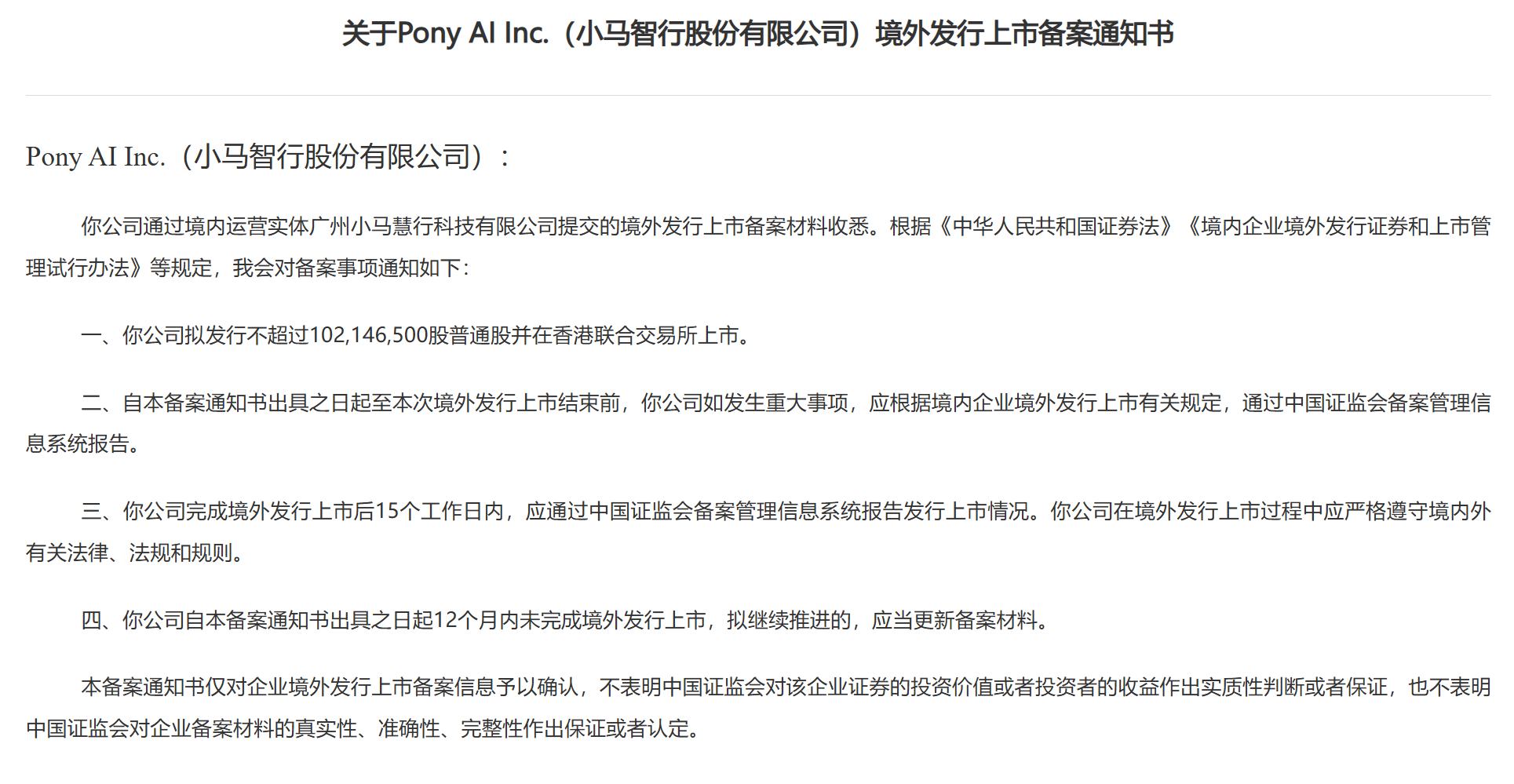
小马智行港股IPO获备案,全球Robotaxi第一股计划回港上市
Jing Ji Guan Cha Wang· 2025-10-14 08:27
Core Insights - Pony.ai has received confirmation for its overseas listing registration from the China Securities Regulatory Commission, marking a significant regulatory milestone for its plans to list in Hong Kong [1] - The company plans to issue up to 102,146,500 ordinary shares for its overseas listing and aims to list on the Hong Kong Stock Exchange [1] - Following its successful listing on NASDAQ in November 2024 under the ticker "PONY," Pony.ai will establish a dual listing structure in both the US and Hong Kong [1] Company Developments - The confirmation of the overseas listing registration is a critical step in Pony.ai's strategy to expand its market presence [1] - The planned issuance of shares indicates the company's intent to raise capital through the Hong Kong market, complementing its existing US listing [1] - The dual listing approach is expected to enhance the company's visibility and accessibility to a broader range of investors [1]
华检医疗(01931.HK):已向美国证交会保密提交F-1表格登记声明草案
Ge Long Hui· 2025-09-30 15:04
Core Viewpoint - The company has submitted a confidential F-1 registration statement to the U.S. Securities and Exchange Commission for a proposed dual listing in the U.S., which is a significant step in its global strategy and is expected to bring multiple positive impacts [1] Group 1: Global Financing and Market Expansion - The dual listing is anticipated to expand the company's global financing channels by entering one of the largest and most comprehensive capital markets, potentially attracting more long-term international investors focused on biotechnology and healthcare [1] - This move is expected to provide strong capital support for the company's future research and commercialization efforts [1] Group 2: Brand and Market Presence - Listing on NASDAQ is expected to enhance the company's international brand influence, improving its corporate image and industry recognition in global markets [1] - It will also increase opportunities for communication and collaboration with potential global partners, clients, and regulatory bodies [1] Group 3: Share Liquidity and Valuation - The establishment of a cross-market trading mechanism is likely to broaden the investor base and enhance overall share liquidity [1] - This international pricing environment is expected to better reflect the company's long-term value [1] Group 4: Governance and Compliance - Adhering to U.S. securities regulations and disclosure requirements is projected to improve the company's governance standards and operational transparency [1] - This will strengthen the company's compliance image and investor trust on a global scale [1] Group 5: Strategic Flexibility - The dual listing structure will provide the company with a richer platform for capital operations and strategic options for future international collaborations, mergers, and business expansions [1]