
股权回购

Search documents
大胜达: 浙江大胜达包装股份有限公司关于行使回购权暨拟出售参股公司股权的公告
Zheng Quan Zhi Xing· 2025-07-31 16:26
证券代码:603687 证券简称:大胜达 公告编号:2025-036 浙江大胜达包装股份有限公司 关于行使回购权暨拟出售参股公司股权的公告 本公司董事会、全体董事及相关股东保证本公告内容不存在任何虚假记载、 误导性陈述或者重大遗漏,并对其内容的真实性、准确性和完整性承担法律责任。 重要内容提示: ? 浙江大胜达包装股份有限公司(以下简称"公司"或"大胜达")于 2021 年 11 月与厦门乾发投资合伙企业(有限合伙)、苏炳龙、远东中乾(厦门)科技 集团股份公司(曾用名:吉特利环保科技(厦门)有限公司,以下简称"远东中乾") 及远东中乾其他股东等相关方签署《关于吉特利环保科技(厦门)有限公司之投资 协议》(以下简称"《投资协议》"),公司以人民币 3,000 万元向远东中乾增资, 取得 4.1096%股权,对应当时远东中乾注册资本 1,147.5594 万元。2023 年 9 月, 公司与相关各方签署了《关于吉特利环保科技(厦门)有限公司之投资协议之补 充协议》(以下简称"《补充协议》"),不行使《投资协议》约定的回购权,继续 投资远东中乾,并约定回购相关条款。 因远东中乾及相关方未能实现其在《补充协议》中所作 ...

大胜达(603687.SH):行使回购权暨拟出售参股公司股权
Ge Long Hui A P P· 2025-07-31 11:01
因远东中乾及相关方未能实现其在《补充协议》中所作承诺,《补充协议》约定的股权回购条款现已触 发。根据《补充协议》相关条款,公司拟启动股权回购程序。回购义务人苏炳龙或其有权指定的由其控 制的关联实体厦门同盈投资有限公司(简称"厦门同盈")将按照协议约定回购公司持有的远东中乾全部 股权,回购金额将根据《补充协议》约定的方式确定,计算方式为:已支付投资款本金(3,000万元) +已支付投资款本金*8%*支付投资款之日(2021年12月7日)直至回购完成之日的天数除以365天,回购 价款暂计算至2025年6月30日为人民币3,856.11万元(具体以实际实施时金额为准)。苏炳龙对厦门同盈 履行回购义务、支付回购价款承担连带责任。 格隆汇7月31日丨大胜达(603687.SH)公布,公司于2021年11月与厦门乾发投资合伙企业(有限合伙)、苏 炳龙、远东中乾(厦门)科技集团股份公司(曾用名:吉特利环保科技(厦门)有限公司,简称"远东中 乾")及远东中乾其他股东等相关方签署《关于吉特利环保科技(厦门)有限公司之投资协议》,公司以 人民币3,000万元向远东中乾增资,取得4.1096%股权,对应当时远东中乾注册资本1,14 ...
博思软件: 第五届监事会第九次会议决议公告
Zheng Quan Zhi Xing· 2025-07-29 16:09
Group 1 - The company held the ninth meeting of the fifth supervisory board on July 29, 2025, which complied with relevant regulations [1] - The supervisory board approved the share repurchase plan of the subsidiary, citing market changes, operational adjustments, and personnel changes as factors for optimizing the equity structure and enhancing team vitality [1] - The pricing of the share repurchase was deemed fair and reasonable, with no harm to the interests of the company and its shareholders [1] Group 2 - The supervisory board agreed to adjust the stock option incentive plan in accordance with relevant laws and regulations, ensuring no harm to the interests of shareholders, especially minority shareholders [2] - The board approved the cancellation of 9.425 million shares of restricted stock that had been granted but not yet vested, with specific details on the cancellation of shares from different vesting periods [2][3] - The board also approved the cancellation of 4.8 million shares of restricted stock from the 2024 incentive plan, confirming the legality and compliance of the process [3]

浙江嘉澳环保科技股份有限公司 第六届董事会第二十次会议决议公告
Zhong Guo Zheng Quan Bao - Zhong Zheng Wang· 2025-07-25 23:54
Group 1 - The board of directors of Zhejiang Jiaao Environmental Technology Co., Ltd. held its 20th meeting on July 25, 2025, to discuss important resolutions [2][3][4] - The board approved a proposal for the capital increase and introduction of new investors for its subsidiary Lianyungang Jiaao New Energy Co., Ltd. [3][11] - The board also approved a proposal to waive the company's preferential subscription rights for the capital increase [6][11] Group 2 - The capital increase involves an investment of 261,444,444 RMB by China Aviation Oil Group Co., Ltd., which will increase the registered capital of the subsidiary from 2,353,000,000 RMB to 2,614,444,444 RMB [11][36] - The company will continue to hold controlling interest in the subsidiary after the capital increase [12][36] - The capital increase is expected to enhance the subsidiary's capital strength and promote new project development, aligning with the company's strategic planning and long-term interests [36][37] Group 3 - The investment agreement stipulates that the investment will be made in two phases, with each phase requiring certain preconditions to be met [19][21] - The agreement includes provisions for buyback rights under specific circumstances, allowing investors to sell their shares back to the company [23][25] - The company will authorize its management to handle all matters related to the capital increase, including signing relevant agreements and handling business registration changes [38]

海正药业: 浙江海正药业股份有限公司关于浙江导明医药科技有限公司增资及债转股事项的进展公告
Zheng Quan Zhi Xing· 2025-07-24 16:33
Core Viewpoint - Zhejiang Haizheng Pharmaceutical Co., Ltd. is involved in a significant arbitration case regarding the buyback of shares from its subsidiary, Zhejiang Daoming Pharmaceutical Technology Co., Ltd., which has implications for its financial obligations and control over the subsidiary [2][3][4]. Group 1: Background and Agreements - In 2017, Haizheng Pharmaceutical approved a financing agreement for its subsidiary Daoming Pharmaceutical, allowing it to borrow 100 million RMB from Shenzhen Songhe Growth No. 1 Equity Investment Partnership, with conditions for share conversion [2]. - The agreement included a buyback clause, which became relevant when Daoming Pharmaceutical failed to meet the conditions for "qualified listing" or "qualified merger" by the end of 2022 [2][3]. - In June 2023, the company reached a settlement regarding the buyback obligations with one of the investors, Shancheng Investment [2]. Group 2: Arbitration Details - The arbitration was conducted by the Hong Kong International Arbitration Centre, with Genius III Found Limited as the claimant, seeking a buyback of 805,249 shares of Cayman Daoming [3]. - The arbitration ruling mandated Haizheng Pharmaceutical and DTRM Innovation to jointly repurchase the shares for a total price of approximately 129.44 million RMB [3][4]. - The ruling also included provisions for the payment of legal fees and interest on the amounts owed, with a specified interest rate of 6% per annum until payment is made [4]. Group 3: Financial Implications - The company has recognized a financial liability of 34.43 million RMB in its financial statements related to the buyback obligation, which will impact its net profit for the first half of 2025 [4]. - The arbitration outcome clarifies the financial obligations of the company and DTRM Innovation regarding the buyback, which is expected to affect the company's consolidated financial statements [4].

紫光国微:紫光集团重整后首度回购已开始实施
Zheng Quan Shi Bao Wang· 2025-06-29 12:45
Group 1 - The company, Unisoc (紫光国微), announced its first share buyback on June 27, 2023, repurchasing 775,600 shares, which accounts for approximately 0.09% of its total share capital, with a total transaction amount of 49.6173 million yuan [1] - The buyback was conducted through a centralized bidding process, with the highest transaction price at 64.28 yuan per share and the lowest at 63.67 yuan per share [1] - The funds for the buyback were sourced from the company's own capital, and the buyback plan complies with relevant legal regulations [1] Group 2 - In August 2018, Tsinghua Holdings announced plans to transfer part of its equity in Unisoc Group, which could lead to a change in the actual controller of the company [2] - Prior to the equity change, Tsinghua Holdings held 51% of Unisoc Group, making it the single largest shareholder, while Jian Kun Group held 49% [2] - As of July 2022, Unisoc Group completed its restructuring and became a company without an actual controller, with shares distributed among ten companies [2] Group 3 - In June 2021, Unisoc completed a public issuance of 1.5 billion yuan in convertible bonds, initially intended for projects related to high-end security chips and vehicle control chips [3] - The investment direction was later changed to focus on the development and industrialization of high-speed RF analog-to-digital converters and new high-performance video processors [3] - Additional funding was allocated for the construction of a joint research and production building [3]

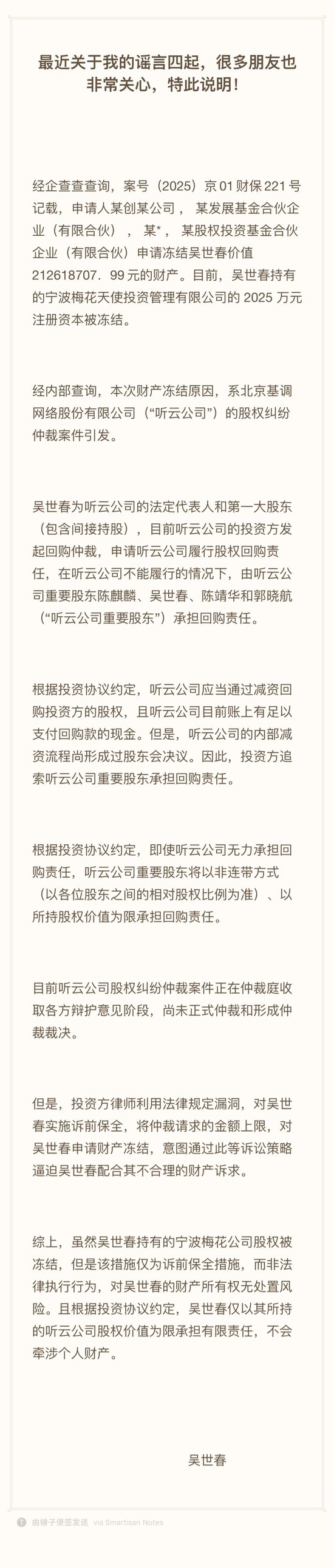
被冻结超2亿?当事人回应
中国基金报· 2025-06-24 12:59
Core Viewpoint - The freezing of over 200 million yuan in assets belonging to Wu Shichun, the founder of Meihua Venture Capital, has sparked significant discussion in the venture capital community, primarily due to a stock buyback arbitration case involving Beijing Jidiao Network Co., Ltd. (Tingyun Company) [2][5][15] Group 1: Asset Freezing Details - The Beijing First Intermediate People's Court has ruled to freeze, seize, or detain assets valued at 213 million yuan belonging to Wu Shichun, following a request from several investment funds [8][12] - The court found that the application from the investors met legal requirements, leading to the asset freezing decision [8][12] - The freezing of Wu Shichun's assets includes shares in multiple companies, with specific amounts frozen such as 20.25 million yuan in Ningbo Meihua Angel Investment Management Co., Ltd. and 30 million yuan in other partnerships [13][11] Group 2: Background of the Dispute - The asset freeze is linked to a stock buyback arbitration case initiated by investors against Tingyun Company, where Wu Shichun is the legal representative and largest shareholder [5][15] - The investors are pushing for compliance with the stock buyback obligations, which has led to the current legal situation [5][6] - The trend of including unlimited joint liability clauses in buyback agreements has become more common, indicating a shift in how venture capital firms manage risks associated with startup investments [17] Group 3: Company and Financing Information - Tingyun Company, established in 2007, focuses on application performance management and has undergone multiple financing rounds, with the latest being a Pre-IPO round in June 2021, raising 500 million yuan [15][16] - The company has been recognized in the Gartner Magic Quadrant for three consecutive years from 2018 to 2020, highlighting its significance in the industry [15] - The increasing frequency of buyback lawsuits among top investment firms indicates a growing concern over the enforceability of buyback clauses in investment agreements [17]


知名投资人吴世春回应“财产冻结”:系听云公司股权纠纷仲裁案件引发
Zhong Zheng Wang· 2025-06-24 09:55
Core Viewpoint - The asset freeze involving investor Wu Shichun is related to a shareholding dispute of a portfolio company, specifically Beijing Jidiao Network Co., Ltd. (referred to as "Tingyun Company") [1][4][6] Group 1: Asset Freeze Details - Wu Shichun's assets worth approximately 21.26 million yuan (around 2 billion) have been frozen as a pre-litigation preservation measure, not as a legal execution action, thus posing no risk to his ownership of assets [1][6] - The freezing of assets is linked to an arbitration case regarding share repurchase obligations initiated by investors in Tingyun Company [4][6] Group 2: Share Repurchase Obligations - According to the investment agreement, Tingyun Company is required to repurchase shares through a capital reduction, and it currently has sufficient cash to cover the repurchase amount [2][4] - The internal process for capital reduction at Tingyun Company has not yet been formalized through a shareholders' meeting resolution, leading investors to seek accountability from key shareholders, including Wu Shichun [2][4] Group 3: Legal Proceedings - The arbitration case concerning the shareholding dispute is currently in the stage of collecting defense opinions from all parties and has not yet reached a formal arbitration decision [6] - Investors' lawyers have utilized legal loopholes to implement pre-litigation preservation against Wu Shichun, aiming to pressure him into complying with unreasonable financial demands [6]
重磅!国资委全面禁止股权回购,释放哪些监管信号?
梧桐树下V· 2025-06-02 03:06
Core Viewpoint - The State-owned Assets Supervision and Administration Commission (SASAC) has explicitly prohibited the inclusion of share repurchase rights in capital increase agreements, aiming to enhance the integrity and transparency of state-owned asset transactions [1][2][3]. Group 1: Legislative Purposes of Prohibiting Repurchase Clauses - Preventing disguised debt arrangements and returning to the essence of equity investment, as repurchase clauses can decouple investment returns from the operational performance of the target enterprise, undermining the principle of shared risks and benefits [1]. - Curbing risks of interest transfer and price manipulation, as the pricing mechanism for share repurchase often implies a transfer of benefits to investors, with repurchase prices typically set above the company's financing costs [2]. - Ensuring procedural justice in public transactions, as pre-agreed repurchase clauses may indicate collusion between parties, undermining the integrity of open market transactions [3]. - Maintaining the strategic layout of state-owned capital, as repurchase clauses could encourage short-sighted behavior from investors, disrupting the long-term strategic objectives of state-owned enterprises [4]. - Strengthening penetrating supervision of state-owned assets, as repurchase clauses may exist in hidden forms, complicating regulatory oversight and potentially leading to asset loss and debt risks [5]. Group 2: Reasons for Prohibiting "Repurchase Rights" - Pre-agreed repurchase rights could serve as a "legal" basis for future violations, potentially leading to the loss of value for state-owned shareholders if they are forced to repurchase shares at a lower valuation [6]. - The rationale for allowing state-owned shareholders to retain repurchase rights is to maintain control, but distinguishing between legitimate control and improper benefit arrangements is challenging, leading to increased regulatory costs [6]. - The new regulations reflect a shift in state-owned asset supervision from "post-event remedy" to "pre-event prevention," indicating a commitment to maintaining transaction authenticity throughout the asset transaction process [6].
控股子公司股权回购案迎最新进展 爱普股份称已接受法院调解方案
Mei Ri Jing Ji Xin Wen· 2025-05-28 08:27
Core Viewpoint - Aipu Co., Ltd. has reached a settlement in a share buyback lawsuit involving its subsidiary, Shanghai Mengze Trading Co., Ltd., after the court proposed a mediation plan [1][2]. Group 1: Share Buyback Lawsuit - In July 2018, Aipu Co., Ltd. invested 51 million yuan in Mengze Trading, acquiring a 51% stake through capital increase and share transfer [1]. - The share buyback clause was triggered when partners Xu Guangyi and Dai Xiaowen were imprisoned, leading Aipu to file a lawsuit in March 2024 [2]. - The court ruled in March 2025 that Xu and Dai must pay Aipu 54.3884 million yuan plus interest, with Aipu bearing certain litigation costs [2]. Group 2: Mediation Agreement - Under the mediation agreement, Xu and Dai are required to pay Aipu 32 million yuan by May 27, after which Aipu will transfer its 51% stake in Mengze Trading back to them [2]. - Aipu will cover the first-instance case acceptance fee and part of the second-instance fee, while Xu and Dai will bear the remaining costs [2]. Group 3: Background of Partners - Xu and Dai were imprisoned due to involvement in a long-standing smuggling case, which has been reported previously [3].
