Fiscal Stimulus

Search documents
Yahoo Finance: Market Coverage, Stocks, & Business News
Yahoo Finance· 2025-10-01 16:08
Labor Market & Economic Data - ADP data indicates a weakening labor market, with jobs shrinking [2] - Small and medium-sized businesses are disproportionately affected by the slowdown in jobs data [3] - The market is increasingly relying on ADP data due to concerns about government economic data delays and revisions [1][5][9][10][11] - The Fed is also reportedly using private data to estimate non-farm payroll numbers [13][14] Monetary Policy & Interest Rates - Investors are pricing in a 99% probability of a Fed rate cut in October, driven by the ADP report [2] - The market anticipates multiple rate cuts to prevent a rapid increase in the unemployment rate [8][17] - Yields are declining in response to the ADP report and expectations of Fed rate cuts [2][7][17] Market Outlook & Investment Strategy - Wall Street remains generally bullish on the stock market despite the labor market slowdown [4] - Goldman Sachs views a slowdown in the labor market as the biggest risk to the economy [4] - Uncertainty, such as tariff uncertainty, is putting downward pressure on yields [16]


Investors look past AI hype to long-term opportunities from government spending
Yahoo Finance· 2025-09-29 07:11
Core Insights - Major investors are shifting focus from the AI boom to long-term government spending driven by geopolitical, technological, and demographic pressures [1] - Asset managers are diversifying investments into infrastructure, energy transition, healthcare, and defense to leverage fiscal stimulus from governments [1][2] Government Fiscal Policies - The U.S. tax-cut and spending bill is projected to add trillions to government debt, extending tax cuts, increasing funding for border security and defense, while reducing Medicare and Medicaid [3] - Europe is also significantly increasing fiscal support, highlighted by Germany's €500 billion ($586 billion) infrastructure fund and NATO members' commitments to raise defense spending to 3.5% of GDP [3] Market Performance and Trends - Fiscal stimulus is a critical factor influencing financial market performance, with unprecedented fiscal commitments expected to drive structural realignment in markets for years [4] - The S&P 500 index has risen nearly 14% this year, primarily due to AI-related momentum, while Europe's STOXX 600 has seen more modest gains of 9.5% [5] - The aerospace and defense index in Europe has surged almost 68%, indicating that fiscal priorities are boosting defense and industrial sectors despite the AI-dominated market [6]
X @Bloomberg
Bloomberg· 2025-09-22 08:56
Market Outlook - Euro-area equities are expected to rebound by 2026 [1] - Fiscal stimulus is expected to boost the economy and earnings [1]
Deutsche Bank Aktiengesellschaft (DB) Presents at Bank of America 30th Annual Financials CEO Conference 2025 Transcript
Seeking Alpha· 2025-09-18 12:43
Group 1 - The former German Finance Minister, Christian Lindner, expressed caution regarding the merits of fiscal stimulus in the short term [1] - Discussion included the impact of tariff politics on the macroeconomic environment in Germany [1] - The conversation aimed to assess how the implementation of fiscal stimulus could benefit the bank [1]


中国经济:三季度 GDP 增速放缓至 4.5%,因财政刺激效应消退-China Economics-3Q GDP Softening to 4.5%Y as Fiscal Impulse Fades
2025-09-16 02:03
Key Takeaways from the Conference Call Industry Overview - The report focuses on the **China Economics** sector, specifically analyzing the **3Q GDP** performance and its implications for the broader economy [1][4]. Core Insights and Arguments - **GDP Growth Rate**: The 3Q GDP is projected to slow to **4.5% YoY**, a decrease from **5.2% YoY** in 2Q, indicating a broader economic slowdown [2][9]. - **Infrastructure Investment Decline**: A significant contributor to the GDP slowdown is the decline in **infrastructure capital expenditure (capex)**, attributed to a high base of government bond funding and tighter local government liquidity [2][9]. - **Retail Sales Performance**: Retail sales growth has dropped to a **9-month low of 3.4% YoY**, influenced by slow disbursement and reduced effectiveness of trade-in subsidies [2][9]. - **Industrial Production**: Industrial production growth has moderated, with key sectors like manufacturing and infrastructure showing negative growth rates [5][9]. - **Stimulus Expectations**: There is an expectation for a **Rmb0.5-1 trillion** stimulus package aimed at infrastructure and consumption support, which is anticipated to cushion growth in the short term [3][9]. Additional Important Points - **Structural Reforms**: The report emphasizes that sustained economic reflation will depend on structural reforms to rebalance the economy, with particular attention to the upcoming **4th Plenary Session** for potential signals of such reforms [3][9]. - **Debt Management**: The report notes that **92%** of this year's **Rmb2 trillion** debt swap quota has been utilized, indicating a potential strain on local government finances [2][9]. - **Sector-Specific Trends**: The property sector continues to struggle, with new starts down **18.3% YoY**, reflecting ongoing challenges in the real estate market [5][9]. This summary encapsulates the critical insights from the conference call, highlighting the economic challenges and potential policy responses in the context of China's current economic landscape.
Fiscal Stimulus Meets Fed Easing
Seeking Alpha· 2025-09-11 17:32
Group 1 - The article suggests that U.S. equities are not considered cheap, but the focus should be on the relative opportunities they present in the current environment [1] - It emphasizes that stock valuations being above historical averages is less important than the potential for returns compared to other investment options [1]

Link: China is turning thanks to aggressive fiscal and consumer stimulus
CNBC Television· 2025-08-08 12:15
Market Trends & Investment Opportunities - Earnings season reveals nearly 10% growth, but disappointing guides may present opportunities, especially if estimates rise [1][2] - China's economic turnaround, driven by aggressive fiscal, monetary, and consumer stimulus programs, suggests adding a "kicker" to portfolios with China exposure [3][4] - U S multinational companies with China exposure offer transparency; Las Vegas Sands, with 60% of revenues tied to Macau and Jaeger, is one example, trading at 11 times EBITDA [5][6] - Industrial data center stocks have reacted poorly to earnings, down 9-10%, despite companies seeing significant activity, presenting potential investment opportunities [10] Company Performance & Strategies - Deckers Outdoor (Hoka parent company) is on the watchlist, down 50% year-to-date, trading at 16 times earnings, with earnings growing at approximately 16-20% and 8% China exposure [7] - Hoka brand saw 20% growth in the last quarter and is guiding for double-digit growth for the year [8] - Uggs experienced 19% growth, improved from 3% in the previous quarter, positioning it well for back-to-school season [9] Portfolio Strategy - Maintaining technology exposure is crucial due to growth, free cash flow, and investment in AI and data centers [10] - A broadening out trade in the market is still considered a viable strategy [9][10]

日本股票策略:短期波动 -为选择性动量反转做好准备-Japan Equity Strategy_ Sho-Time_ Brace for Selective Momentum Reversal
2025-08-05 03:15
Summary of Key Points from the Conference Call Industry Overview - The report focuses on the **Japanese equity market**, particularly the **TOPIX 500** index and its performance in relation to earnings and market dynamics [1][11][12]. Core Insights and Arguments - **Contrarian Bias in Stock Reactions**: Share price reactions to 1Q earnings have shown a strong contrarian bias, with high-momentum stocks facing potential profit-taking despite solid earnings support [1][11][27]. - **Profit-Taking Opportunities**: Temporary selling in high-momentum names is viewed as an opportunity to buy on dips as the market heads into 2Q results [1][11][32]. - **Earnings Support Lacking**: The post-tariff-agreement rally lacks strong earnings support, with recent gains driven more by P/E expansion than by earnings strength [11][12]. - **Focus on Domestic Politics**: The focus of uncertainty is shifting from external pressures, such as tariffs, to internal pressures related to domestic politics, which could impact fiscal stimulus expectations [11][40][43]. - **Banking Sector Outlook**: The report maintains a long position in banks, anticipating that proactive fiscal stimulus could positively affect the banking sector [11][44]. Important but Overlooked Content - **Market Liquidity Concerns**: August is typically marked by lower market liquidity, raising caution against potential profit-taking by foreign investors, which could increase volatility [11][19]. - **Historical Patterns**: Historically, stocks with high run rates tend to rise until Q2 results are released, but a contrarian pattern emerges when considering Q1 earnings reactions [27][30]. - **Sector-Specific Risks**: Auto stocks are highlighted as particularly vulnerable due to ongoing tariff uncertainties, which could constrain EPS growth [11][14]. - **Dividend Yield Factor**: The effectiveness of the dividend yield factor has increased, suggesting a shift in focus for investors amid rising volatility [11][19][21]. Data and Exhibits - **Exhibit 1**: Shows the TOPIX 500 revision and YoY stock price comparison, indicating that stock increases following the Japan-US tariff agreement lack strong earnings support [3][16]. - **Exhibit 2**: Illustrates stock reactions to recurring profit achievement rates, emphasizing the need to watch for profit-taking in high-momentum names [5][36]. - **Exhibit 13 and 14**: Lists high-momentum stocks with elevated valuations and limited earnings support, as well as those with strong earnings backing price gains, respectively [37][38]. This summary encapsulates the key insights and data points from the conference call, providing a comprehensive overview of the current state and outlook of the Japanese equity market.
摩根士丹利:中国经济-财政驱动的信贷脉冲可能已见顶
摩根· 2025-07-15 01:58
Investment Rating - The report indicates a weaker credit impulse expected from Q3, suggesting a cautious outlook for the industry [4][13]. Core Insights - Strong government bond issuance has driven a 10bps increase in broad credit year-on-year, reaching 9.1% [3][13]. - Private credit demand remains weak, with bank loans unchanged at 7.1%, reflecting subdued private credit amid a softer property market and external tariff impacts [3][13]. - A supplementary budget of Rmb0.5-1 trillion is anticipated from Beijing in September/October to address slowing GDP growth, projected to dip to 4.5% year-on-year [5][13]. Summary by Sections - **Credit Impulse and Government Bonds**: The fiscal-led credit impulse peaked due to strong government bond issuance, which has improved liquidity for local governments and infrastructure entities [3][4]. - **Future Projections**: The remaining quota for government bond issuance in the second half of 2025 is expected to be below Rmb6 trillion, leading to a reversal in the credit impulse trend [4][5]. - **Economic Growth Outlook**: The report forecasts a slowdown in real GDP growth to 4.5% year-on-year in Q3, influenced by the payback of front-loaded exports and a negative deflationary feedback loop [5][13].
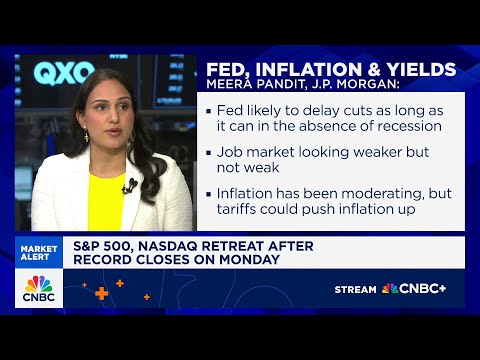
J.P. Morgan’s Meera Pandit: Budget bill would be short-term positive, but deficit question remains
CNBC Television· 2025-07-01 14:57
International Markets - US stocks still have a home bias, but international markets offer catalysts beyond just a weaker dollar [1] - Europe benefits from lower rates and fiscal stimulus, China from AI, and Japan from corporate reform [2] - Emerging markets, including Korea, Taiwan, and Latin America, benefit from the resurgence in hardware within tech and the reorganization of global trade [2][3] - International opportunities are not all dependent on each other, providing diversification [3] US Market & Fiscal Policy - The market has largely priced in the "big beautiful bill," with short-term positive impacts on equity markets due to growth boosts [4][5] - The long-term impact of the bill includes a potentially ever-expanding deficit, estimated to be in the trillions, which could create a floor on yields [5][6] - The market seems to have gotten comfortable with tariffs around 14% or 15%, after a previous range of 2% to 25% [8] Market Resilience & Outlook - The market has shown resilience to geopolitical risks, the reconciliation bill, and recession risks [9][10] - The path of least resistance for the market is higher, given its resilience to various downside risks [10] - The market could become more rangebound in the second half of the year due to higher valuations [12][13] - Diversified portfolios are up 6% to 7% in the first half of the year [14] Bond Market & Yields - Resistance has been met around 45% on the 10-year Treasury yield [15] - Yields could drift lower throughout the year, potentially providing opportunities for investors [16] - Even if yields remain stable, the income cushion will generate a decent return further out on the curve [16]