
AI bubble

Search documents
Wall Street pushes back on AI bubble concerns, BLS plans to release Sept CPI
Youtube· 2025-10-10 14:59
Market Overview - US stock futures are slightly changed as the S&P 500 aims to finish a modest week of gains, transitioning from a debasement trade to a broad rally across various asset classes [1][5] - The dollar has seen its best week of the year, while gold and cryptocurrencies have reached new highs [1][33] Economic Data - The Bureau of Labor Statistics is preparing to release the September CPI report, with staff being called back despite the government shutdown [2][3] - This CPI data is crucial for calculating Social Security adjustments and will influence the Federal Reserve's rate decisions [3][17] Company Earnings - Levi Strauss reported third-quarter revenue of $1.5 billion, meeting estimates, and raised its full-year outlook, but warned of tariff impacts and provided conservative guidance for Q4, expecting only 1% organic net sales growth compared to 7% in Q3 [4][24][25] - The cautious outlook led to a nearly 11% drop in Levi's stock in pre-market trading [24] AI Sector Insights - Concerns about a potential bubble in the AI sector have been discussed, with Goldman Sachs and UBS suggesting that the current market leaders have strong balance sheets, differentiating them from the dotcom bubble era [7][8] - The NASDAQ has rallied approximately 50% since April, raising concerns about stretched valuations [8][9] Treasury Market and Dollar Dynamics - Despite the narrative of a debasement trade, the dollar has been consolidating and is currently at a two-month high, with a year-to-date decline of about 10% [11][13] - The behavior of the Treasury market does not align with expectations of a debasement trade, indicating strong demand for US assets [34][36] Rare Earth and Tech Stocks - Qualcomm is under scrutiny from China for potential anti-monopoly violations, which may heighten tensions between the US and China [28] - Applied Digital reported better-than-expected first-quarter revenue and is in advanced talks for a new data center, reflecting growth in the tech sector [29][30] - Rare earth stocks are gaining due to China's tightening grip on global supplies, with speculation about increased US government involvement in the sector [31]
Wall Street pushes back on AI bubble concerns, BLS plans to release Sept CPI
Yahoo Finance· 2025-10-10 14:59
Welcome to Yahoo Finance's flagship show, The Morning Brief. I'm Julie Heyman. Let's get to the three things you need to know today.First up, US stock futures little changed as the S&P 500 looks to close out a modest week of gains. What started off as the so-called debasement trade this week quickly turned into the buy everything rally. Stocks soared to new highs, gold hit fresh records, crypto jumped, and the dollar saw its best week of the year.Investors also bought treasuries for good measure. Plus, the ...


Stop worrying about the AI bubble: SocGen strategists tell clients the dollar and fundamentals will sustain this rally.
MarketWatch· 2025-10-10 12:56
Core Insights - Société Générale conducted a survey among clients to identify the primary concerns regarding U.S. markets [1] Group 1 - The survey aimed to gauge client sentiment on various aspects of the U.S. markets [1]


Alibaba, Baidu, Other China Tech Stocks Fall. It's an AI Problem.
Barrons· 2025-10-10 12:19
Core Viewpoint - Concerns are rising about the potential formation of an AI bubble, highlighted by warnings from the Bank of England and the International Monetary Fund [1] Group 1 - The Bank of England has issued warnings regarding the risks associated with the rapid growth of AI technologies [1] - The International Monetary Fund has also expressed concerns about the sustainability of the current AI investment trends [1]


Are Big Tech ETFs Strong Enough to Weather AI Bubble Fears?
ZACKS· 2025-10-10 11:40
Core Viewpoint - Wall Street is concerned about a potential bubble in the artificial intelligence (AI) sector, with analysts divided on the viability of AI investments within the expected timeframe [1] Group 1: Market Sentiment - Goldman Sachs strategist Peter Oppenheimer suggests that fears of a bubble in U.S. tech stocks may be premature, attributing the current rally to strong earnings rather than speculation [2] - Oppenheimer notes that while valuations are stretched, they are not yet at levels consistent with historical bubbles, with the Nasdaq 100 trading at 28x forward earnings compared to its 10-year average of 23 [2] - Some experts, like Santa Clara University's Ram Bala, believe that AI investments will yield long-term returns, while AMD CEO Lisa Su views the AI boom as the start of a 10-year super-cycle [6] Group 2: AI Investment Landscape - OpenAI, valued at $500 billion, has not yet demonstrated a profitable business model despite significant investments in data centers and partnerships with NVIDIA, AMD, and Oracle [4] - Major tech companies, including NVIDIA, Oracle, Amazon, Google, Meta, and Microsoft, are making substantial investments in AI, indicating a bullish outlook despite concerns about a bubble [4][7] - Jeff Bezos and Goldman Sachs CEO David Solomon express caution, warning that rapid capital formation may outpace actual potential [5] Group 3: Financial Metrics of Big Tech - Big tech companies are characterized by strong cash positions, with Alphabet's cash flow/share at 9.47X, Amazon at 10.57X, Microsoft at 18.29X, and Meta at 30.73X, compared to the S&P 500 average of 8.99X [9] - The debt/equity ratios for Alphabet and Tesla are 0.07X, significantly lower than the S&P 500 average of 0.58X, indicating a strong balance sheet position for these companies [10][11] - The overall financial health of these companies suggests they are well-positioned to navigate potential market volatility [11] Group 4: Investment Vehicles - Investors may consider exchange-traded funds (ETFs) to gain exposure to Big Tech, with notable ETFs including Roundhill Magnificent Seven ETF (MAGS) up 5.6% in the past month, MicroSectors FANG+ ETN (FNGS) up 2.4%, and Vanguard Mega Cap Growth ETF (MGK) up 4.7% [12]





Asian shares dip at open, gold trades below $4,000
The Economic Times· 2025-10-10 01:01
Market Overview - Stocks in Japan and Australia experienced declines, while South Korea's market rose, particularly driven by a 6% increase in Samsung Electronics Co. [1][9] - US stocks slipped as investors took a breather after a strong rally in the S&P 500 from its April lows, raising concerns about potential market overheating [1][9]. Economic Indicators - The yen is on track for its largest weekly loss in a year, despite comments from Japan's new ruling-party leader advocating against an excessively weak currency [4]. - The Argentine peso rebounded following a $20 billion financing offer from the US aimed at stabilizing the country's economy after significant declines [5]. Investment Sentiment - Some analysts, including Keith Lerner from Truist Advisory Services, noted that certain areas of the market appear overheated, making it more sensitive to negative surprises [2][9]. - Stock positioning data from JPMorgan Chase & Co. indicates that some investors, including hedge funds, are holding back, with the equity beta of macro hedge funds remaining modestly negative [7][10]. Sector Analysis - The demand for precious metals has increased, with silver reaching its highest price since 1980, while oil prices steadied after a previous drop [2][9]. - Daniel Skelly from Morgan Stanley argued that concerns about an AI bubble are misplaced, as leading spenders continue to show increased earnings power, contrasting with the dot-com era companies that lacked viable business models [8][10].

Tom Lee: S&P can still get to at least 7,000 this year
Youtube· 2025-10-09 19:28
It does take us to our talk of the tape, the rallies road ahead. I mentioned that call from Tom Lee. He does join us now.He's a CNBC contributor. It's good to have you back. Welcome.Great to see you, Scott. So, what what do you make of just how the market's trading today. We've had a nice run.Um, it's given a little bit back. Maybe some concerns are out there about the strength of the economy, the labor market, some other stuff. What do you see.Well, I I think markets are uh trying to balance a few things b ...
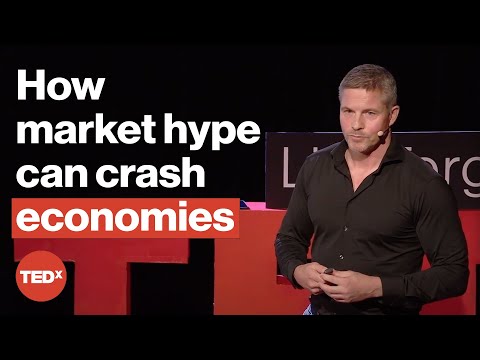
Is the AI bubble going to burst? | Henrik Zeberg | TEDxLilla Torg
TEDx Talks· 2025-10-09 17:00
[Music] Don't think you're special. Don't think that you know more than we do. These are some of the statements from the law of Yan.I think that is dangerous. I think that is actually driving a common thinking that can bring you know hazard uh outcomes. And today I want to talk about something that may be a little more dry than what we have uh just heard which is Bitcoin crypto bubbles financial bubbles.Bitcoin is a mineral disease. Bitcoin is rat poison squared. These are not my words. These are the words ...
Top strategist Paul Dietrich shares 2 picks to ride out an AI crash
Yahoo Finance· 2025-10-09 17:00
Core Viewpoint - The AI boom is perceived as a bubble, with concerns about inflated valuations and potential market corrections [1][5]. Group 1: Market Comparisons - The current AI stock surge is likened to the dot-com bubble of the late 1990s and the housing bubble of the mid-2000s, characterized by irrational exuberance [2]. - Nvidia's stock has increased approximately 13-fold since the beginning of 2023, leading to a market capitalization of $4.5 trillion, surpassing the combined value of major companies like Berkshire Hathaway and JPMorgan [2]. Group 2: Valuation Concerns - Despite the belief that AI will revolutionize industries, current valuations are considered excessive, with historical precedents indicating that such trends are unsustainable [3][5]. - The example of Microsoft is cited, where its shares fell 63% during the dot-com crash, highlighting the risks associated with overvalued stocks [3]. Group 3: Investor Behavior - There is a growing concern about retail investors using borrowed funds to invest in riskier assets, particularly in leveraged ETFs within the technology sector [4]. - The unprecedented level of leverage in the current market raises alarms about potential rapid declines if the market turns [4]. Group 4: Economic Context - Government stimulus measures over the past five years have temporarily supported demand and delayed economic downturns, but fundamental market principles remain unchanged [5]. - Alternative investment recommendations include utilities and gold as safer options amidst the perceived AI bubble [5].
Manning & Napier (NYSE:MN) Update / Briefing Transcript
2025-10-09 17:00
Summary of the Conference Call Industry Overview - The discussion primarily revolves around the **AI industry** and its implications for the **U.S. economy** and **technology sector**. The focus is on the investment landscape, particularly in relation to AI and its value chain. Key Points and Arguments U.S. Economy and Federal Reserve - The U.S. economy is described as **resilient**, supported by high-end consumer spending and strong nonresidential fixed investment [6][12][13] - There is a **bifurcation** in consumer-focused tech companies, with management teams reporting decent consumer health, while enterprise tech shows **tepid growth** in IT budgets due to rapid changes in technology [7][9] - The Federal Reserve is facing trade-offs regarding interest rate cuts amidst rising inflationary pressures and resilient growth [11][14] AI Investment Landscape - There is significant **enthusiasm** for AI-related investments, leading to a **dichotomy** between perceived AI winners and losers across sectors [17][21] - The **tech momentum factor** has reached levels not seen since 2002, indicating a potential risk in the market [18] - The **AI value chain** is broken down into four categories: application providers, AI models, data center operators, and semiconductor capital equipment suppliers [22][21] Data Center Infrastructure - The largest spenders in data centers are **hyperscale cloud service providers** (Amazon, Google, Microsoft), expected to spend around **$350 billion** in CapEx this year [39] - The **Neo Clouds** are emerging as a new category, reselling access to GPUs, but are heavily reliant on debt financing [40][44] - The **data center spending** is transitioning from cash flow funded to more debt-fueled investments, raising concerns about sustainability [41][42] AI Model Providers - The main players in AI model development include **OpenAI, Google, Meta, Anthropic**, and **XAI** [48] - These companies are projected to spend around **$150 billion** on training AI models next year, primarily funded through existing profitable businesses or ongoing debt issuance [50][51] Application Layer - The application layer is dominated by AI chatbots like **ChatGPT**, which has scaled to **800 million users** and a revenue run rate exceeding **$10 billion** [60][61] - Revenue generation is currently driven by paid subscriptions, with expectations for future monetization through advertising [61][62] - There is a significant mismatch between the scale of investment in infrastructure and the current revenue generated from AI applications, estimated at **$15-20 billion** [63][64] Investment Opportunities and Risks - The investment strategy focuses on **semiconductors** and **hyperscalers**, with caution advised regarding **Neo Cloud providers** due to high customer concentration and cash burn [46][47] - Concerns about overinvestment and potential market corrections are highlighted, with a warning that many companies may not achieve sustainable profits [71][72] - The discussion suggests that AI may be more of a **sustaining innovation** rather than a disruptive one, indicating potential opportunities in traditional sectors like **enterprise software** and **IT services** [69][70] Global Perspective - China's AI ecosystem is rapidly developing, with companies like **Tencent, Baidu, and Alibaba** benefiting from AI advancements, despite challenges in accessing cutting-edge technology [77][78] Other Important Insights - The call emphasizes the need for a cautious approach to investing in AI, recognizing the potential for both significant opportunities and risks in the current market environment [74][75]


