空天一体

Search documents
军工板块再度回调,航空航天ETF(159227)军工含量最高,规模位居同类第一
Mei Ri Jing Ji Xin Wen· 2025-08-01 03:29
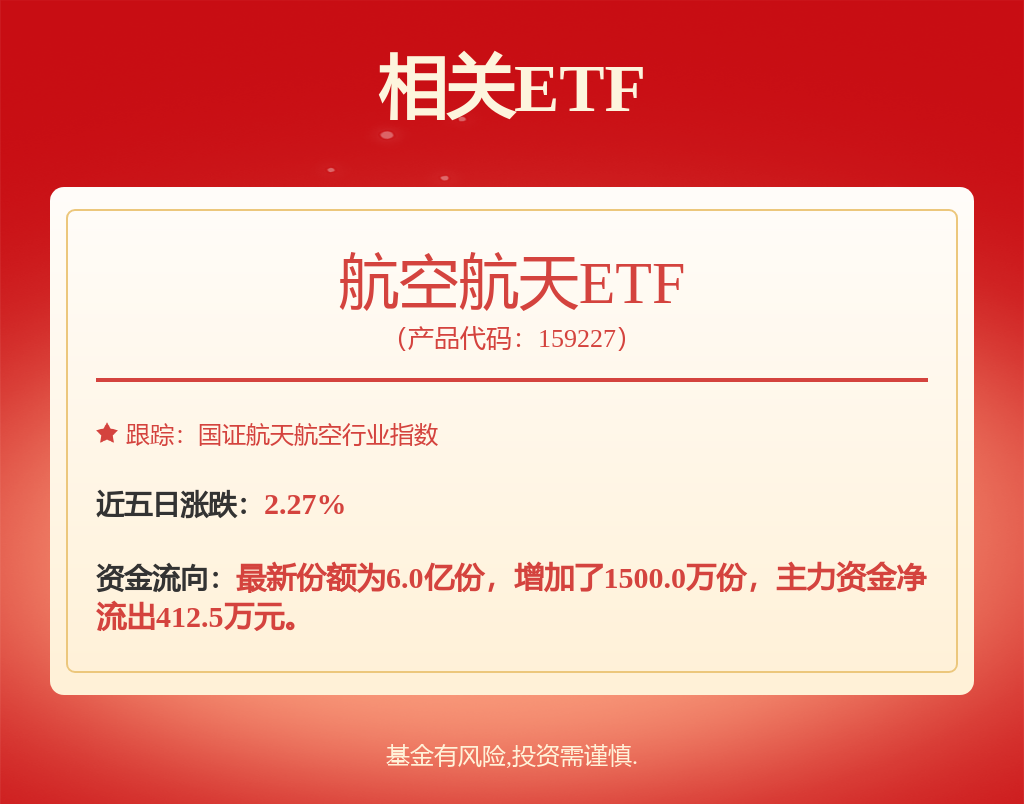
Core Viewpoint - The aerospace and defense sector experienced a significant pullback on August 1, with the Aerospace ETF (159227) showing signs of recovery after hitting a low, narrowing its decline to 1.62% by 11:10 AM, with a trading volume of 1.03 billion yuan, maintaining its position as the leader in its category [1] Fund Flows - In July, the Aerospace ETF attracted a net inflow of over 4.21 billion yuan, bringing its latest scale to 7.75 billion yuan, marking a new high since its inception and ranking first among its peers [1] Index Performance - The Aerospace ETF tracks the Guozheng Aerospace Index, which has a high concentration of 98.2% in the Shenwan first-level military industry, focusing on the aerospace segment. The constituent stocks cover the entire industry chain, including fighter jets, transport aircraft, helicopters, aircraft engines, missiles, satellites, and radars, aligning perfectly with the "integrated aerospace" strategic direction [1] Historical Returns - From July 29, 2024, to July 28, 2025, the Guozheng Aerospace Index is expected to yield a return of 38.85%, outperforming the CSI National Defense Index (34.37%), CSI Military Industry Index (32.84%), and Military Leaders Index (28.02%) [1] Future Outlook - Shanxi Securities indicates that 2025 will be a pivotal year, with the gradual release of delayed orders from the "14th Five-Year Plan" over the past six months and a marginal improvement in demand. With the initiation of the "15th Five-Year Plan" and the approaching 2027 centenary military goal, the military industry’s performance is expected to bottom out and recover in the second half of 2025, entering an upward cycle [1]
近一年收益领跑军工类指数,航空航天ETF(159227)规模再创新高,中船应急午后拉升
Mei Ri Jing Ji Xin Wen· 2025-07-30 05:38
Group 1 - A-shares showed mixed performance on July 30, with sectors like petrochemicals, steel, and insurance leading the gains, while the defense and military industry experienced fluctuations, presenting layout opportunities [1] - The Aerospace ETF (159227) saw a decline of 1.01% with a trading volume of 108 million yuan, ranking first among its peers, while stocks like China Shipbuilding Emergency Response surged over 4% in the afternoon [1] - The Aerospace ETF has attracted significant capital, with a net inflow of over 357 million yuan in July, bringing its latest scale to 724 million yuan, a record high since its inception [1] Group 2 - The military industry is characterized by strong planning, with five-year plans significantly impacting industry operations and market expectations, serving as a key driver for military market trends [1] - The execution of the military construction plan for the "14th Five-Year Plan" is entering a critical phase, with order demand expected to accelerate as 2025 approaches [1] - According to Shenwan Hongyuan, the upcoming "9.3 military parade" is likely to cause fluctuations in the military sector, and with increasing market attention and the gradual advancement of the "15th Five-Year Plan," the military industry is expected to experience a dual boost in fundamentals and valuations [1] Group 3 - The Aerospace ETF tracks the National Aerospace Index, with a high concentration of 98.2% in the primary military industry, focusing on aerospace capabilities and covering leading companies across the entire industry chain, including fighter jets, transport aircraft, helicopters, and more [2] - From July 29, 2024, to July 28, 2025, the National Aerospace Index is projected to yield a return of 38.85%, outperforming other military indices such as the CSI National Defense Index (34.37%) and the CSI Military Industry Index (32.84%) [2]

建军节临近,军工板块反复活跃,航空航天ETF(159227)回调迎布局机会
Mei Ri Jing Ji Xin Wen· 2025-07-30 04:21
Group 1 - The A-share market showed mixed performance on July 30, with the military industry sector being active, particularly the aerospace ETF (159227), which saw a decline of 0.59% and a trading volume of 646.1 million yuan, maintaining its position as the top in its category [1] - The aerospace ETF has attracted significant capital, with a net inflow of over 357 million yuan in July, bringing its latest scale to 724 million yuan, a record high since its inception [1] - The upcoming Army Day and the military parade on September 3 have increased market attention on the defense and military industry, alongside a recovery in demand and orders since 2025, leading institutions to begin increasing allocations to the military sector after ten consecutive quarters of reduction [1] Group 2 - Northeast Securities indicated that as the "14th Five-Year Plan" approaches its final year, disturbances in the military industry have largely dissipated, with downstream demand showing signs of recovery [2] - The long-term goals for the military industry provide clear guidance for development, aiming for modernization by 2035 and establishing a world-class military by 2050, which is expected to significantly improve the defense and military sector [2] - With recovering demand and an improving capacity structure, the defense and military sector is anticipated to have a high safety margin and long-term growth certainty [2]
业绩领跑军工类指数,航空航天ETF聚焦空天国防,规模居同类第一
Zheng Quan Zhi Xing· 2025-07-29 06:50
Group 1 - The aerospace and defense sector is experiencing significant market activity, with the aerospace ETF (159227) rising by 1.02% and reaching a new high, with a trading volume of 1.01 billion yuan, leading its category [1] - The aerospace ETF has attracted over 348 million yuan in net inflows since July, bringing its total size to 703 million yuan, a record high since its inception [1] - The aerospace ETF tracks the Guozheng Aerospace Index, which has a high concentration of 98.2% in the defense industry, focusing on the aerospace sector and covering key components such as fighter jets, transport aircraft, helicopters, and missiles [1] Group 2 - Shanxi Securities indicates that 2025 will be a pivotal year for the military industry, with demand gradually improving as delayed orders from the 14th Five-Year Plan are released [2] - The military sector's performance is expected to bottom out and recover in the second half of 2025, coinciding with the initiation of the 15th Five-Year Plan and the approach of the 2027 centenary military goal [2]

飞机为什么会出事故
Hu Xiu· 2025-06-12 11:51
Core Viewpoint - The article discusses the historical development of aviation, highlighting key figures and technological advancements that have shaped the industry over time. Group 1: Historical Milestones - The ancient Chinese had dreams of flying, as evidenced by historical artifacts like the Dunhuang murals [4] - The first powered flight was achieved by the Wright brothers in 1903, marking the beginning of modern aviation [7] - Chinese aviator Feng Ru created two aircraft models and conducted test flights in China, but tragically died in a crash in 1912 [12] Group 2: Engineering Challenges - Early aviation safety considerations focused on structural integrity, such as wing strength and fuselage durability [13][17] - Engineers used sandbags to simulate aerodynamic loads during ground tests due to the lack of advanced technology [16] - The concept of strength refers to a structure's ability to resist failure under load [17] Group 3: Aircraft Design and Safety - Lift is generated by the pressure difference between the upper and lower surfaces of the wing as it moves through the air [20] - Aircraft can experience vibrations and structural deformation during high-speed flight, necessitating a focus on wing stiffness [26][28] - Historical aircraft like the DC-3 and the Comet faced structural failures due to material fatigue [29][31] Group 4: Material Science and Testing - The introduction of fatigue testing and damage tolerance concepts has improved aircraft safety [59][62] - Modern aircraft design utilizes advanced materials like carbon fiber composites, which offer high strength-to-weight ratios [78][79] - Testing methods have evolved to include simulations and dynamic load tests to ensure structural integrity [88][90] Group 5: Human Factors and Operational Safety - Human error accounts for 70% to 80% of aviation accidents, highlighting the importance of training and technology in mitigating risks [93] - Modern aircraft employ advanced flight control systems that reduce the likelihood of pilot error [97] Group 6: Future of Aviation - The future of aviation is expected to integrate air and space travel, with advancements in high-speed vehicles that could redefine distance and travel time [130][131]

富士达(835640) - 投资者关系活动记录表
2025-05-21 11:20
Group 1: Investor Relations Activities - The company participated in the 2025 Shaanxi Listed Companies Investor Reception Day and 2024 Annual Performance Briefing on May 20, 2025 [3] - Key attendees included the General Manager, Deputy General Manager, and Financial Officer [3] Group 2: Performance Expectations - The company anticipates challenges and opportunities in 2025, with defense sector demand gradually increasing and communication sector demand remaining stable [4] - The company has core capabilities in aerospace and has made product and technology reserves in emerging industries like commercial aerospace and low-altitude economy [5] Group 3: Profitability and Production Capacity - Profit margin decline in 2024 was attributed to insufficient demand in the defense sector and increased R&D investment [6] - The company plans to enhance production capacity to meet market demand as it recovers [7] Group 4: Product Development and Market Strategy - The company focuses on modular design to enhance the value of commercial satellite products [8] - There is an expectation of continued growth in defense orders in Q2 and Q3, alongside efforts to balance fluctuations with high-margin civilian projects [9] Group 5: Governance and Sustainability - The company has established a modern governance structure and maintains a stable management team [11] - The company adheres to environmental management standards and has received recognition as a "Green Factory" [13] Group 6: Competitive Positioning - The company invests over 7% of its revenue in R&D to maintain a competitive edge and expand into new fields [12]