
Agentic Commerce

Search documents
Walmart Inc. Q4 2026 Earnings Call Summary
Yahoo Finance· 2026-02-19 21:33
Core Insights - The company's performance was significantly driven by the omnichannel model, with adjusted operating income growing at over twice the rate of sales growth in the fourth quarter, marking the third consecutive year of profit growth outpacing sales growth [1] Market Dynamics - Management noted market share gains primarily from households earning over $100,000, while lower-income consumers are focused on convenience and price due to stretched budgets [1] Strategic Initiatives - The company is shifting its strategic positioning towards 'agentic commerce,' leveraging AI assistants like Sparky to transition from traditional search to intent-driven shopping experiences [1] Operational Efficiency - Operational efficiency has improved through supply chain automation, with 60% of U.S. stores now receiving freight from automated distribution centers [1] Technology and Global Strategy - The 'build one, scale globally' philosophy is being applied to technology platforms to reduce marginal costs and ensure consistent customer experiences across international markets [1] Inventory Management - Inventory management remains a key driver of health, with inventory levels growing at approximately half the rate of sales due to enhanced visibility from AI and computer vision tools [1]

The Retail Stocks Set to Dominate In 2026
Youtube· 2026-02-19 20:03
Core Insights - Walmart's earnings report indicates strong momentum, with a solid holiday quarter and positive outlook for 2026 [2][3] - Amazon has surpassed Walmart in annual revenue for the first time, marking a significant shift in the retail landscape [22][24] - The consumer market is bifurcated, with higher-income households benefiting from wealth effects while lower to middle-income households are more price-sensitive [5][9] Walmart Performance - All three business segments of Walmart—Walmart US, Walmart International, and Sam's Club—are performing well [3] - Walmart typically provides conservative guidance at the beginning of the year, but historically raises its outlook as the year progresses [3][4] - The company is attracting both higher-income and lower-income consumers, indicating broad appeal across demographics [6][10] Consumer Behavior - The consumer landscape shows a divide, with higher-income households spending more while lower-income households are more cautious [5][9] - Walmart is successfully catering to both demographics, enhancing its market position [6][10] AI Integration - Walmart is leveraging AI for both customer-facing and backend operations, which could enhance product discoverability and improve supply chain efficiency [11][12] - The integration of AI is expected to benefit Walmart's top line and margins, positioning it favorably in the retail sector [11][13] Competitive Landscape - Amazon's growth, particularly in its cloud business, presents a different competitive dynamic compared to Walmart [22][24] - Specialty retailers and smaller retailers are at greater risk due to cost pressures and competition from larger retailers like Walmart and Amazon [17][19] Tariff and Inflation Outlook - Tariff pressures are expected to lessen in 2026 compared to 2025, which could positively impact discretionary retailers [20][21] - Inflation remains a concern for retail margins, with a preference for consumer discretionary over staples in the current market [31] Stock Recommendations - Top retail stock picks for 2026 include Amazon, Costco, and Walmart, with a strong buy rating on Amazon [28] - Target is seen as a higher-risk play but still offers value relative to peers [34]



ACI Worldwide Executive Philip Bruno to Address the Rise of Agentic Commerce at MIT Sloan Fintech Conference
Businesswire· 2026-02-19 19:50
Core Insights - ACI Worldwide, a leader in global payments technology, is participating in the MIT Sloan Fintech Conference where Philip Bruno will discuss the role of AI in commerce [1] Company Overview - ACI Worldwide is recognized as an original innovator in the global payments technology sector [1] Event Details - Philip Bruno, the chief strategy and growth officer of ACI Worldwide, will speak on a panel titled "Agentic Commerce: When AI Starts Buying" [1] - The conference is scheduled for February 20 in Cambridge, Massachusetts [1] - The panel will explore the emerging trend of AI agents making purchasing decisions in digital ecosystems [1]



Klarna(KLAR) - 2025 Q4 - Earnings Call Transcript
2026-02-19 14:32
Financial Data and Key Metrics Changes - In Q4 2025, active consumers reached 180 million, up 28% year-over-year, while merchants grew to 966,000, up 42% year-over-year [4] - Gross Merchandise Volume (GMV) was $38.7 billion, exceeding guidance, and revenue grew 38% to over $1 billion, also beating guidance [4] - Transaction margin dollars before provisions increased 31% to $622 million, while after provisions, it was $372 million, up 17% year-over-year and up 28% sequentially from Q3 [5] Business Line Data and Key Metrics Changes - The adoption of banking products, including the Klarna Card and deposit accounts, accelerated, with active card users growing to 4.2 million, up 288% year-over-year [11] - Consumer deposits reached $13 billion, up 37%, and the most engaged banking customers reached 15.8 million, growing at 101% year-over-year [11] - Fair financing products saw GMV growth of 165% annually, indicating strong demand [8] Market Data and Key Metrics Changes - Klarna operated across 26 markets and three continents, achieving over $127 billion in volume in 2025 [5] - The company added 285,000 merchants, up 42% year-over-year, and expanded partnerships with major players like Walmart and Stripe [9] Company Strategy and Development Direction - Klarna aims to become a ubiquitous payment solution, enhancing its partnerships and expanding its payment network [9] - The company is focused on building a consumer bank of the future, with a strategy to leverage existing consumer relationships for deeper banking engagements [14] - The operating model emphasizes efficiency and technology, allowing for a leaner workforce while maintaining high revenue per employee, which reached $1.24 million in 2025 [15] Management's Comments on Operating Environment and Future Outlook - Management expressed confidence in the growth trajectory, emphasizing that faster growth in banking products may lead to lower upfront transaction margins but will yield higher future profits [16] - The company noted stability in credit loss provisions, with a decline from 0.72% of GMV in Q3 to 0.65% in Q4, reflecting stable delinquency trends [21] - Management highlighted the importance of maintaining a disciplined approach to growth and risk management, leveraging a deep understanding of consumer behavior [14][88] Other Important Information - The company is experiencing a compounding growth effect as more consumers engage with its banking products, leading to increased revenue per user [12] - Klarna's unique underwriting model allows for stable charge-off rates, significantly lower than traditional credit card banks [14] Q&A Session Summary Question: When are you planning to become profitable? - Management indicated that while current growth may reduce transaction margin dollars, it will lead to increased future profits as loan portfolios mature [16] Question: How will you prioritize capital allocation between reinvestment, debt reduction, and shareholder returns? - Management emphasized the focus on growth and product development while being disciplined with costs, which will inform future capital allocation decisions [19] Question: What are the latest delinquency trends and confidence in provisions stabilizing? - Management reported stability in delinquency trends, with a decline in provisions for credit losses in Q4 compared to Q3 [21] Question: Can you elaborate on the impact of excess loan growth on transaction margin dollars? - Management explained that strong growth in non-interest-bearing loan products has led to higher volumes, impacting transaction margin dollars but ultimately benefiting the overall financial health [24] Question: How is the Walmart rollout performing? - Management expressed satisfaction with the Walmart partnership, noting it as a significant accomplishment that will drive future growth [34] Question: What are the expectations for transaction margin in the coming year? - Management indicated that transaction margin dollars are expected to remain consistent with Q4 2025 levels as the company continues to invest in growth [42]

Klarna(KLAR) - 2025 Q4 - Earnings Call Transcript
2026-02-19 14:32
Financial Data and Key Metrics Changes - In Q4 2025, active consumers reached 180 million, up 28% year-over-year, while merchants grew to 966,000, up 42% year-over-year [4] - Gross Merchandise Volume (GMV) was $38.7 billion, exceeding guidance, and revenue grew 38% to over $1 billion, also beating guidance [4] - Transaction margin dollars before provisions grew 31% to $622 million, while after provisions, it was $372 million, up 17% year-over-year and up 28% sequentially from Q3 [5][6] Business Line Data and Key Metrics Changes - The adoption of banking products, including the Klarna Card and fair financing, accelerated beyond expectations, contributing to revenue growth [4] - Active card users grew to 4.2 million, up 288% year-over-year, and consumer deposits reached $13 billion, up 37% [11] - The most engaged banking customers reached 15.8 million, growing at 101% year-over-year, with a significant increase in average revenue per user (ARPU) [12] Market Data and Key Metrics Changes - Klarna operated across 26 markets and three continents, achieving over $127 billion in volume in 2025 [5] - The company added 285,000 merchants, up 42% year-over-year, and expanded partnerships with major players like Walmart and Stripe [9][10] Company Strategy and Development Direction - Klarna aims to become a ubiquitous payment solution, leveraging partnerships to expand its acceptance points and product offerings [9][10] - The company is focused on building a consumer bank of the future, emphasizing efficiency and technology to maintain a competitive advantage [14][15] - The strategy includes scaling banking relationships and enhancing product ubiquity, with a focus on consumer trust and engagement [10][11] Management's Comments on Operating Environment and Future Outlook - Management expressed confidence in the stability of credit quality and the potential for future profitability despite near-term provisioning impacts [16][21] - The company anticipates continued growth in banking products and a positive trajectory for transaction margins as cohorts mature [42][43] - Management highlighted the importance of maintaining a disciplined approach to growth and cost management while expanding product offerings [20][68] Other Important Information - Revenue per employee reached $1.24 million in 2025, a 3.6x increase since 2022, indicating improved operational efficiency [15] - The company is experiencing a compounding growth effect as more consumers engage with its banking products [11][12] Q&A Session Summary Question: When are you planning to become profitable? - Management indicated that while upfront transaction margins may be lower due to growth, future profits from increased loan volumes will offset this [16] Question: How will you prioritize capital allocation between reinvestment, debt reduction, and shareholder returns? - Management emphasized the importance of growth and product adoption while remaining disciplined on costs, with future discussions on capital allocation to occur once profits are realized [19][20] Question: What are the latest delinquency trends and confidence in provisions stabilizing? - Management reported a decline in provisions for credit losses from 0.72% of GMV to 0.65%, indicating stability in delinquency trends [21] Question: Can you elaborate on the impact of excess loan growth on transaction margin dollars? - Management explained that strong growth in pay-later volumes is driving higher provisions, but this is expected to normalize over time [23][24] Question: How is the Walmart rollout performing? - Management expressed satisfaction with the Walmart partnership and its potential to drive growth, highlighting the importance of distribution partnerships [34][36] Question: What are the expectations for transaction margins in the coming year? - Management indicated that transaction margins are expected to remain consistent with Q4 2025 levels, with growth anticipated in the second half of 2026 [42][43] Question: What is the outlook for fair financing loan growth in 2026? - Management expects absolute volume growth to accelerate compared to 2025, despite potential deceleration in year-over-year percentage growth [49]
Klarna(KLAR) - 2025 Q4 - Earnings Call Transcript
2026-02-19 14:30
Financial Data and Key Metrics Changes - Active consumers reached 180 million, up 28% year-over-year [3] - Merchants grew to 966,000, up 42% year-over-year [3] - Gross Merchandise Volume (GMV) was $38.7 billion, exceeding guidance [3] - Revenue grew 38% to over $1 billion, also beating guidance [3] - Transaction margin dollars before provisions grew 31% to $622 million [4] - After provisions, transaction margin dollars were $372 million, up 17% year-over-year [4] Business Line Data and Key Metrics Changes - Klarna's banking products, including the Klarna Card and deposit accounts, saw accelerated adoption [3] - Active card users grew to 4.2 million, up 288% year-over-year [11] - Consumer deposits reached $13 billion, up 37% [11] - Klarna banking customers reached 15.8 million, growing at 101% year-over-year [11] Market Data and Key Metrics Changes - In 2025, Klarna processed over $127 billion in volume across 26 markets [4] - The adoption of fair financing products grew at 165% annually [8] - The company added 285,000 merchants, up 42% year-over-year [9] Company Strategy and Development Direction - Klarna aims to become a ubiquitous payment solution, expanding its network and partnerships [9] - The company is focusing on building deeper relationships with consumers to transition them from casual users to banking customers [10] - The strategy includes enhancing product offerings and ensuring relevant payment options are available at every checkout [10] Management's Comments on Operating Environment and Future Outlook - Management expressed confidence in the stability of credit quality and the potential for future profitability despite current provisioning impacts [16][20] - The company anticipates continued growth in banking products and expects transaction margins to improve as loan cohorts mature [42] - Management highlighted the importance of maintaining a lean cost structure while scaling operations [14] Other Important Information - Revenue per employee reached $1.24 million in 2025, a 3.6x increase since 2022 [14] - Adjusted operating expenses declined by 8% while revenue grew 104% since 2022 [14] Q&A Session Summary Question: When are you planning to become profitable? - Management indicated that while current growth may reduce transaction margin dollars, it will lead to increased future profits as loan books mature [16] Question: How will you prioritize capital allocation between reinvestment, debt reduction, and shareholder returns? - Management emphasized the focus on growth and product adoption while being disciplined on costs, which will inform future capital allocation decisions [19] Question: What are the latest delinquency trends and confidence in provisions stabilizing? - Management reported a decline in provisions for credit losses from 0.72% of GMV to 0.65%, indicating stable delinquency trends [20][21] Question: Can you elaborate on the impact of excess loan growth on transaction margins? - Management explained that strong growth in pay later volumes is affecting transaction margins but is expected to normalize as the business matures [23][24] Question: How is the Walmart rollout performing? - Management expressed satisfaction with the Walmart rollout and highlighted the importance of partnerships in driving growth [35][36] Question: What are the expectations for transaction margins in the coming year? - Management indicated that transaction margins are expected to remain consistent with Q4 2025 levels as the company continues to invest in growth [42]
Walmart(WMT) - 2026 Q4 - Earnings Call Transcript
2026-02-19 14:02
Financial Data and Key Metrics Changes - Revenue increased by 4.9% in constant currency, with e-commerce growth at 24% and adjusted operating income growing at 10.5% [5][15] - For the full year, revenue exceeded $700 billion for the first time, growing approximately 5% in constant currency, adding $35 billion [15] - Adjusted operating income grew 5.4%, despite a 300 basis point headwind from increased claims expenses and tariffs [15][24] Business Line Data and Key Metrics Changes - Walmart U.S. comp sales increased by 4.6%, with e-commerce sales growing 27% [16] - International operating income increased by over 26%, driven by improved e-commerce economics [16] - Advertising businesses globally increased by 37%, with Walmart Connect in the U.S. up 41% [17][36] Market Data and Key Metrics Changes - E-commerce in China grew 28%, representing over 50% of the sales mix in that market [16] - Sam's Club U.S. doubled their growth in club-fulfilled delivery sales [16] - The majority of share gains came from households earning over $100,000, while lower-income households are managing spending more carefully [6][7] Company Strategy and Development Direction - The company is focused on an omnichannel model, emphasizing inventory management and fast delivery [5][9] - Investments in technology and supply chain are aimed at enhancing customer experience and operational efficiency [9][25] - The strategy includes capital allocation based on return on investment, with a focus on maintaining a strong value proposition for customers [8][24] Management's Comments on Operating Environment and Future Outlook - Management expressed confidence in the business model's ability to deliver strong growth and profits despite dynamic operating conditions [14] - The outlook for the upcoming year includes expected sales growth of 3.5% to 4.5% and operating income growth of 6% to 8% [23][26] - Management remains cautious about potential economic headwinds but is optimistic about the company's momentum and growth opportunities [41][42] Other Important Information - The company authorized a $30 billion share repurchase program, the largest to date, reflecting confidence in cash flow generation [24] - The focus on AI and technology partnerships is expected to enhance customer experiences and operational efficiencies [25][68] Q&A Session Questions and Answers Question: On agentic commerce and its impact on customer traffic and advertising - Management highlighted that agentic commerce is part of the omnichannel strategy, enhancing customer intent understanding and driving higher average order values [30][32] Question: How to factor unknown costs into the outlook - Management indicated a balanced approach to guidance, considering potential economic indicators while maintaining flexibility [40][42] Question: Expectations for inflation and disinflation - Management noted that inflation was trending slightly above 1%, with expectations for food and general merchandise inflation to remain stable [45][46] Question: Outlook for gross margin and inventory management - Management discussed improvements in inventory management through automation and technology, expecting continued benefits in gross profit [49][55] Question: Progression of Marketplace growth and fulfillment services - Management characterized Marketplace as an area of ongoing investment, focusing on growth rather than immediate profitability [59][60] Question: E-commerce profitability and personalization with AI - Management emphasized the importance of AI in enhancing customer experiences and driving e-commerce profitability [63][67] Question: Advertising growth expectations - Management expressed optimism about advertising growth, particularly in the Marketplace and VIZIO acquisition, while acknowledging the challenges of scaling [70][73]
Walmart(WMT) - 2026 Q4 - Earnings Call Transcript
2026-02-19 14:00
Financial Data and Key Metrics Changes - Revenue for the fourth quarter increased by 4.9% in constant currency, with e-commerce growth at 24% [4][14] - Adjusted operating income grew by 10.5%, outpacing sales growth [4][14] - For the full year, total revenue exceeded $700 billion for the first time, with a 5% increase in constant currency [14] - Adjusted operating income for the full year grew by 5.4%, despite a 300 basis point headwind from increased claims expenses [14][23] Business Line Data and Key Metrics Changes - Walmart U.S. comp sales rose by 4.6%, with e-commerce sales growing by 27% [14][15] - International segment operating income increased by over 26%, driven by improved e-commerce economics [15] - Advertising income globally increased by 37%, with Walmart Connect in the U.S. up by 41% [16][35] - Membership income grew by over 15%, reflecting strength in Sam's Club in China and the U.S. [16] Market Data and Key Metrics Changes - E-commerce sales in China grew by 28%, representing more than 50% of the sales mix in that market [15] - Fast delivery services in the U.S. saw a growth of over 60% year-over-year [9][15] - The majority of share gains in the U.S. came from households earning over $100,000, while lower-income households are managing spending carefully [5][6] Company Strategy and Development Direction - The company is focused on an omnichannel strategy, leveraging technology and automation to enhance customer experience and delivery speed [4][9] - Investments in AI and technology are aimed at improving inventory management and customer engagement through tools like Sparky [10][11] - The strategy includes capital allocation based on return on investment, with a focus on maintaining a strong value proposition for customers [7][20] Management's Comments on Operating Environment and Future Outlook - Management expressed confidence in the business's momentum and the ability to navigate complex operating conditions [13][41] - The outlook for the upcoming fiscal year includes sales growth expectations of 3.5% to 4.5% and operating income growth of 6% to 8% [21][22] - Management remains cautious about potential economic headwinds but is optimistic about the company's ability to outperform guidance [41][42] Other Important Information - The company authorized a $30 billion share repurchase program, its largest to date, reflecting confidence in cash flow generation [23] - Capital expenditure levels for FY 2027 are expected to be approximately 3.5% of sales, with a focus on supply chain automation and store remodels [24] Q&A Session Summary Question: On agentic commerce and its impact on customer traffic and advertising - Management highlighted that agentic commerce is part of the omnichannel strategy, enhancing customer intent understanding and driving higher average order values [28][29][32] Question: Regarding unexpected costs and outlook for the year - Management noted a measured approach to guidance, considering potential economic indicators while maintaining flexibility [37][41] Question: On disinflation and its impact on pricing - Management indicated that inflation trends are expected to remain stable, with some pressures from legislation affecting drug prices [44][45] Question: About e-commerce profitability and competition - Management emphasized the importance of maintaining share momentum through effective inventory management and leveraging technology [84]
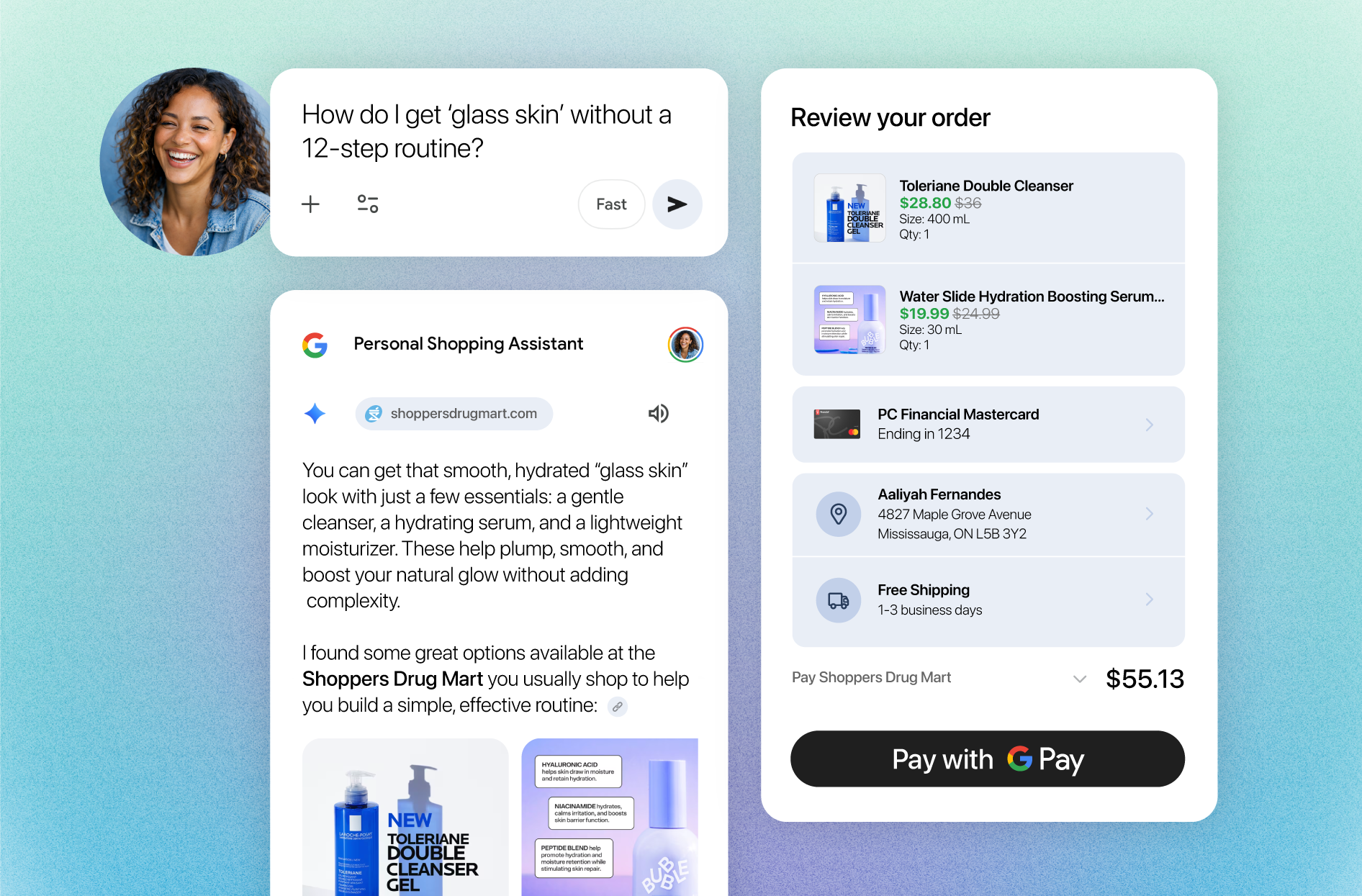
Loblaw Accelerates the Adoption of AI-driven Digital Commerce in Canada with Google Collaboration
Globenewswire· 2026-02-19 12:00
Core Insights - Loblaw Companies Limited has announced a collaboration with Google to enhance shopping experiences for Canadians through conversational AI [1][2] - This partnership positions Loblaw as the first major retailer in Canada to enable product purchases via Google's AI mode, indicating a shift towards agentic commerce [2][3] Group 1: Collaboration and Technology - The collaboration will allow Canadians to shop for health, beauty, and apparel products directly through AI Mode in Google Search and the Gemini app [2] - The Universal Commerce Protocol (UCP) will facilitate secure shopping, booking, and payments across various channels, enhancing the overall shopping experience [4] - Loblaw plans to scale its use of Google Cloud's Vertex AI platform, which has already been integrated into various retail functions, to further its transformation into an AI-native enterprise [5] Group 2: Strategic Vision and Leadership - The CEO of Loblaw emphasized the company's commitment to leveraging technology and AI to improve customer experiences and operational efficiency [6] - The Chief Digital Officer highlighted the evolution of shopping preferences and the importance of personalization in enhancing customer engagement [6] - Google Cloud's Chief Product and Business Officer noted that Loblaw's AI integration serves as a roadmap for retailers to convert technological innovations into measurable business value [7] Group 3: Company Overview - Loblaw is recognized as Canada's food and pharmacy leader and the largest retailer in the nation, operating over 2,800 locations and employing more than 220,000 individuals [8]


Artemis 研究:Agentic Commerce 正在加速发展
Xin Lang Cai Jing· 2026-02-19 02:33
Core Insights - Agentic Commerce is accelerating in development, with its landscape categorized into various segments [1] Group 1: Categories of Agentic Commerce - The landscape includes data and analytics, user front-end, wallets, Universal Balance & account abstraction, exploration, facilitators, agent networks, agent frameworks & tools, payments, identity & reputation, hosting/cloud/computing, foundation models, stablecoins, and blockchain [1]