
Embodied Intelligence

Search documents
理性看待机器人产业速度与泡沫
Jing Ji Ri Bao· 2025-12-13 01:21
客观上看,资本的密集涌入、市场的高度关注,对于鼓励创新来说是件好事,但真正的风险在于, 如果资本过度集中在少数"讲故事"的企业,过于强调投资市场回报而忽略了基础研发、核心零部件突 破、应用场景深耕等长期投入,那么当潮水退去,留下的可能并不是我们想要的坚实的产业基础。 原标题:理性看待机器人产业速度与泡沫 资本的密集涌入、市场的高度关注,对于鼓励创新来说是件好事。但真正的风险在于,如果过于强 调投资市场回报而忽略了基础研发、核心零部件突破、应用场景深耕等长期投入,那么当潮水退去,留 下的可能并不是我们想要的坚实的产业基础。 近来,有关人形机器人的声音不绝于耳,大概观点有两个:一是人形机器人市场将持续升温,明年 将成为人形机器人落地的关键一年;二是有市场人士担忧,当前人形机器人技术成熟度、应用场景、安 全性等方面仍有不少缺陷,市场过热或引发投资泡沫。 在机器人产业融资活跃、资本热捧之际,及时提醒市场保持清醒头脑与理性态度是十分必要的。正 如国家发展改革委新闻发言人在回应上述关切时所言,"速度"与"泡沫"一直是前沿产业发展过程中需要 把握和平衡的问题,对于具身智能产业也一样。 近年来,在创新引领和需求释放的双重作用 ...

China Media Group Eyes on Future Industries, Six Future-Oriented Arenas Reveal Chinese Solutions
Newsfile· 2025-12-12 02:10
Core Insights - China Media Group's "Direct to the Future" Annual Ceremony highlighted six key sectors aimed at accelerating technological breakthroughs into commercial adoption [1][2] - The event showcased the low-altitude economy, artificial intelligence, embodied intelligence, commercial space, brain-computer interfaces, and future energy as pivotal areas for China's industrial transformation [1][2] Low-Altitude Economy - The low-altitude economy is being positioned as a new pillar industry in China's 15th Five-Year Plan, reflecting a strategic commitment to develop a comprehensive industrial chain [4][5] - Real-world applications, such as Tuohang Technology's "Camel" drone and Beluga Airways' W5000 unmanned cargo aircraft, are creating a three-dimensional transport network [4][6] Artificial Intelligence - China is entering the "AI+" era, characterized by foundational technology advancements and deep integration across various sectors [8] - The "AI+" initiative has transformed technological dividends into economic growth drivers, with China's vast market serving as a rapid iteration sandbox [9] Embodied Intelligence - The sector is at a critical juncture, with a benchmark identified for humanoid robots to execute 80% of voice commands in 80% of unfamiliar environments [11] - Investor interest is rising, with deal volume in the first half of 2025 surpassing the total for all of 2024, despite challenges related to safety protocols and public perception [12] Commercial Space - China's commercial space sector is transitioning from technological validation to scaled development, with significant milestones such as Tianbing Technology's upcoming rocket launch [14] - The development model is state-guided and market-driven, aiming to create a low-cost, efficient space-based information network [14] Brain-Computer Interfaces - BCI technology is advancing in both medical and industrial applications, with significant breakthroughs enabling paralyzed patients to regain mobility [16][17] - The model focuses on expanding BCI applications from niche medical uses to broader domains like wellness monitoring and human-machine interaction [17] Future Energy - The energy transition involves systemic transformation, showcasing advancements in photovoltaics, hydrogen, and nuclear fusion as part of China's energy strategy [19] - AI-driven grid management is fostering a new energy architecture, crucial for achieving China's "Dual Carbon" goals and influencing the global energy transition [19] Conclusion - The ceremony concluded with the unveiling of a "China Future Industries Map" and a "Future Industries 100" list, marking a milestone in China's integrated industrial advancement [20][21] - The focus is shifting from isolated breakthroughs to the systemic rise of entire industrial clusters, aiming to build competitive advantages and offer "Chinese Solutions" to global challenges [21]


NeurIPS 2025大洗牌:清华390篇险胜Google,一张图看懂全球AI权力迁徙
Xin Lang Cai Jing· 2025-12-09 13:43
Core Insights - NeurIPS 2025 showcased a significant shift in the AI landscape, with a record 5825 accepted papers, indicating a new order emerging in the field [1][29] - The bipolar structure between China and the US is solidifying, with diminishing returns on the architecture of large language models (LLMs) as reinforcement learning and embodied intelligence take center stage [1][28] - The boundary between academia and industry has blurred, with computational power and talent becoming the key to achieving state-of-the-art (SOTA) results [1][28] Group 1: Overall Statistics - Tsinghua University surpassed Google in total accepted papers, achieving 390 papers (2.18%) compared to Google's 388 papers (2.17%), marking a significant achievement for Chinese academia [4][32] - In the Top 50 weighted share, Google leads with 4.84%, while Tsinghua follows closely at 4.73%, highlighting the concentration of AI resources globally [5][34] Group 2: Regional Insights - The global AI research landscape is dominated by three key regions: Beijing, Shanghai, and the San Francisco Bay Area, with Tsinghua, Peking University, and Shanghai Jiao Tong University representing China's academic strength [6][35] - The structural differences in the research ecosystem between the US and China are evident, with US strengths lying in tech giants like Google and Meta, while China's core engines are its top universities [6][35] Group 3: Quality of Research - In terms of high-quality papers (Oral + Spotlight), Google regained the top position with a share of 2.82% (72 papers), while Tsinghua maintained a strong second place with 2.54% (65 papers), indicating a competitive edge in breakthrough work [10][39] - The gap in high-quality research between Tsinghua and Google is narrowing, with only a 7-paper difference, suggesting that Chinese universities are making significant strides in quality [10][39] Group 4: Trends in AI Research - The field of Reinforcement Learning (RL) and Robotics has become the fastest-growing segment, with a total of 2302 papers, reflecting a 39.4% year-over-year growth [12][14] - China has captured 29.9% of the RL and Robotics market share, with an impressive growth rate of 81.1%, while the US holds 32.1% [17][47] Group 5: Emerging Areas - The AI for Science sector is experiencing a 37.4% annual growth rate, with balanced contributions from the US (31.7%), China (29.5%), and Europe (23.1%), indicating a competitive global landscape [20][52] - Europe is focusing on Explainable AI, holding a 23.5% share, second only to the US, as it seeks to establish regulatory frameworks for AI [25][55]


SoftBank and Nvidia Consider Joining Funding Round for Robotics Firm Skild AI
PYMNTS.com· 2025-12-08 21:43
Core Insights - SoftBank Group and Nvidia are in discussions to invest over $1 billion in Skild AI, a company specializing in foundation models for robots [1] - The funding round could increase Skild's valuation from $4.7 billion to approximately $14 billion [2] Funding Details - Skild previously raised $500 million in a Series B round, achieving a valuation of $4.7 billion, and $300 million in a Series A round, which valued the company at $1.5 billion [2] Product Development - Skild's model is designed as a "shared, general-purpose brain" for various robots, aiming to enable low-cost robots for diverse industries and applications [3] - The AI model, named "Skild Brain," can operate on a wide range of robots, enhancing their ability to think and respond like humans [5] Industry Context - Nvidia has introduced over 70 research papers on AI applications beyond text and images, focusing on "embodied intelligence" for industries such as manufacturing and transportation [6] - SoftBank Group plans to acquire ABB's robotics business for $5.375 billion, aligning with its investments in AI and robotics [6]


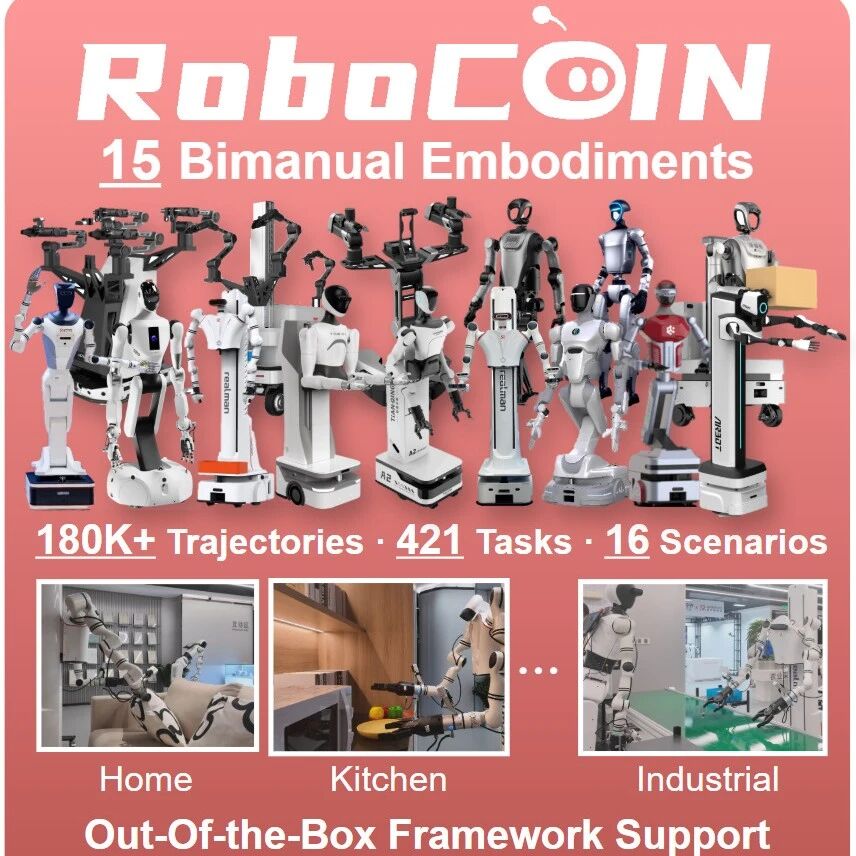
智源RoboCOIN重磅开源!全球本体数最多、标注最精细、使用最便捷的高质量双臂机器人真机数据集来了
机器人大讲堂· 2025-11-30 06:25
Core Insights - The article discusses the launch of RoboCOIN, a high-quality bimanual robotic dataset aimed at overcoming the challenges in embodied intelligence applications, particularly the scarcity of large-scale, high-quality, and multi-platform compatible robotic operation data [2][5]. Group 1: Challenges in Embodied Intelligence Data - The current embodied intelligence data faces three main challenges: lack of standards, weak quality control, and high usage barriers, which severely restrict industry development [3]. - Existing datasets are often characterized by insufficient real-world coverage, single-task focus, and excessive laboratory conditions, leading to a lack of generalizability across different robotic platforms [2][6]. Group 2: RoboCOIN Dataset Features - RoboCOIN dataset boasts three core advantages: it includes 15 heterogeneous robotic platforms, over 180,000 trajectories, and 421 tasks, making it the most diverse bimanual real-machine dataset globally [5][7]. - The dataset covers 16 types of real-world environments and includes 432 different objects, supporting 36 types of bimanual operation skills, thus creating a progressive task system from simple to complex [7][8]. Group 3: Data Quality and Annotation - The dataset is collected through human teleoperation, ensuring high quality with over 180,000 real trajectories, each equipped with multi-view images, joint states, and end-effector poses, all synchronized in time and unified in coordinate systems [8][9]. - RoboCOIN introduces a "Hierarchical Capability Pyramid" for multi-resolution annotation, enhancing data information density and teaching value, allowing models to learn "what to do," "how to do it," and "how to do it accurately" [10][19]. Group 4: CoRobot Software Framework - To support the efficient construction and application of RoboCOIN, the CoRobot software framework has been developed, featuring three core components: RTML for trajectory markup, an automated annotation toolchain, and a unified multi-embodiment management platform [12][13][16]. - The RTML significantly improves data reliability by automatically evaluating and filtering low-quality trajectories [13]. Group 5: Performance Improvement - Experiments on real robotic platforms show that the introduction of RoboCOIN's hierarchical annotation has increased the success rate of complex tasks from 20% to 70% [19]. - Training models with high-quality data filtered through RTML has resulted in an average success rate improvement of 23%, validating the "quality over quantity" data paradigm [20]. Group 6: Community and Collaboration - The initiative encourages global researchers and developers to join the RoboCOIN community, aiming to build a new ecosystem for embodied data and promote the transition of embodied intelligence from laboratories to various industries [22][23].
最后一周!2025年度中国技术力量榜单申报即将截止
AI前线· 2025-11-24 05:52
Core Insights - The article announces the upcoming deadline for the "2025 China Technology Power Annual List" registration, which is set for November 30, 2023 [3] - This year marks the fifth consecutive year of the InfoQ list evaluation, with participation from over 100 companies, including major industry players and innovative representatives [4] - The theme for this year's list is "Insight into AI Transformation, Witnessing Intelligent Future," focusing on eight key areas related to AI advancements [4] Summary by Categories - The evaluation will cover eight award categories, including: - 2025 AI Infrastructure Excellence Award TOP20 - 2025 AI Engineering and Deployment Excellence Award TOP20 - "Artificial Intelligence +" Best Industry Solution TOP20 - AI Agent Most Productive Product/Application/Platform TOP15 - Data & AI Most Valuable Product/Platform TOP10 - AI Coding Most Productive Product TOP5 - Embodied Intelligence Star Product TOP10 - AI Open Source Star Project TOP10 [5] Event Details - The results of the annual list evaluation will be announced on December 19, 2023, during the AICon·Beijing event, which will also feature an award ceremony [8] - The two-day event will gather industry experts from leading companies and innovative teams to discuss trending AI topics, including Agents, AI Programming, Embodied Intelligence, and Multimodal [8] Keynote Sessions - The event will feature various keynote sessions focusing on topics such as: - The revolution in content creation driven by multimodal large models - The evolution and implementation of Agent technology - New paradigms in software development in the LLM era - Practical challenges and experiences in deploying Coding Agents at scale [10][11][12] Participation Invitation - Companies and teams are encouraged to share their latest achievements and outstanding projects in the AI field, covering areas such as infrastructure development, innovative engineering and deployment, and productivity enhancement through intelligent agents [25]



2025人形机器人大时代 - 具身智能大脑的进化之路
2025-11-24 01:46
Summary of Key Points from the Conference Call Industry Overview - The conference call discusses the **embodied intelligence** sector, focusing on the evolution of robotics and AI technologies, particularly the shift from model-driven to data-driven approaches in robot algorithms [1][2][3]. Core Insights and Arguments - **Algorithmic Changes**: The robotics industry is experiencing a significant transition from model-driven algorithms to data-driven approaches, driven by advancements in generative AI since 2022. This shift allows robots to not only perform actions but also understand and reason about tasks [2][3]. - **Main Algorithm Architectures**: Three primary algorithm architectures are identified: 1. **Hierarchical Control Framework**: Established since 1985, separating perception and motion control, still widely used due to its minimal disruption to existing systems [4]. 2. **VLA (Vision-Language-Action) Model**: Gaining traction among startups since 2023, suitable for interactive scenarios but may need to work alongside hierarchical frameworks in industrial settings for safety [4]. 3. **World Model**: Focuses on autonomous understanding of the physical world through continuous data, requiring high-fidelity simulations, but faces challenges in practical deployment [4][8]. - **Data Acquisition Methods**: The industry relies on three main data acquisition methods: 1. **Real Machine Acquisition**: High-value but costly, involving remote operations and large-scale training environments. 2. **Video Learning**: More cost-effective, using real video recordings to train robots. 3. **Simulation Data**: Often used by startups to compensate for the lack of real data, requiring strict data cleaning [10][20]. - **Data Security Concerns**: Increasing data security issues are highlighted, with incidents of unauthorized data transmission raising concerns about privacy and safety, especially as robots enter domestic service sectors [11][12]. - **Benchmarking and Evaluation**: The lack of a unified evaluation benchmark in the embodied intelligence sector is noted, with Stanford University introducing the **Behavior 1K** benchmark to assess embodied intelligence models, which could accelerate technological development [17]. Additional Important Content - **Research and Development Efficiency**: Companies are urged to optimize R&D processes and enhance cross-department collaboration to improve efficiency in response to industry demands [13]. - **Physical AI's Role**: Physical AI is recognized as crucial for simulation modeling, with applications in various industrial scenarios, showcasing its potential to enhance intelligent attributes [18][19]. - **Software Ecosystem**: The robotics software ecosystem comprises models, data analysis, simulation tools, and evaluation systems, attracting numerous tech companies to participate and create commercial opportunities [21]. - **Future Trends**: Over the next 3-5 years, the three algorithmic approaches are expected to coexist and evolve gradually, with hierarchical frameworks remaining relevant for industrial applications while VLA models gain traction in human-robot interaction [9]. This summary encapsulates the key points discussed in the conference call, providing insights into the current state and future directions of the embodied intelligence industry.
TOP50榜单申报!寻找定义中国机器人“领军力量”与具身智能“变革新星”
机器人大讲堂· 2025-11-24 00:00
Core Insights - The article discusses the pivotal moment for China's robotics industry as it transitions from a phase of introduction and expansion to a period of deep cultivation and strength by 2025 [4][5] - It emphasizes the importance of identifying key players and emerging stars in the industry to guide future development and resource allocation [6][8] Group 1: Industry Characteristics - The robotics industry is characterized by a dual structure: mature market competition in industrial and service robots, and an impending technological breakthrough in humanoid robots and embodied intelligence [5][11] - The competition has shifted from incremental growth to a mix of stock and incremental competition, necessitating leadership from major enterprises to drive high-quality growth [5][6] Group 2: Significance of the Rankings - The LeadeRobot rankings aim to systematically identify and value the core forces in the robotics industry, serving as a guide for current and future developments [3][6] - The rankings consist of two lists: the "Top 50 Leading Enterprises" and the "Top 50 Emerging Stars," each fulfilling distinct roles in the industry [3][11] Group 3: Leading Enterprises - The "Top 50 Leading Enterprises" list identifies industry giants that have established systematic advantages and overcome initial uncertainties [8][10] - These leading enterprises are not only market leaders but also technology innovators, market educators, ecosystem builders, and benchmarks for sustainable business models [9][10] Group 4: Emerging Stars - The "Top 50 Emerging Stars" list focuses on companies with transformative potential in embodied intelligence, showcasing their unique technological advancements and innovative applications [11][12] - Key traits of these emerging stars include forward-looking technology, innovative scene definitions, exceptional team execution, and verifiable commercial potential [12][13] Group 5: Call to Action - The article invites industry leaders and innovative newcomers to participate in the rankings, emphasizing the importance of showcasing their strengths and contributions to the industry [16][17]

「星动纪元」完成吉利领投的10亿元A+轮融资,商业化订单已超5亿|36氪独家
3 6 Ke· 2025-11-20 01:29
Group 1 - The core point of the article is that the embodied intelligence robotics company "Star Motion Era" has completed a 1 billion yuan A+ round of financing, led by Geely Capital, with participation from several other investment funds [1][4] - "Star Motion Era" has established partnerships with major companies such as Geely, Renault, SF Express, TCL, Haier, and Lenovo, with commercial orders expected to exceed 500 million yuan by 2025 [1][4] - The company is actively expanding its overseas business, with 50% of its products already entering markets in North America, Europe, Japan, and South Korea [4] Group 2 - "Star Motion Era" is implementing a standardized and reusable logistics handling and sorting solution, utilizing its full-size bipedal robot, Star Motion L7, integrated with the VLA embodied model ERA-42 [3][4] - The company has developed various robotic modules, including multiple dexterous hands and service robots, allowing for flexible adjustments to meet different industry needs [8][9] - The self-research ratio of core components exceeds 95%, indicating a strong commitment to in-house development and innovation in robotics [9] Group 3 - The ERA-42 model incorporates vast internet video data to enhance the robot's ability to learn physical laws and perform more refined operations, improving task completion rates in unfamiliar scenarios by 44.7% [7][9] - "Star Motion Era" aims to build a "model-body-scene data" flywheel through its focus on both robotics hardware and embodied intelligence [9] - The company's founder, Chen Jianyu, is affiliated with Tsinghua University, highlighting the academic backing and expertise behind the company's innovations [9]

中国考察要点:人形机器人聚焦应用场景验证-China Industrials-Trip Takeaways – Humanoids Eyes on Use Case Verification
2025-11-18 09:41
Summary of Conference Call on Humanoid Robotics Industry Industry Overview - The conference focused on the humanoid robotics sector within the China Industrials industry, highlighting the current state and future expectations for humanoid robots and related technologies [1][3][9]. Key Companies Discussed - **Fortior (1304.HK)** - **Paxini (Private)** - **Zhaowei (003021.SZ)** - **UBTECH (9880.HK)** - **TC Drive (Private)** - **Youibot (Private)** [3] Core Insights and Arguments Adoption and Market Growth - UBTECH has delivered approximately 200 humanoid robots year-to-date (YTD) and anticipates reaching around 500 units and approximately Rmb400 million in revenue for the full year 2025, with expectations of 2,000 to 3,000 units in 2026 [4][18]. - Paxini predicts the industry volume of humanoids with working capabilities will reach 10,000 units in 2026 [4]. - Zhaowei expects its revenue from humanoid-related products to quadruple to around Rmb100 million in 2026 from Rmb20-30 million in 2025 [14]. - TC Drive anticipates its humanoid-related revenue to double next year [27]. Importance of Use Case Verification - User feedback is deemed crucial for growth in 2026, with companies like TC Drive and Youibot emphasizing the need for real-world application testing to validate humanoid robots' effectiveness [5][30]. - Specialized robots are seen as more efficient and cost-effective for industrial applications, with humanoids serving as supplemental solutions [5][30]. Technological Developments - Fortior is developing a coreless motor joint venture and rotary transformer technology, indicating ongoing innovation in humanoid components [12]. - Zhaowei is exploring various dexterous hand technologies, noting that no single optimal solution exists yet [15]. - UBTECH is set to unveil a new humanoid model equipped with the Nvidia Thor chip in 1H26, aiming to enhance performance [18][20]. Challenges and Limitations - Despite improvements in humanoid robots' working capabilities, efficiency remains significantly lower than human labor, currently at about 30% of human efficiency, with a target to improve to 60% next year [19]. - The humanoid robotics industry is still in its early stages, with many technologies not yet fully developed or settled [12][9]. Additional Important Insights - The supply chain is experimenting with new technologies, such as rotary transformers and aluminum components, but practical applications remain uncertain [9]. - Real data collection is critical for training humanoid robots, with companies like Paxini investing in data collection facilities to gather high-quality data for machine learning [23][25]. - The market outlook for humanoid robotics remains optimistic, with various companies setting ambitious targets for 2026 despite the current limitations in humanoid capabilities [9]. Conclusion - The humanoid robotics industry is poised for growth, driven by technological advancements and increasing adoption in various sectors. However, challenges related to efficiency, technology development, and real-world application validation must be addressed to realize the full potential of humanoid robots in the market [1][9].