Seasonality

Search documents
Chime CEO Says User Growth 'Seasonal’
Bloomberg Technology· 2025-08-08 19:14
Financial Performance - The company experienced a solid 37% revenue growth [1][2] - Gross margin stands at 87% [1] - The company exceeded expectations across the board on revenue growth and adjusted EBIT [2] Active Member Growth - Active member growth was 23% year-over-year in both Q1 and Q2, accelerating the rate [1][4] - Investors may be starting to understand the nuances of the business, including its seasonality [3] - Sequential quarter-to-quarter growth might be disappointing to some who don't understand the seasonality [4] Business Model & Strategy - The company focuses on serving everyday consumers and banking them in a primary account capacity [6] - The company is primarily a payments-driven business, not a lending business [7] - Credit and lending constitute a mid-teens percentage of the company's revenue [8] - The company aims to develop long-term partnerships with members, helping them avoid fees, build credit, and save [8] AI Integration - The company is leveraging AI to enhance the product experience and operations [11] - Over 70% of customer interactions are served with generative AI, leading to increased customer satisfaction [12] - The company envisions AI as a digital partner to help customers manage their day-to-day financial life [13]

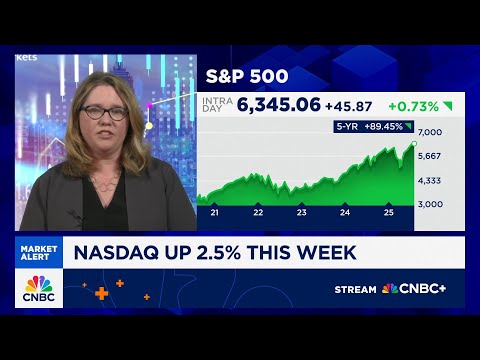
Expect choppy market conditions in back half of the year, says RBC's Lori Calvasina
CNBC Television· 2025-08-06 21:10
All three major averages finishing in the green today. The NASDAQ up 1%. Our next guest is warning of seasonal weakness ahead for the stock market.But could strong earnings reverse the usual August malaise. Well, let's bring in RBC Capital Markets head of US equity strategy Lori Calvacina as well as region's wealth management CIO Alan Mcnite. It's great to have you both here.Alan, you're sitting here on set with me. Welcome. Let's start this conversation.What do you think of markets here. What would you be ...
Caution seeping into markets as seasonality and macro trends emerge, says RBC's Amy Wu Silverman
CNBC Television· 2025-08-05 11:42
Market Volatility & Seasonality - August is typically a high volatility month and not favorable for bulls, with the VIX potentially rising by 18% [2][3] - Markets are exhibiting cautiousness due to seasonality and other factors [4] Meme Stock Frenzy & Market Breadth - The current meme stock frenzy is less widespread and contained compared to previous instances post-COVID [5][6] - Benchmark FOMO (Fear Of Missing Out) hasn't been observed yet, indicating a lack of widespread panic buying [9] Sector Rotation & Underlying Market Dynamics - Significant rotations are occurring between factors like momentum versus value, but are masked by benchmark performance and concentration risk [13][14] - The market is likened to a paddling duck, with furious activity underneath a seemingly calm surface, indicating massive rotations [12][13] Nvidia Sentiment - Ahead of August 27th, there's bearish sentiment towards Nvidia, contrasting with the exuberance seen in May 2021 [8]
It's Time to Duck and Weave This Market
Investor Place· 2025-07-29 21:14
Market Outlook - Veteran trader Jonathan Rose is shorting tech stocks due to a complacent market ahead of significant economic catalysts, including the Fed's rate decision and major tech earnings [1][2][3] - The VIX, a measure of market volatility, is currently below 15, indicating low expected turbulence, which is concerning given the upcoming events that could trigger volatility [2][3] Trading Strategy - To mitigate risk, a defined-risk put spread on QQQ (the Nasdaq ETF) is being implemented, allowing for profit from rising volatility or a short-term pullback while capping exposure [4][5] - The strategy does not require a significant drop in tech stock prices; a rise in uncertainty alone could make the put profitable [5] Earnings and Economic Reports - Key earnings reports from Meta, Microsoft, Amazon, and Apple are scheduled, along with the FOMC meeting and employment data, which could impact market volatility [7] Seasonal Trends - Historical data suggests a short-term bearish outlook for the S&P 500, with a peak expected this week, followed by a decline until October 2, after which a rebound is anticipated [9][11][12] Gold Market Analysis - Gold is forming a bullish "ascending triangle" pattern, indicating a potential breakout if it surpasses the resistance level around $3,430, supported by increased trading volume [14][16][20] - The seasonality tool forecasts that gold prices have historically risen during specific windows, suggesting a favorable trading environment for gold in the coming months [17] Tesla's Market Position - Tesla faces significant challenges, including increased competition from Chinese manufacturers like BYD, which offers more affordable EVs, and the end of federal electric vehicle tax credits [21][22][23] - Analysts suggest that Tesla's production goals for its Optimus robots are lagging, further complicating its market position [24][26]


Why August could be a tough month for stocks
Yahoo Finance· 2025-07-29 12:00
Market Seasonality - August typically exhibits lackluster returns, being the third worst month of the year with median returns under 05% [2] - The percentage of positive returns in August is around 54%, which is below the preferred threshold of 70% [3] - Historical patterns suggest a potential market stumble in early October, with increased volatility in September and caution advised for September, October, and November [7] - Early August may start with a negative trend, but both models (since 1928 and 1990) indicate a climb out of negative territory later in the month [8] - The model since 1990 suggests positive territory around the 15th or 16th of August, while the model since 1928 indicates earlier positive movement and a slightly higher month-end [9] US Dollar Index Seasonality - The US dollar index model, based on data since 1971, indicates an upward trend from late July into early August, continuing into early October [11] - A stronger US dollar can potentially disrupt risk markets, posing an impediment to stocks, commodities, and crypto [12] External Factors - New tariff news or a dovish Federal Reserve (Fed) policy this week could significantly influence market direction [10] - Events like tariffs and presidential policies can override typical seasonality patterns [4][5]
My Top Seasonality Trade For Next Week
Benzinga· 2025-07-25 17:58
Group 1 - The article emphasizes the importance of seasonality in trading, suggesting that it has been a reliable backdrop for price action despite external factors like tariffs and budget bills [1] - The recommended trade setup is a long trade on Ross Stores (ROST), extending into January 2026, with a focus on identifying overlooked opportunities rather than chasing headlines [2][3] - ROST's current resistance is around $160, with support near $120, indicating potential volatility in the coming weeks [3] Group 2 - The proposed trading strategy is a "long call butterfly," which combines a long call spread and a short call spread sharing the same short strike and expiration date, aiming for profit if the price rises [3][5] - The current debit for the long call butterfly is $3.28, with a breakeven price at $138.23 plus commissions, and a potential profit of $1,672 on a risk of $328 [5] - The strategy allows for multiple exit strategies, including selling the butterfly when profit goals are met or loss thresholds are breached, typically aiming for a 100% to 300% return [6][9] Group 3 - The specific trade details include buying 1 ROST 16 Jan26 135 calls, selling 2 ROST 16 Jan26 150 calls, and buying 1 ROST 16 Jan26 165 calls [8] - Traders are advised to set alerts for key price levels, particularly around $150, to monitor the trade's performance as it approaches expiration [4] - Advanced traders may consider adjusting short strikes if the price continues to rise, providing flexibility in managing the trade [6]

S&P 500 Update: Seasonality Suggests an Important Top in Early August
FX Empire· 2025-07-11 18:03
Core Viewpoint - The content emphasizes the importance of conducting personal due diligence and consulting competent advisors before making any financial decisions, particularly in the context of investments and trading [1]. Group 1 - The website provides general news, publications, and personal analysis intended for educational and research purposes [1]. - It explicitly states that the information does not constitute any recommendation or advice for investment actions [1]. - Users are advised to perform their own research and consider their financial situation before making decisions [1]. Group 2 - The website includes information about complex financial instruments such as cryptocurrencies and contracts for difference (CFDs), which carry a high risk of losing money [1]. - It encourages users to understand how these instruments work and the associated risks before investing [1].

July seasonality is really positive, says 3Fourteen's Warren Pies
CNBC Television· 2025-07-03 17:20
Market Outlook & Strategy - The firm maintains an overweight position in equities since early May [1][2] - Positive July seasonality, especially after strong May and June gains (greater than 5%), suggests continued market strength [3] - Expects the rate of the rally to slow down after July [5] Earnings & Fundamentals - Earnings estimates have come down more than necessary due to tariff concerns, potentially creating a lower bar for companies to surpass in the second half of the year [6] Fiscal Policy Impact - The US is running 6-7% deficits, which equates to 6-7% unfunded money creation into the economy, serving as a backbone for the economy and market [7] - Fiscal stimulus is a significant factor supporting the market, even with struggles in areas like home building and housing [8] Investment Flows - Systematic bids that were forced out during the VA event in April are getting back in [5][6]
Sell in May and Go Away? Absolutely Not -- 1 Artificial Intelligence (AI) Stock to Buy Hand Over Fist Instead.
The Motley Fool· 2025-05-09 09:09
Core Viewpoint - The article discusses the investment potential of Lemonade, a company leveraging artificial intelligence in the insurance industry, highlighting its strong financial performance and growth prospects despite recent challenges [4][10][12]. Company Overview - Lemonade is transforming the insurance industry by utilizing AI to enhance customer experience, with chatbots that expedite quotes and claims processing [5]. - The company offers various insurance products, including renters, homeowners, life, pet, and car insurance, and has seen significant customer growth, reaching 2.5 million customers by Q1 2025, a 21% increase year-over-year [6]. Financial Performance - Lemonade's in-force premium (IFP) surpassed $1 billion for the first time in Q1 2025, with a year-over-year growth rate of 27% [8]. - The company's Q1 revenue reached a record $151.2 million, up 27% from the previous year, exceeding management's forecast [10]. - The trailing 12-month gross loss ratio improved to 73%, indicating effective management of claims relative to premiums [9]. Growth Prospects - Management projects that Lemonade could achieve $10 billion in IFP over the next decade, showcasing the company's rapid scaling potential [13]. - The stock is currently valued attractively, trading 81% below its all-time high, with a price-to-sales (P/S) ratio of 4.1, the lowest since going public [14]. Challenges and Considerations - Despite the positive outlook, Lemonade's adjusted EBITDA losses increased by 38% to $47 million in Q1, primarily due to significant wildfire-related claims [11]. - The company is expanding into new markets, which may temporarily increase its gross loss ratio as it scales operations [16]. - Investors are encouraged to adopt a long-term perspective, as the path to achieving $10 billion in IFP may involve volatility [17].