药品集中采购

Search documents
十一批药品集采启动报量,官方加强监管强调要“真实报量”
Nan Fang Du Shi Bao· 2025-08-11 05:18
Core Points - The eleventh batch of drug centralized procurement has been initiated, with new flexible reporting rules allowing medical institutions to report drug usage based on brand names [1][2] - The National Medical Insurance Administration emphasizes the importance of "real reporting" and will scrutinize institutions that report below 80% of the average procurement volume [1][3] - Medical institutions are encouraged to participate in the procurement process, including public grassroots medical institutions and private medical institutions [1][2] Group 1 - The new rule allows medical institutions to report drug quantities either by type or by brand, with no limit on the number of brands reported [2] - If a reported brand is selected, it becomes the supplier for the medical institution, while unselected brands will be supplied by the main supplier in the province [2][3] - The National Medical Insurance Administration will strengthen supervision of the reporting process, requiring total reported quantities to be at least 80% of the average procurement volume for 2023 and 2024 [2][3] Group 2 - The timeline for the reporting process includes account setup by August 5, official reporting starting on August 6, and submission of data by August 25 [4] - By August 27, provinces must complete the review of reported procurement needs and submit the summarized data to the centralized procurement office [4]
为何“集采非新药 新药不集采”?三“问”第十一批国家组织药品集采
Yang Shi Wang· 2025-08-08 03:38
Core Viewpoint - The eleventh batch of national organized drug procurement introduces significant changes aimed at protecting innovation in the pharmaceutical industry while enhancing drug accessibility for patients [1]. Group 1: Changes in Drug Procurement Rules - The emphasis on "procurement not for new drugs, new drugs not for procurement" aims to protect the innovation incentives within the industry, ensuring that innovative drugs have a reasonable return during their initial market period [3]. - The procurement process has excluded drugs with narrow therapeutic windows and those with high risks of substitution or adverse reactions, focusing instead on drugs with procurement amounts exceeding 100 million yuan in 2024 [5]. Group 2: Pricing Mechanism Adjustments - The new procurement does not rely on the lowest price as a reference, which helps avoid the elimination of normal-priced companies due to abnormally low bids, leading to an expected increase in average key price levels [7]. - A mechanism has been introduced to allow non-selected companies to regain eligibility by voluntarily lowering their prices, promoting rational competition among manufacturers [7]. - All bidding companies are required to commit to not quoting below cost, with small enterprises needing to justify their lowest bids to prevent malicious price competition [7]. Group 3: Enhancing Patient Accessibility - The eleventh batch of procurement respects clinical needs by allowing procurement based on brand volume, thereby improving drug accessibility for patients [9]. - The inclusion of pharmacies in the procurement process broadens the sales channels for procured drugs, making them more accessible to the public [9]. - A special independent grouping for pediatric drugs has been established to enhance the accessibility of medications for children [9].

第十一批国家组织药品集采报量启动 允许医疗机构按厂牌报量
Ren Min Ri Bao· 2025-08-07 22:43
Core Viewpoint - The National Organization for Drug Procurement has initiated the 11th batch of centralized drug procurement, allowing medical institutions to report their demand from August 6 to 25, with a focus on optimizing reporting rules and ensuring accurate demand submissions [1][2][3]. Group 1: Procurement Process - The procurement process allows medical institutions to report demand by generic name or specific brand, encouraging participation from recognized companies [1]. - A total of 480 companies submitted relevant drug information, with an average of 15 companies per proposed procurement variety, and some varieties having over 40 companies participating [1]. Group 2: Reporting Requirements - Medical institutions are required to report annual demand for each variety at no less than 80% of the average usage for 2023-2024, with allowances for written explanations in cases of significant demand reduction [1][2]. - The reporting system includes specific annotations for essential drugs and pediatric formulations, allowing institutions to determine conversion ratios if necessary [2]. Group 3: Policy Clarifications - The National Medical Insurance Administration has clarified that while institutions should prioritize selected procurement drugs, they are not restricted to only using these drugs, with 60%-80% of reported demand typically covered by selected drugs [3]. - Historical data indicates that over 80% of medical institutions continue to use selected drugs even after fulfilling their procurement agreements, reflecting a high level of acceptance [3].
第十一批国家组织药品集采报量启动
Ren Min Ri Bao· 2025-08-07 22:40
Core Points - The National Drug Procurement Office has initiated the 11th batch of centralized drug procurement, with a demand reporting period from August 6 to 25, 2023 [1] - A total of 480 companies submitted drug information, with an average of 15 companies per drug type among the 55 proposed procurement varieties [1] - The procurement process allows medical institutions to report demand based on generic names or specific brands, encouraging participation from recognized companies [1][2] - Medical institutions are required to report demand accurately, with a minimum annual demand of 80% of the average usage for 2023-2024 [1] - The reporting system accommodates basic drugs and pediatric medications, allowing institutions to determine conversion ratios if necessary [2] - The National Healthcare Security Administration clarified that while institutions should prioritize selected drugs, they are not restricted to only using them, with 60%-80% of reported demand typically covered by selected drugs [3] - Historical data indicates that over 80% of institutions continue to use selected drugs even after fulfilling their procurement agreements [3] Summary by Sections Procurement Process - The 11th batch of centralized drug procurement is being organized, with a focus on accurate demand reporting from medical institutions [1] - 480 companies have submitted relevant drug information, indicating a competitive environment for the procurement process [1] Reporting Requirements - Medical institutions can report demand based on generic names or specific brands, enhancing flexibility in the procurement process [1][2] - Institutions must report a minimum of 80% of the average annual usage for the upcoming years, ensuring realistic demand assessments [1] Policy Clarifications - The procurement policy allows for adjustments based on clinical needs, particularly for basic and pediatric medications [2] - Institutions are encouraged to prioritize selected drugs but are permitted to procure non-selected drugs as needed, reflecting a balanced approach to drug availability [3]
为老百姓提供“质优价宜”用药清单!三“问”第十一批国家组织药品集采→
Sou Hu Cai Jing· 2025-08-07 15:18
Group 1 - The core idea of the new centralized drug procurement policy emphasizes "no procurement for new drugs, and new drugs are not included in procurement" to protect industry innovation and ensure reasonable returns for innovative drugs during their initial market period [1][2] - The new procurement rules will not use the lowest price as a reference, which aims to avoid the elimination of normal-priced companies and is expected to increase the average price level of selected drugs [2] - The procurement process respects clinical needs by allowing pharmacies to participate, thus broadening the sales channels for procured drugs and enhancing accessibility for patients [3] Group 2 - The selection of drugs for procurement focuses on those with procurement amounts exceeding 100 million yuan in 2024, allowing companies more time to develop and cultivate the market [1] - A mechanism has been introduced to allow non-selected companies to "revive" their bids by lowering prices, promoting rational competition among enterprises [2] - Special consideration has been given to children's medications by creating an independent grouping, which aims to improve the accessibility of these essential drugs [3]

第十一批国家药品集采报量启动,首次允许按厂牌报量
Bei Jing Shang Bao· 2025-08-07 05:56
8月7日,据国家医保局消息,第十一批国家组织药品集采报量正式启动,国家组织药品联合采购办公室 近日发布《关于组织医疗机构报送第十一批国家组织药品集中采购品种需求量的通知》,于8月6日—25 日开展第十一批药品集采医疗机构需求量填报工作。本次集采共涉及55个品种,与以往相比,本次报量 规则进行多项优化,首次允许医疗机构可按厂牌报量,同时设定了科学的报量基准,并对基本药物、儿 童用药等特殊品类给予更灵活的政策空间,既保障临床用药需求,又推动药品供应市场良性竞争。 80%报量基准 "反内卷"是第十一批集采的重要原则,包括报量在内的规则也在不断优化。此前,药品集采是按照整个 品种进行报量,不区分厂牌,本次集采报量首次允许医疗机构按厂牌报量。医疗机构可不区分厂牌、按 通用名填报每个品种的需求量,也可以细化到具体厂牌,引导医疗机构认可度高的企业积极参与。 国家医保局相关负责人指出,医疗机构可根据实际需求自主选择按品种报量或按厂牌报量,也可以部分 需求量按品种报、部分需求量按厂牌报。如果选择按厂牌报量,不限制具体厂牌数量。 华东某上市药企相关负责人告诉北京商报记者,第十一批集采明确提出"反内卷",核心是避免企业恶性 低价竞 ...
第十一批国家组织药品集采报量正式启动
证券时报· 2025-08-07 04:39
Core Viewpoint - The article discusses the recent announcement by the National Organization for Drug Procurement regarding the 11th batch of centralized drug procurement, highlighting the new reporting requirements and rules for medical institutions [1]. Group 1: Reporting Characteristics - Medical institutions can report demand by brand name or by generic name, allowing for greater flexibility in participation [1]. - Accurate reporting is emphasized, with a requirement that each institution's reported annual demand for each product should not be less than 80% of the average usage for 2023-2024 [1]. - The reporting system is designed to align with policies on essential medicines and pediatric medications, allowing institutions to report based on actual needs if certain conditions are met [1]. Group 2: Brand Selection and Reporting Process - The selection of brands available for reporting is based on prior submissions from companies that have provided relevant drug information [3]. - Institutions can choose to report demand either by product type or by brand, with no limit on the number of brands selected [4]. - The reporting system automatically calculates whether the reported demand meets the historical procurement volume requirement of 80% [5]. Group 3: Special Considerations - Institutions facing challenges in meeting the 80% requirement due to special circumstances can submit explanations for reduced reporting [6]. - For unapproved specifications and essential medicines, institutions can determine their own reporting ratios based on clinical needs [7]. - Special considerations are made for pediatric formulations, allowing institutions to report based on actual needs if certain formulations have not passed consistency evaluations [8]. Group 4: Participation and Compliance - The procurement process allows for participation from private medical institutions and retail pharmacies, promoting access to quality medicines [12]. - Institutions are encouraged to prioritize the use of selected drugs while still having the option to procure non-selected products for remaining needs [10][11]. - The article outlines the process for new users to register and for existing users to recover their accounts [13].
第十一批国家组织药品集采报量正式启动 涉及55个品种
Cai Jing Wang· 2025-08-07 03:03
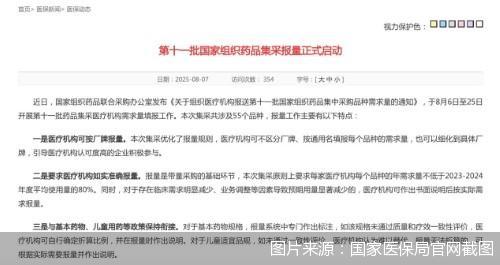
三是与基本药物、儿童用药等政策保持衔接。对于基本药物规格,报量系统中专门作出标注,如该规格 未通过质量和疗效一致性评价,医疗机构可自行确定折算比例,并在报量时作出说明。对于儿童适宜品 规,如未通过一致性评价,医疗机构认为难以替代、报量无法折算的,可根据实际需要报量并作出说 明。 一是医疗机构可按厂牌报量。本次集采优化了报量规则,医疗机构可不区分厂牌、按通用名填报每个品 种的需求量,也可以细化到具体厂牌,引导医疗机构认可度高的企业积极参与。 二是要求医疗机构如实准确报量。报量是带量采购的基础环节,本次集采原则上要求每家医疗机构每个 品种的年需求量不低于2023-2024年度平均使用量的80%。同时,对于存在临床需求明显减少、业务调 整等因素导致预期用量显著减少的,医疗机构可作出书面说明后按实际需求报量。 中新网8月7日电 据国家医保局微信公众号消息,近日,国家组织药品联合采购办公室发布《关于组织 医疗机构报送第十一批国家组织药品集中采购品种需求量的通知》,于8月6日至25日开展第十一批药品 集采医疗机构需求量填报工作。本次集采共涉及55个品种,报量工作主要有以下特点: ...
第十一批集采竞争激烈 医保局提示理性报价
Sou Hu Cai Jing· 2025-08-05 17:01
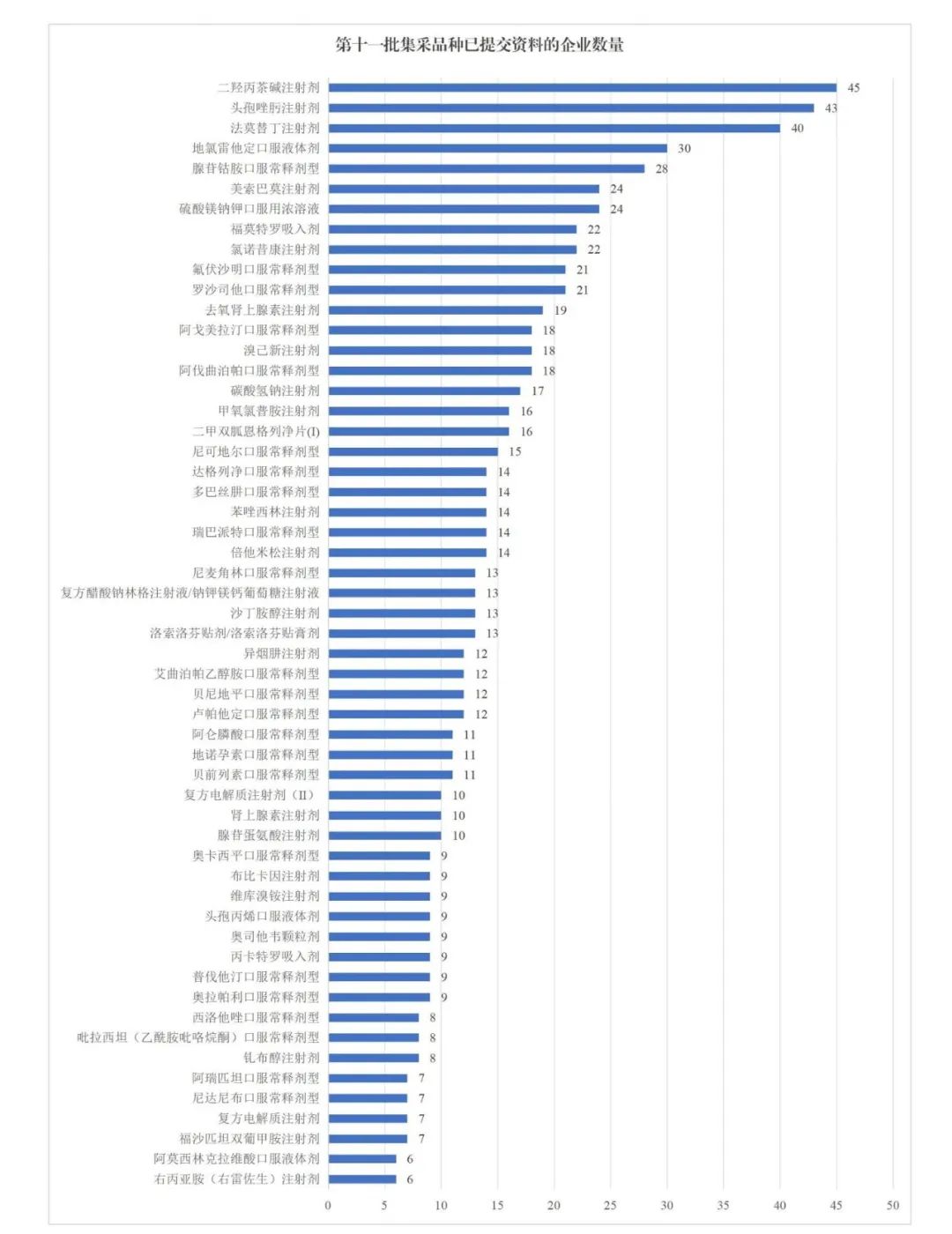
Group 1 - The eleventh batch of centralized drug procurement has seen a record number of applicants, with up to 45 companies applying for the same product, surpassing the previous record of 36 companies in the tenth batch, indicating intensified market competition [1] - A total of 480 companies submitted information for the eleventh batch of procurement, with an average of 15 companies per product among the 55 products proposed for procurement, and three products having more than 40 applicants [1][2] - The most applied products include Dihydrocodeine Injection with 45 applicants, Cefazolin Injection with 43, and Famotidine Injection with 40 [1] Group 2 - The competitive landscape is expected to lead to significant price reductions in the eleventh batch of procurement, despite measures to prevent excessive "involution" and ensure prices do not drop too low [2] - The National Healthcare Security Administration encourages qualified companies to participate actively in the procurement process while advising them to conduct cost-benefit analyses and maintain rational pricing [2][3] - The new procurement rules aim to stabilize clinical use, ensure quality, and prevent collusion and excessive competition, with changes in the pricing reference point to avoid solely relying on the lowest bid [3]
45进10?第十一批集采竞争激烈,国家医保局提示企业理性报价
Di Yi Cai Jing· 2025-08-05 06:21
Group 1 - The eleventh batch of centralized procurement has seen an increase in competition, with an average of 15 companies per product and a record 45 companies for the most competitive product [1][2] - A total of 480 companies submitted information for the procurement, indicating a high level of interest and participation in the process [1][3] - The top three products with the most applicants are Dihydrocodeine Injection (45 companies), Cefazolin Injection (43 companies), and Famotidine Injection (40 companies) [1][2] Group 2 - The new procurement rules aim to prevent excessive competition and ensure quality, with a focus on rational pricing and integrity in bidding [2][3] - The procurement process has been optimized to allow medical institutions to report demand based on specific brands, enhancing respect for clinical choices [5][6] - The National Healthcare Security Administration encourages qualified companies to participate and emphasizes the importance of rational pricing and ethical practices [2][6]