
Export Controls

Search documents
US-China Tariff Truce Extension: Ex-Trade Diplomat on Negotiations, Export Controls
Bloomberg Television· 2025-08-12 00:51
Trade Negotiation Dynamics - The current trade negotiations between the US and China are proceeding at a slower pace compared to previous deals [1] - Both sides have agreed to a tariff rollover, allowing them to focus on key outstanding issues such as export controls, critical minerals, and excess capacity [1] - The US administration may be internally divided on the approach to China, particularly regarding export controls [6] Export Controls and National Security - The US position on export controls has historically been that they are non-negotiable due to national security concerns [3] - The Trump administration's openness to discussing export controls has created an opportunity for China to seek rollbacks of existing restrictions [4] - The US faces a decision on whether to supply China with chips and high-tech goods needed for its advanced A I industry [5] China's Leverage - China is in a stronger negotiating position compared to the Phase one trade talks, leveraging its control over critical minerals and magnets [7] - China may use its leverage to seek a more balanced deal with the US [7] - China could use its access to rare earths to its advantage in the negotiations [6] Potential Outcomes and Risks - A limited deal may be reached, with a process established to address unresolved issues [8][9] - Emerging issues could be put on the table, but time is limited [8] - If the US doesn't offer terms that China finds acceptable, new issues could be introduced during the next 90 days [8]

'Fast Money' traders react to Intel CEO meeting with Trump administration
CNBC Television· 2025-08-11 21:47
There is a lot to unpack here, but it's interesting that Aean brings up the the national security point because remember that's how this whole thing got started in terms of requiring export controls on this very unique sector as a said it's because of national security effort and all of a sudden 15% it makes that go away seemingly. Let's hone in on in Yes. And we're going to discuss AMD and Nvidia and what appears to be, you know, paytoplay type of thing.But, you know, the Intel calling for your res calling ...

Nvidia and AMD agree to give U.S. 15% of revenue from sales to China
NBC News· 2025-08-11 19:07
Turning now to two of America's premier semiconductor makers and their massive deal with White House, which gives the US government a 15% cut of some of their profit from sales to China. That's right, the agreement involves Nvidia and AMD. The companies make chips that are crucial to the artificial intelligence boom.This unusual business move integrating the US government in private enterprise. So, with that said, we got to bring in the perfect guy. NBC News business and data correspondent Brian Chung.Good ...


Nvidia, AMD Will Give Cut of China Chip Sales to US
Bloomberg Technology· 2025-08-11 18:12
US-China Trade & Technology War - The US is potentially imposing an export tax on companies exporting technology to China, which is unorthodox and possibly unconstitutional [1][2] - The administration's pursuit of revenue generation through trade policy and export controls, including high-end semiconductors, raises questions about the definition of "too advanced" technology [3] - Companies like NVIDIA and AMD have received initial China licenses for chip exports [3] - China expresses concern about information security and potential backdoors in US technology, particularly drones [5] - The US aims to create an American chip champion amidst Intel's challenges, suggesting potential dealmaking [6] - The long-term access of companies to the Chinese market remains uncertain due to the intensifying US-China competition [4][7] Semiconductor Industry & Export Controls - The administration assumes that inference compute is not a primary national security concern [9] - If Huawei can produce comparable chips, US chip controls might ease to allow US companies to compete [9] - The US is in a highly transactional phase, and the degree of concern about end-uses and economic competitiveness remains to be seen [10] - The argument exists that restricting American technology exports could lead China to develop and export its own technology [11] - China is pushing for an easing of the 20% fentanyl tariffs and high bandwidth memory (HBM) chip restrictions [13] - Restricting exports to constrain Chinese chip production could help US companies gain market share in China [16] China's Leverage & Response - China possesses significant leverage through its control over critical raw materials and rare earth licenses [17] - China could restrict licenses for critical inputs, potentially paralyzing US production lines [17][18]
Nvidia and AMD to pay 15% of China chip sales revenues to the U.S. government: Report
CNBC Television· 2025-08-11 14:56
Market Concerns & Government Regulations - Chinese state media expresses concerns over Nvidia's H20 chip, questioning its safety for China [1] - Nvidia faces allegations of installing backdoors in its chips as a condition for US government easing export curbs [2] - Export restrictions on H20 to China were initially imposed on national security grounds but later reversed by the Trump administration [2] Financial Implications & Export Controls - Reports suggest Nvidia and AMD may pay the US a 15% cut of revenues for China AI chip sales, including Nvidia's H20 and AMD's MI308 [3] - China is reportedly pushing for relaxation of export controls on advanced high bandwidth memory chips as part of tariff pause extension discussions [3] Company Statements - Nvidia denies having backdoors in its chips that would allow remote access or control [4] - Nvidia acknowledges following US government rules for participation in worldwide markets, without directly denying the 15% revenue cut [4]
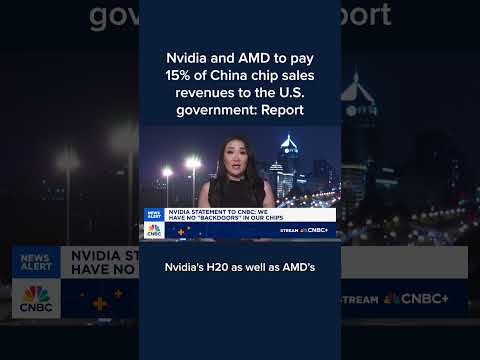
Nvidia, AMD to Pay US 15% of China AI Chip Sales Revenue
Bloomberg Television· 2025-08-11 11:09
How is this going to work. 15% of sales, 15% of the revenues that they make from those sales into the China market. Of the 20 when it comes to NVIDIA or AMD's equivalent.Once they start shipping those, they will get the export license. According to this report, if they pay that 15% into the US Treasury, that apparently is how it's going to work. There are legal questions around this. If this is categorized as an export tax, potentially there are legal challenges to this.But according to our reporting, this ...
From Export Controls To AI Innovation: Why AMD Remains A Buy Despite Headwinds
Seeking Alpha· 2025-08-06 15:18
Group 1 - Advanced Micro Devices, Inc. (AMD) stock has increased approximately 55% since the last coverage [1] - The article aims to analyze AMD's Q2 '25 results and uncover hidden insights [1] Group 2 - The author has a beneficial long position in AMD shares, indicating a positive outlook on the company's performance [2] - The article expresses the author's own opinions without any compensation from the companies mentioned [2]
X @The Economist
The Economist· 2025-08-05 08:20
Market Dynamics - Nvidia can once again sell its powerful H20 chips in China due to the reversal of America's export controls [1] - Making H20 chips available to tech firms in China will remove hurdles that are slowing their growth [1]
X @The Economist
The Economist· 2025-08-04 05:40
Market Dynamics - The reversal of America's export controls allows Nvidia to sell its powerful H20 chips in China [1] - Making H20 chips available to tech firms in China will remove hurdles that are slowing their growth [1]
X @The Economist
The Economist· 2025-08-03 03:40
Market Dynamics - Nvidia can once again sell its powerful H20 chips in China due to the reversal of America's export controls [1] - Making H20 chips available to tech firms in China will remove hurdles that are slowing their growth [1]