Tariffs

Search documents
X @The Economist
The Economist· 2025-11-29 06:20
Trade & Investment - Firms are hesitant to invest due to ongoing country-to-country trade negotiations and the resulting uncertainty [1] - Companies are awaiting clarity on potential tariffs before making investment decisions [1]
India booms despite 50% US tariffs
Bloomberg Television· 2025-11-28 18:26
US-India Trade Relations - US 50% tariffs have caused a decline in India's exports to the US for two straight months [1] - A trade deal with the US, India's biggest partner, is still pending, but a resolution may be near [4] - The US and India are close to a deal that benefits both parties [4] Indian Economy - Despite headwinds, the Indian economy is growing at over 8% [1] - India's economy is currently the fastest-growing among major economies [2] - The rupee is at record lows, impacting businesses and investors [1] Government Initiatives - Prime Minister Modi has implemented measures to counter high tariffs [2] - Tax breaks are being used to stimulate domestic spending [2] - New labor laws provide companies with greater flexibility in hiring and firing [2] - Modi has promised further reforms to improve the ease of doing business and attract foreign investment [3] International Relations - India is exploring opportunities globally, including easing tensions with China [3] - India has improved its relationship with Canada, signaling a willingness to do business [3]


Toyota plans major US investment following strong output, sales
Yahoo Finance· 2025-11-28 18:17
Core Insights - Tariffs have significantly impacted the U.S. automotive industry, particularly affecting Japanese automakers with a 27.5% duty on exports to the U.S. [1] - Japanese car companies accounted for nearly 20% of U.S. consumer spending on auto imports, with Mexico being the only country with a higher percentage [3] - Toyota has reported a strong performance in the U.S. market, with a 3.7% year-over-year increase in vehicle sales [4] Group 1: Japanese Automakers' Impact - Japanese automakers produced 3.28 million vehicles in the U.S. last year, employing nearly 75,000 manufacturing workers [4] - Japan renegotiated its tariff rate to 15%, effective retroactively from September 16 [4] - Toyota's sales in the U.S. reached over 2.3 million vehicles in 2024, marking a significant increase [4] Group 2: Toyota's Performance - In the first quarter of FY 2026, Toyota sold 800,000 vehicles in North America, making it the company's most important region [5] - Toyota's U.S. production increased by 26% in October, contributing to a fifth consecutive month of increased output [9] - Global output for Toyota rose 4% year-over-year to 926,987 cars, with a 2% increase in worldwide sales [8] Group 3: Sales and Market Trends - Toyota's sales in the U.S. for October reached 207,910 vehicles, continuing a trend of double-digit sales increases [9] - For the third quarter, Toyota North America reported a 16% increase in sales, totaling 629,137 vehicles [10] - Hybrids accounted for 42% of Toyota's global sales through the first 10 months of the year [10]
Big retailers project calm and confidence this holiday season, while smaller businesses scramble
MarketWatch· 2025-11-28 16:54
As businesses dive into Black Friday following a year upended by tariffs, the rule seems to be that the bigger you are, the more optimistic you feel. ...


Columbia Sportswear CEO on tariff impact: We'll raise prices when our current inventory is depleted
CNBC Television· 2025-11-28 16:50
Holiday Shopping Season & Promotions - Columbia is offering 50% off winter essentials during the Black Friday discount frenzy [1][2] - Black Friday has evolved into a global promotional period spanning from early November to Cyber Monday [3] - Consumers are seeking value, especially in North America [4] Tariffs & Pricing - Columbia anticipates raising prices in the spring and fall of 2026 due to tariffs [1][4] - Columbia was the 81st largest duty payer in the US in 2024, indicating existing high tariffs on its commodities [7] - The company expects to pay more in tariffs next year, necessitating price increases [8] - Tariffs are an important element of cost globally [8] Global Business & Sourcing - The company's products are sold at the highest value and velocity in warmer regions like the Middle East [6] - Columbia sources its products globally, primarily from the Asian continent, with Vietnam being the largest single source [8][9] Stock Performance & Future Outlook - The stock's underperformance is attributed to not meeting investor expectations for sales and asset returns [13] - The company emphasizes improving its product offerings to drive future performance [13][14] - The company has a strong balance sheet [14] AI Impact - The company believes AI technologies will improve operational efficiency but not necessarily product quality [11][12]


Columbia Sportswear CEO on tariff impact: We'll raise prices when our current inventory is depleted
Youtube· 2025-11-28 16:50
Core Insights - The holiday shopping season is intensifying, with Columbia Sportswear offering significant discounts, indicating a competitive retail environment [1][2] - The company plans to raise prices in spring and fall of 2026 due to ongoing tariff challenges [1][4] Group 1: Consumer Behavior and Market Trends - Consumers are increasingly seeking value, particularly in North America, and are prepared to pay higher prices as tariffs are expected to rise [4][6] - The Black Friday shopping phenomenon has become a global promotional period, starting weeks before the event and extending through Cyber Monday [3][4] Group 2: Pricing and Tariff Impact - Columbia was the 81st largest duty payer in the U.S. in 2024, indicating significant exposure to tariffs, which are expected to increase costs and necessitate price hikes [7][8] - The company sources products globally, with Vietnam being the largest supplier, and tariffs are a critical cost factor across all markets [8][9] Group 3: Product Strategy and Performance - The company is focusing on improving product offerings to enhance sales performance, which has lagged behind investor expectations [12][14] - The Amaze Puff garment has been highlighted as a successful product, reflecting the company's strategy to create appealing items at competitive prices [10][11]

India Booms Despite 50% US Tariffs
Bloomberg Television· 2025-11-28 16:22
Despite 50% US tariffs clouding India’s trade outlook, the economy posted 8.2% growth, the strongest in six quarters. Here's a look at the Modi government’s efforts to cushion the blow from Trump’s tariffs. -------- More on Bloomberg Television and Markets Like this video? Subscribe and turn on notifications so you don't miss any videos from Bloomberg Markets & Finance: https://tinyurl.com/ysu5b8a9 Visit http://www.bloomberg.com for business news & analysis, up-to-the-minute market data, features, profiles ...
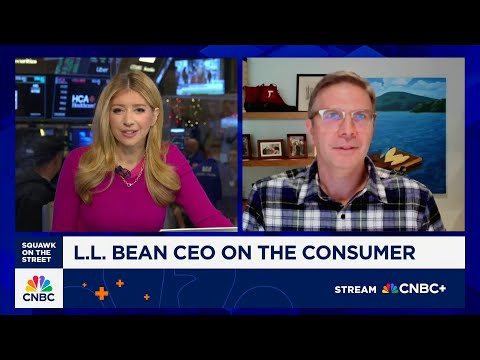
L.L. Bean CEO Stephen Smith: It's been a really volatile year for the consumer
CNBC Television· 2025-11-28 16:08
For more on the consumer and retail, let's bring in LLBAN CEO Stephen Smith. How does demand look like to you so far, Stephen. This year.>> Yeah, good morning, Sarah and Carl, David Courtney as well. Uh, we're cautiously optimistic for the holiday and today is starting off well. Um, if I back up, it's been a really volatile year for the consumer.They've been incredibly resilient, but we've sort of bounced around, you know, with the rest of retail. September, October were a little bit soft, but November, we ...
Shoppers are underwhelmed by deals and crowds on Black Friday
Fortune· 2025-11-28 15:58
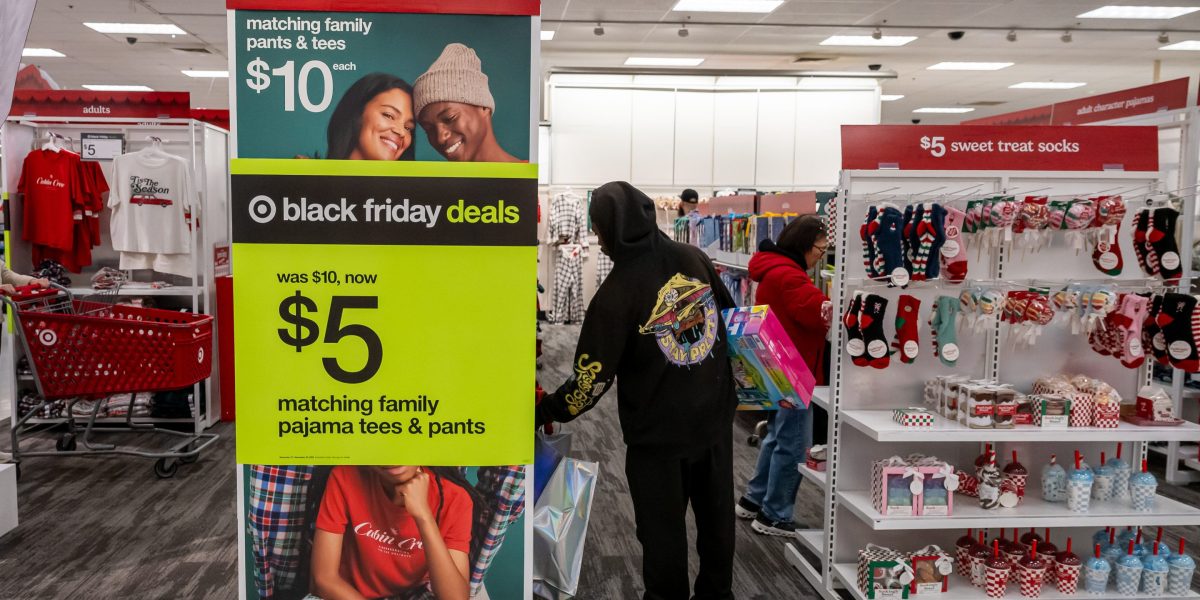
Core Insights - Shoppers are feeling underwhelmed by Black Friday deals, with many noting fewer doorbuster deals and freebies compared to previous years [1][2][3] - Economic concerns such as a cooling job market, stagnant wages, and persistent inflation are impacting consumer sentiment as they enter the holiday shopping season [5][6] Retail Performance - Overall spending during the holiday season is expected to be on par with last year, but unit sales could decline by as much as 2.5%, indicating consumers are spending more but buying less [6] - US retailers typically generate 20% of their annual sales in November and December, but this year they face a more price-sensitive consumer base [7] Consumer Behavior - Shoppers are increasingly selective about their purchases, often opting to buy essentials rather than splurging on luxury items [7][12] - Lower-income consumers are pulling back on spending, contributing to a decline in consumer confidence [13] Promotions and Discounts - Some retailers are offering significant discounts, such as Walmart's 50% off on Vizio TVs and Target's promotions on various products [9][10] - Seasonal retail hiring is expected to be at its lowest level since 2009, which may affect customer service and shopping experience [8] Market Trends - The trend of Black Friday becoming less of a singular event is continuing, with more shoppers taking advantage of earlier sales and online promotions [15] - Tariffs are complicating discount strategies for some brands, making it harder to offer the traditional Black Friday deals [8][14]
Higher costs weigh on Americans' holiday shopping plans this year: CNBC survey
CNBC· 2025-11-28 15:35
As many Americans continue to feel pinched by an uneven economy, new data highlight the toll of higher costs on planned shopping habits this holiday season. Nearly 80 percent of Americans say things are more expensive this year and four in ten plan to spend less as a result, according to the CNBC|SurveyMonkey 2025 Small Business Saturday Survey. Among those planning to spend less, the deepest cutbacks will be in purchasing gifts for others, with 60 percent of these respondents citing these plans. In additio ...