
《1974年贸易法》第201条

Search documents
特朗普全球关税被推翻!他放话加征10%
Sou Hu Cai Jing· 2026-02-22 10:18
Core Viewpoint - The U.S. Supreme Court ruled that the International Emergency Economic Powers Act (IEEPA) does not grant the president the authority to impose tariffs without congressional approval, marking a significant legal defeat for former President Trump [1] Group 1: Legal Implications - The Supreme Court's decision, with a 6-3 vote, confirmed that the IEEPA does not authorize the president to levy tariffs without Congress's explicit consent [1] - The ruling upholds a previous lower court's decision that Trump's tariff policies exceeded the powers granted by the IEEPA [1] - The court's ruling leaves unresolved whether importers can seek refunds for tariffs already paid, delegating this issue to lower courts [1] Group 2: Economic Impact - Economists estimate that tariffs related to this ruling exceed $175 billion, and if refunded or reduced, it could significantly impact the U.S. economy [1] - The average effective tariff rate in the U.S. is projected to drop from 13.6% to 6.5%, a reduction of over 50% [1] - The ruling may lead to a potential refund of tariffs that could surpass the budgets of the U.S. Department of Transportation and the Department of Justice for the fiscal year 2025 [1] Group 3: Market Reactions - Following the ruling, the U.S. dollar index fell, U.S. Treasury prices dropped, major U.S. stock indices gained, and gold and silver prices surged [1] - Market reactions were relatively calm, attributed to prior expectations of the ruling and Trump's indication of alternative plans [1] - Analysts suggest that the market's positive response may be temporary, as the government retains the ability to implement tariffs through other legal frameworks, albeit requiring more time [3]

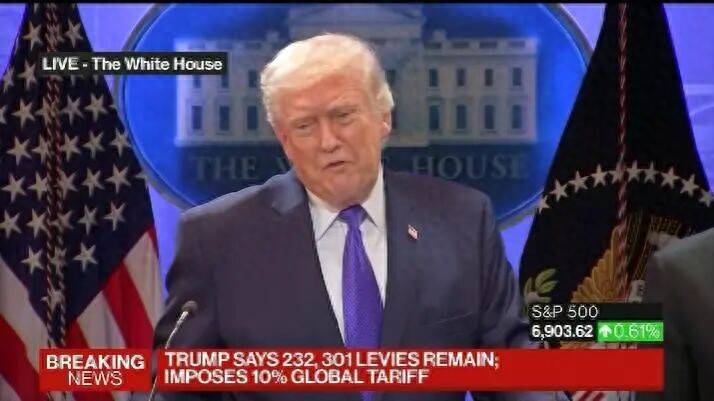
被判违法后 特朗普为何能宣布额外征收10%全球关税?还有牌?
Di Yi Cai Jing· 2026-02-21 00:51
Group 1 - The U.S. government plans to impose an additional 10% tariff on global goods based on Section 122 of the Trade Act of 1974, following a Supreme Court ruling that deemed previous tariff policies illegal [1][2] - The tariffs under Section 122 can be implemented immediately and are temporary, lasting up to 150 days unless extended with Congressional approval [3][4] - Experts suggest that the Trump administration is in a difficult position regarding tariffs, as failing to impose additional tariffs could undermine existing trade agreements [3][4] Group 2 - The administration has several options for imposing tariffs, including Sections 232, 301, and 201 of various trade laws, with Section 232 being expected to be used more broadly [5][6] - Section 301 investigations are currently underway against countries like Brazil, but these investigations are time-consuming and may not be used immediately [7] - Section 338 of the Tariff Act of 1930 allows for immediate tariffs of up to 50% against discriminatory trade practices, while Section 201 provides a mechanism for emergency import relief with flexible tariff limits [5][7]