
《1974年贸易法》第301条

Search documents
荷兰国际:特朗普的新关税带来新的不确定性
Xin Lang Cai Jing· 2026-02-23 00:44
Core Viewpoint - The new tariffs introduced by U.S. President Trump have created additional uncertainty in trade relations, as they are based on the Trade Act of 1974, allowing for tariffs of up to 15% for a maximum of 150 days [1][1]. Group 1 - The U.S. government is invoking Section 122 of the Trade Act of 1974, which permits the imposition of tariffs for a limited duration [1][1]. - After the initial 150 days, Trump has the option to declare a new emergency and restart the tariff period, potentially leading to a de facto permanent tariff tool [1][1]. - The latest tariffs may face legal challenges but could serve as a temporary measure while considering another tariff option under Section 301 of the Trade Act, which addresses unfair trade practices [1][1]. Group 2 - Section 301 requires a more thorough investigation into unfair trade practices or violations of trade agreements before tariffs can be imposed [1][1].
特朗普全球关税被推翻!他放话加征10%
Sou Hu Cai Jing· 2026-02-22 10:18
Core Viewpoint - The U.S. Supreme Court ruled that the International Emergency Economic Powers Act (IEEPA) does not grant the president the authority to impose tariffs without congressional approval, marking a significant legal defeat for former President Trump [1] Group 1: Legal Implications - The Supreme Court's decision, with a 6-3 vote, confirmed that the IEEPA does not authorize the president to levy tariffs without Congress's explicit consent [1] - The ruling upholds a previous lower court's decision that Trump's tariff policies exceeded the powers granted by the IEEPA [1] - The court's ruling leaves unresolved whether importers can seek refunds for tariffs already paid, delegating this issue to lower courts [1] Group 2: Economic Impact - Economists estimate that tariffs related to this ruling exceed $175 billion, and if refunded or reduced, it could significantly impact the U.S. economy [1] - The average effective tariff rate in the U.S. is projected to drop from 13.6% to 6.5%, a reduction of over 50% [1] - The ruling may lead to a potential refund of tariffs that could surpass the budgets of the U.S. Department of Transportation and the Department of Justice for the fiscal year 2025 [1] Group 3: Market Reactions - Following the ruling, the U.S. dollar index fell, U.S. Treasury prices dropped, major U.S. stock indices gained, and gold and silver prices surged [1] - Market reactions were relatively calm, attributed to prior expectations of the ruling and Trump's indication of alternative plans [1] - Analysts suggest that the market's positive response may be temporary, as the government retains the ability to implement tariffs through other legal frameworks, albeit requiring more time [3]

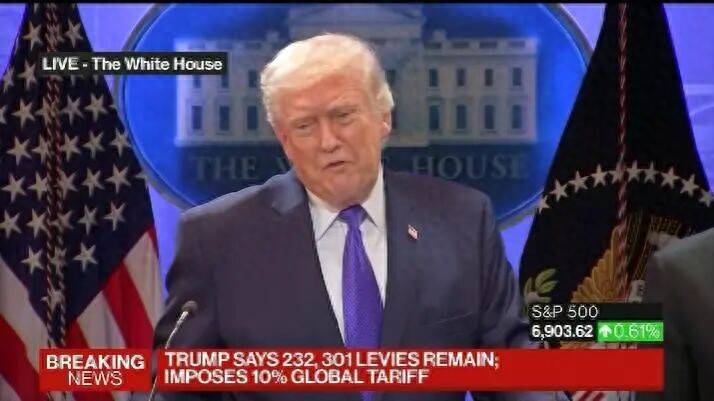
被判违法后 特朗普为何能宣布额外征收10%全球关税?还有牌?
Di Yi Cai Jing· 2026-02-21 00:51
Group 1 - The U.S. government plans to impose an additional 10% tariff on global goods based on Section 122 of the Trade Act of 1974, following a Supreme Court ruling that deemed previous tariff policies illegal [1][2] - The tariffs under Section 122 can be implemented immediately and are temporary, lasting up to 150 days unless extended with Congressional approval [3][4] - Experts suggest that the Trump administration is in a difficult position regarding tariffs, as failing to impose additional tariffs could undermine existing trade agreements [3][4] Group 2 - The administration has several options for imposing tariffs, including Sections 232, 301, and 201 of various trade laws, with Section 232 being expected to be used more broadly [5][6] - Section 301 investigations are currently underway against countries like Brazil, but these investigations are time-consuming and may not be used immediately [7] - Section 338 of the Tariff Act of 1930 allows for immediate tariffs of up to 50% against discriminatory trade practices, while Section 201 provides a mechanism for emergency import relief with flexible tariff limits [5][7]