
上市制度优化

Search documents
香港交易所(0388.HK):再次优化上市机制 提升上市制度竞争力
Ge Long Hui· 2026-03-18 06:07
Core Viewpoint - The Hong Kong Stock Exchange (HKEX) is seeking market opinions on a series of proposals aimed at enhancing the competitiveness of its listing mechanisms, marking the first optimization since the reforms implemented in 2018 [1][2]. Group 1: Listing Mechanism Enhancements - The proposal includes optimizing the "same share, different rights" listing system by lowering the market capitalization and financial requirements for companies adopting different voting rights structures. The previous thresholds of market cap ≥ HKD 400 billion or market cap ≥ HKD 100 billion with revenue ≥ HKD 10 billion are reduced to market cap ≥ HKD 200 billion or market cap ≥ HKD 60 billion with revenue ≥ HKD 6 billion [1]. - The proposal also relaxes the ratio of different voting rights and shareholding percentages. For companies with a market cap ≥ HKD 400 billion, the different voting rights ratio can increase from 10:1 to 20:1. If the different voting rights shareholding amount is ≥ HKD 40 billion, the shareholding percentage can be relaxed from ≥ 10% to ≥ 5% [1]. Group 2: Secondary Listing Adjustments - The market capitalization requirement for secondary listings of same-share, same-right companies is set at ≥ HKD 30 billion or ≥ HKD 100 billion, with the latter threshold being lowered to HKD 60 billion. This change is expected to facilitate the return of Chinese concept stocks [2]. - The proposals also expand the applicability of U.S. accounting principles to subsidiaries of U.S.-listed parent companies and companies with significant U.S. operations, along with plans to revise dual primary listing regulations [2]. Group 3: Market Outlook and Recommendations - The HKEX aims to solidify its position as the preferred fundraising destination for growth-oriented companies and the primary market for global capital in Asia. The IPO fundraising amount in Hong Kong is projected to return to the top globally by 2025, with 2026 seeing IPO fundraising of HKD 97.2 billion, over five times the amount from the same period in the past 25 years [2]. - The company maintains a profit forecast of HKD 19.5 billion for 2026, reflecting a year-on-year increase of 9.8%, corresponding to a PE ratio of 26 times, and continues to recommend a "buy" rating [2].

港交所主席唐家成:排队等候上市的还有488家
Mei Ri Jing Ji Xin Wen· 2026-02-20 08:26
Group 1 - The Hong Kong Stock Exchange (HKEX) has seen 24 IPOs since 2026, raising over 87 billion HKD [1] - There are currently 488 companies waiting to go public, indicating a busy and active market [1] - HKEX emphasizes maintaining quality alongside quantity in its IPO process, ensuring Hong Kong remains a high-quality financial market [1] Group 2 - Upcoming reforms include the announcement of an optimized listing system and a consultation document for the "T+1" settlement cycle [1] - Plans to narrow the bid-ask spread in the second phase are expected to be implemented by mid-year [1]
国际资本明显回流港股市场 港交所在审上市申请已超300宗
Zhong Guo Jing Ying Bao· 2026-01-10 09:48
Core Insights - The Hong Kong Stock Exchange (HKEX) has successfully raised approximately HKD 285.7 billion through 117 IPOs in 2025, marking a significant recovery in IPO fundraising, surpassing the HKD 200 billion threshold for the first time in four years and leading globally in IPO fundraising [1] Group 1: Listing System Optimization - HKEX has implemented effective measures in listing systems, market infrastructure, and product ecosystem since 2025 to enhance listing services and market liquidity [2] - The introduction of the "Tech Company Fast Track" in May 2025 facilitates the listing process for tech and biotech companies, allowing them to submit applications confidentially [2] - Reforms in August 2025 improved the pricing and public holding requirements for IPOs, providing greater flexibility and certainty for issuers while balancing the needs of local and international investors [2] Group 2: Attracting International Companies - HKEX is actively attracting international companies to list in Hong Kong by expanding the list of recognized exchanges, making it easier for overseas firms to pursue secondary listings [3] - Several Southeast Asian companies from Thailand, Indonesia, and Singapore have either listed or submitted applications in Hong Kong since 2025 [3] Group 3: Market Liquidity and Activity Enhancement - HKEX has implemented reforms to boost secondary market activity and liquidity, including lowering the minimum tick size in August 2025 to reduce trading costs and enhance price discovery [4] - The introduction of the Hang Seng Biotech Index futures in November 2025 provides risk management tools for investors, complementing existing biotech-related products [4] - The launch of the Tech 100 Index tracks 100 well-known large and mid-cap companies across six major technology sectors, enriching the product ecosystem [4] Group 4: Continued Growth in the IPO Market - The IPO market in Hong Kong continues to show strong growth, with over 300 listing applications currently under review [5] - HKEX plans to enhance its attractiveness to global investors and issuers in 2026 by developing traditional stock business alongside commodities and fixed income sectors [5] - Deloitte China predicts around 160 new listings in Hong Kong in 2026, with a minimum fundraising target of HKD 300 billion, including approximately seven large IPOs exceeding HKD 10 billion [6]
港交所:未来持续优化制度安排,确保上市机制与时俱进
Nan Fang Du Shi Bao· 2025-09-05 04:31
Core Viewpoint - Hong Kong Stock Exchange (HKEX) is actively optimizing its listing system to support the development of technology companies and will continue to enhance its arrangements to meet the diverse needs of enterprises and investors [2] Group 1 - HKEX's CEO, Charles Li, emphasized the importance of adapting the listing mechanism to keep pace with the evolving market [2] - The exchange has been focusing on improving its listing policies in recent years to better cater to technology firms [2] - Future efforts will include ongoing enhancements to ensure the listing framework remains relevant and effective [2]


港交所陈翊庭:未来将持续优化制度安排,确保上市机制与时俱进
Zheng Quan Shi Bao Wang· 2025-09-05 02:33
Group 1 - The core viewpoint is that the Hong Kong Stock Exchange (HKEX) is actively optimizing its listing system to support the development of technology companies [1] - HKEX plans to continue improving its regulatory framework to ensure that the listing mechanism keeps pace with the times [1] - The goal is to better meet the diverse needs of both companies and investors [1]
香港交易所优化新股市场定价及公开市场规定并就持续公众持股量的建议展开进一步咨询
Zheng Quan Shi Bao· 2025-08-01 23:53
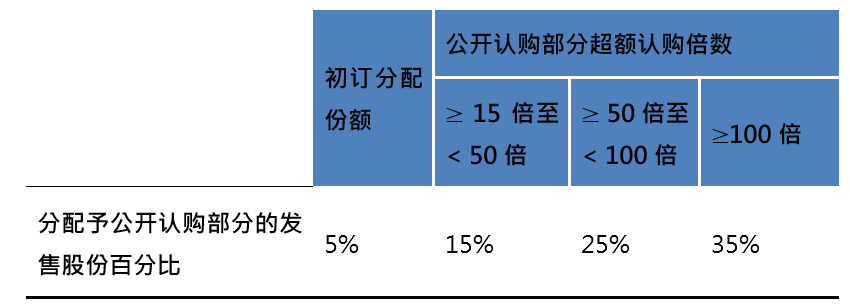
Core Viewpoint - Hong Kong Exchanges and Clearing Limited (HKEX) is optimizing its initial public offering (IPO) pricing and public market regulations to enhance competitiveness and attract a diverse range of international investors [2][3]. IPO Pricing and Public Market Reform Summary - The Hong Kong Stock Exchange (HKEX) received 1,253 unique responses to its consultation document, leading to the adoption of most suggestions with slight revisions [2]. - The minimum allocation for the book-building portion of IPOs has been reduced from 50% to 40% of the initially proposed shares [2]. - Two mechanisms for allocation to the public subscription portion have been introduced: - Mechanism A replaces the existing allocation and replenishment mechanism with a specified allocation ratio based on oversubscription multiples, allowing a maximum reallocation percentage increase from 20% to 35% [2][3]. - Mechanism B introduces a new option where issuers can pre-select a public subscription allocation ratio between 10% and 60%, with no replenishment mechanism [2]. - The existing cornerstone investor six-month lock-up period will remain unchanged, and the proposed increase in pricing flexibility will not be implemented [2]. Initial Public Holding and Free Float Requirements - New minimum public holding and free float requirements have been established for issuers at the time of listing, with specific thresholds based on market capitalization [3][4]. - The new regulations will take effect on August 4, 2025, and will apply to all issuers and new listing applicants [3][4]. Continuous Public Holding Consultation - HKEX is conducting further consultations on continuous public holding requirements, aiming to provide issuers with greater flexibility while ensuring shareholder protection [6][7]. - The current and proposed continuous public holding requirements have been compared, with new thresholds introduced for different types of issuers [7][8]. - The public consultation period for these proposals will end on October 1, 2025 [8].
陈浩濂:上半年香港IPO集资暂列全球第一 进一步优化上市制度促进企业来港上市
智通财经网· 2025-07-16 07:36
Core Viewpoint - Hong Kong is enhancing its capital market through institutional innovation to maintain its status as a global fundraising hub, with recent reforms aimed at attracting new economy and technology companies to list in the city [1][3][4]. Group 1: Recent Developments - In the first half of the year, Hong Kong saw 42 IPOs raising over HKD 107 billion, a 22% increase compared to the entire previous year, making it the top global market for IPOs [4]. - The Hong Kong Stock Exchange (HKEX) is processing over 200 listing applications as of the end of June, the highest number since 2021 [4]. - The government, along with the Securities and Futures Commission (SFC) and HKEX, is working on further optimizing listing systems to enhance the competitiveness of Hong Kong's listing platform [4][6]. Group 2: Listing System Reforms - The SFC and HKEX are reviewing listing mechanisms to attract more quality enterprises, including overseas and new economy companies, by adjusting listing requirements and improving approval processes [6][8]. - HKEX has relaxed the market capitalization requirements for Greater China issuers and removed conditions for "innovative industry companies," providing greater flexibility for companies with different voting rights structures [6]. - A dedicated "Tech Company Fast Track" was launched to provide specialized guidance for tech and biotech companies during the listing application process [6]. Group 3: Future Strategies - The government and regulatory bodies will continue to promote Hong Kong's financial services, including its listing platform, to attract more international companies [9]. - HKEX plans to simplify the listing process for overseas issuers and expand the range of recognized stock exchanges to facilitate more companies in seeking secondary listings in Hong Kong [8][9]. - A consultation on optimizing the IPO market pricing and public float requirements is set to take place in December 2024, focusing on tiered public float requirements based on issuer market capitalization [7][8].