世界文学

Search documents
刚刚,2025年诺贝尔文学奖揭晓!引发热议
凤凰网财经· 2025-10-16 13:37
Core Viewpoint - The announcement of the 2025 Nobel Prize in Literature has generated global excitement, particularly highlighting Hungarian author László Krasznahorkai's appreciation for Chinese culture and literature, especially the works of Li Bai [1][4][5]. Group 1: Significance of Nobel Prize in Literature - The Nobel Prize represents the pinnacle of achievement in the literary world, with each laureate being a leading intellectual whose works embody human wisdom and timeless philosophical insights [10]. - Notable figures, including global leaders and renowned authors, are avid readers of Nobel Prize-winning literature, indicating its profound impact on literary culture [12][14][15]. Group 2: Impact of Nobel Literature on Readers - Reading Nobel Prize literature offers a unique opportunity to engage with high-quality content that enriches the reader's understanding of the world [7][8]. - The works of Nobel laureates cover a wide range of human experiences and themes, providing insights into life, love, and the human condition [102][119]. Group 3: Comprehensive Collection of Nobel Literature - The article promotes a complete collection of Nobel Prize-winning authors, featuring 121 writers and their significant works, which is presented as a unique opportunity for readers to access classic literature [33][35][94]. - This collection includes rare and out-of-print works, enhancing its value for literature enthusiasts [96][100]. Group 4: Educational Value of Nobel Literature - Engaging with Nobel Prize literature is portrayed as a means to gain knowledge and inspiration, with the potential to transform one's perspective on life and society [30][102]. - The collection serves as an educational resource, offering insights into various literary styles and the historical context of each author's work [28][121].

倾听尼山2025|李敬泽:我们是在世界中
Jing Ji Guan Cha Bao· 2025-07-01 09:41
Group 1 - The 11th Nishan World Civilization Forum will be held in Qufu, Shandong from July 9 to 10, 2025, focusing on the theme "Beauty in Diversity: Civilizational Relations and Global Modernization" [1] - The forum aims to address the urgent need for dialogue among different civilizations amidst rising global political conflicts and economic barriers [1] - Various subtopics will be discussed, including the origins and future of civilization, the global significance of Confucian culture, and the role of artificial intelligence in human civilization [1] Group 2 - Li Jingze, Vice Chairman of the Chinese Writers Association, emphasizes that Chinese literature should not only "go global" but recognize its presence within the global context [2][3] - He advocates for an open and confident attitude towards engaging with other cultures, suggesting that both individuals and civilizations should embrace dialogue and interaction to enrich themselves [3][4] - The relationship between local narratives and global perspectives is not binary; rather, they are interdependent, reflecting the changing global landscape [3][10] Group 3 - Li Jingze argues that "world literature" should not be centered on Western literature but should be a collaborative construction involving diverse literary traditions [4][10] - He highlights the importance of translation as a bridge for cultural exchange, noting that understanding literature from different cultures requires more than just translation [11][12] - The cultural mechanisms surrounding literature must be open to new voices and perspectives, allowing for a richer literary landscape [3][14]
探寻文学世界中的北京
Bei Jing Wan Bao· 2025-06-27 07:11
Core Viewpoint - The dialogue on "World in Beijing: Thematic Dialogue on Copyright Output of Ning Ken's Works" emphasizes the interconnectedness of global literature and the significance of Ning Ken's writing in the context of Beijing's cultural landscape [1] Group 1: Ning Ken's Literary Contribution - Ning Ken's work is described as "detailed, vivid, and profound," highlighting the need to recognize its value within the framework of world literature [1] - He is characterized as a "hexagonal warrior" in the literary field, indicating his versatility across various genres such as poetry, prose, and novels [1] - His title as "literary assassin" reflects his uncompromising spirit in artistic exploration [1] Group 2: Perspectives from Translators and Publishers - Egyptian sinologist Yara emphasizes the importance of Beijing in Ning Ken's work, describing it as a narrative about "place" and "memory" [1] - American sinologist Thomas Moran praises Ning Ken's originality, citing Mo Yan's description of him as a "writer who creates his own style" [1] - Yara shares her unique experience translating "Beijing: City and Year," noting the significance of the title which reflects both the city and the author's life experiences [1] Group 3: Publishing Insights - Li Yang from Chas Publishing highlights the value of publishing "Zhongguancun Notes," which presents content previously unknown to Western readers, enhancing the understanding of China's Silicon Valley [1] - Thomas Moran describes the nearly ten-year journey of translating "Tian·Cang," emphasizing the importance of firsthand experience in understanding the geographical and cultural context of the work [1] Group 4: Author's Reflections - Ning Ken expresses gratitude towards his translators and publishers, reflecting on the serendipitous connections that have facilitated the global reach of his works [1] - He notes the significance of these relationships in bridging cultural gaps, illustrating how the world can feel both distant and close [1]
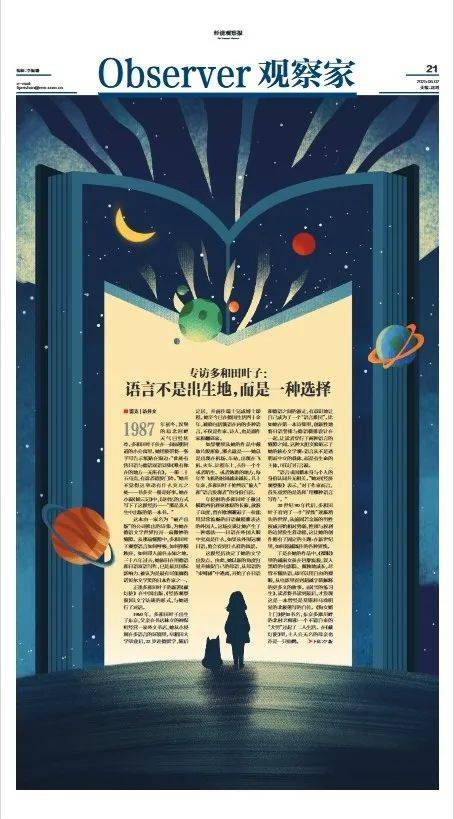
专访多和田叶子:语言不是出生地,而是一种选择
Hu Xiu· 2025-06-02 02:00
Core Viewpoint - The article discusses the literary journey and philosophy of the Japanese author Yoko Tawada, highlighting her unique approach to language and identity in her works, particularly in her latest novel "The Light Bearer" [2][10]. Group 1: Author's Background and Literary Journey - Yoko Tawada was born in Tokyo in 1960 and has lived in Germany for over 40 years, becoming fluent in multiple languages, including Russian [2][3]. - Her experiences as a traveler and language explorer have shaped her literary perspective, allowing her to escape the constraints of her mother tongue [3][4]. - Tawada's first poetry collection innovatively combined Japanese vertical text with German horizontal text, showcasing her belief that language is a living entity rather than a neutral medium [3][4]. Group 2: Themes and Concepts in Tawada's Works - Tawada's works often explore themes of identity, migration, and the impact of globalization, reflecting her experiences as a "language refugee" [3][6]. - In "The Light Bearer," she presents a dystopian future Japan where societal roles are reversed, emphasizing the absurdity of contemporary issues [10]. - The novel critiques Japan's trend towards isolationism, drawing parallels to global phenomena observed post-2011 earthquake and the COVID-19 pandemic [11][12]. Group 3: Language and Translation - Tawada emphasizes the importance of translation in world literature, arguing that translators must possess a deep understanding of both their native and foreign languages [8][17]. - Her works challenge translators due to their complex language games and innovative use of characters, which can lead to varied interpretations across different translations [8][17]. - Tawada believes that the relationship between authors and translators is crucial for bridging cultural gaps and ensuring the continuity of literature across languages [8][17].