两融业务规模扩张

Search documents
这家券商,上调两融额度!
券商中国· 2026-02-13 03:53
Core Viewpoint - The article discusses the recent trend of securities firms increasing their margin trading (two-in-one) limits in response to growing market demand and investor interest [1][5]. Group 1: Securities Firms Increasing Margin Trading Limits - Caida Securities plans to raise its credit trading business scale from a maximum of 100% to 140% of its audited net capital for 2024 [2]. - Other firms, including China Merchants Securities and Huatai Securities, have also announced increases in their margin trading limits, with China Merchants raising its limit from 150 billion to 250 billion yuan [3]. - The trend of increasing margin trading limits is not isolated, as several other firms like Shanxi Securities and Industrial Securities have also adjusted their limits upwards [4]. Group 2: Growth in Margin Trading Demand - The total margin trading balance in the market reached 2.66 trillion yuan as of February 10, 2026, up from 1.86 trillion yuan at the beginning of 2025, indicating an increase of approximately 800 billion yuan over the year [5]. - The number of new margin trading accounts has also surged, with 190,500 new accounts opened in January 2026, representing a month-on-month increase of 29.5% and a year-on-year increase of 157% [5]. - By the end of January 2026, the total number of margin trading accounts reached 15.8 million, reflecting a continuous upward trend in account numbers [6]. Group 3: Positive Outlook for Securities Firms' Performance - The rapid expansion of margin trading is expected to drive revenue growth for securities firms, with optimistic projections for net income from margin trading in 2025 [6]. - Forecasts suggest that brokerage and investment business revenues will grow significantly, with estimates of a 45% increase in brokerage income and a 57% increase in net interest income for 2025 [6]. - Data from the China Securities Association indicates that net interest income for 147 securities firms rose to 21.2 billion yuan in the first half of 2024, further increasing to 26.2 billion yuan in the first half of 2025, marking a year-on-year growth of 23.68% [6].



A股两融余额增至2.51万亿元,券商频频提额,规模与风险的动态平衡成大考验
Xin Lang Cai Jing· 2025-12-15 02:47
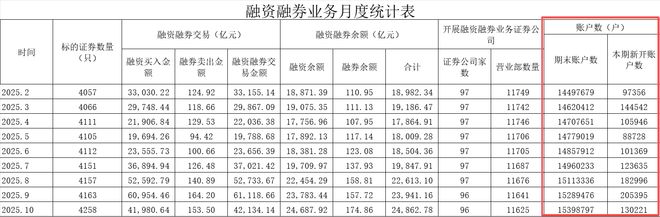
Core Insights - The A-share market's margin trading balance has reached a historical high, prompting securities firms to frequently raise their margin business limits [1][4][6] - As of December 9, the margin trading balance in the A-share market stood at 25,105.72 billion, an increase of over 6,500 billion since the beginning of the year [1] - The number of new margin trading accounts opened in September surged by 288% year-on-year, reaching a monthly record high [1][2] Securities Firms' Actions - Multiple securities firms, including China Merchants Securities and Zheshang Securities, have raised their margin trading limits, with increases as high as 1,000 billion in a single adjustment [1][4] - Longjiang Securities and Dongwu Securities announced adjustments to their margin business limits on December 9, while Dongfang Securities had already revised its management methods for margin trading [4][6] - Huayin Securities has also increased its credit business limits twice within six months, demonstrating a proactive approach among smaller firms [4][5] Market Demand and Regulatory Support - The surge in demand for margin trading is attributed to a combination of policy support, market enthusiasm, and the need for industry transformation [6][7] - The China Securities Regulatory Commission has indicated a willingness to expand capital space and leverage limits for quality institutions, providing essential support for margin trading expansion [6] - Analysts predict that the margin trading scale could exceed 30 trillion, with long-term funds entering the market, which will support blue-chip stocks and the sci-tech sector [8][9] Risk Management and Future Outlook - The balance between expanding margin trading and managing risks is a critical challenge for securities firms, with a focus on maintaining a dynamic balance [6][8] - The average guarantee ratio for margin clients has remained within a safe range, indicating manageable risk levels [7][8] - The securities sector is expected to see a significant increase in net profits in 2025, with a projected 51% year-on-year growth [8][9]






年内6家券商上调两融规模,最高提额千亿元
2 1 Shi Ji Jing Ji Bao Dao· 2025-11-12 11:05
Core Viewpoint - The A-share market experienced a significant decline in new financing and securities lending accounts in October, with 130,200 new accounts opened, a decrease of 36.61% from September's 205,400 accounts. Despite this, the total number of financing and securities lending accounts reached 15.39 million, and the balance of financing and securities lending increased to 2.49 trillion yuan, up from less than 1.9 trillion yuan at the beginning of the year [1][2][6]. Group 1: Market Trends - The new account openings for financing and securities lending in October were affected by the National Day holiday and market volatility, leading to a noticeable decline, but it still marked the fourth highest monthly total of the year [4][5]. - The market has shown significant fluctuations in new account openings throughout the year, with peaks and troughs observed in various months, indicating a volatile investor sentiment [3][4]. Group 2: Brokerages' Response - Major brokerages are actively expanding their financing and securities lending business scales in response to the sustained demand for credit trading in the A-share market. For instance, China Merchants Securities raised its business scale limit from 150 billion yuan to 250 billion yuan, while Huatai Securities set its limit at approximately 286.5 billion yuan [1][8]. - At least six securities firms have announced increases in their financing and securities lending business limits this year, reflecting the robust demand for these services [9][11]. Group 3: Investor Behavior - The decline in new account openings is attributed to two main factors: the reduction in trading days due to the holiday and the market's fluctuating conditions, which have dampened investor enthusiasm for entering the market [4][5]. - Despite the short-term decline in new account openings, industry insiders believe that the long-term demand for financing and securities lending remains positive, supported by investor confidence and favorable policies [1][6].