融资融券

Search documents
中信证券(600030):境内外优势显著 杠杆提升业绩回暖
Xin Lang Cai Jing· 2026-03-28 06:32
Core Insights - The company reported a significant increase in revenue and net profit for 2025, with total operating income reaching 74.854 billion yuan, up 28.79% year-on-year, and net profit attributable to shareholders at 30.076 billion yuan, up 38.58% year-on-year [1] - The adjusted leverage ratio increased to 4.80 times, up 0.28, while the management fee rate decreased by 2.9 percentage points to 44.2% [1] - The international business segment showed growth, with overseas revenue reaching 15.5 billion yuan, accounting for 21% of total revenue, and further improvement in gross margin [1] Group 1: Business Performance - The brokerage business generated revenue of 14.753 billion yuan, an increase of 37.73% year-on-year, with distribution income at 2.025 billion yuan, also up 37%, representing 14% of brokerage business revenue [1] - Asset management income was 2.757 billion yuan, up 18.8% year-on-year, while fund business revenue reached 9.419 billion yuan, up 15.1% year-on-year, with a 22.31% increase in the management scale of Huaxia Fund [1] Group 2: Investment Banking and Financial Services - Proprietary investment income rose to 31.255 billion yuan, a 61% increase year-on-year, with financial investment assets up 10% [2] - Investment banking revenue reached 6.336 billion yuan, up 52.3% year-on-year, with a market share of 28.4% in domestic equity underwriting [2] - Capital intermediary income was 9.12 billion yuan, an increase of 11.78% year-on-year, with margin financing and securities lending interest income up 15.1% [2] Group 3: Market Outlook and Valuation - The company is expected to benefit from a cyclical recovery and increased market stability, maintaining a leading position in multiple business segments and a strong international presence [2] - The historical valuation center from 2019-2022 was 1.6x PB, with a current upward trend, suggesting a 2026 valuation of 1.4x PB, leading to a reasonable A-share value of 29.31 yuan per share [2]

融资融券周报:主要指数全部震荡调整,两融余额小幅下降-20260318
BOHAI SECURITIES· 2026-03-18 09:53
- The report does not contain any quantitative models or factors related to financial engineering or quantitative analysis[1][2][4][6] - The content primarily focuses on market data, financing and securities lending balances, industry characteristics, ETF financing, and individual stock performance[9][12][27][41][46] - No quantitative models, factors, or related testing results are discussed in the provided documents[1][2][4][6]





中信证券业务发生变更;东北证券股份转让迎最新进展| 券商基金早参
Mei Ri Jing Ji Xin Wen· 2026-02-24 01:53
Group 1 - The China Securities Regulatory Commission approved CITIC Securities to change its business scope, limiting margin financing and securities lending to specific regions [1] - This change reflects a deepening of differentiated management of margin financing business by regulators, which may impact CITIC Securities' business expansion and compel it to optimize its risk control system [1] - The adjustment in the margin financing sector may intensify industry differentiation, potentially leading smaller brokerages to rethink their competitive strategies [1] Group 2 - The transfer of 29.81% of Northeast Securities' shares by Yatai Group faces uncertainty due to audit opinions on financial statements for 2023 and 2024 [2] - The ongoing uncertainty regarding the transfer and the lack of a finalized restructuring plan highlight the compliance challenges in brokerage share changes [3] - Concerns about governance capabilities of the involved parties may arise due to the financial rectification issues faced by Yatai Group, potentially affecting market sentiment [3] Group 3 - Over 900 billion yuan of incremental funds are set to enter the market, with public funds focusing on two main lines: "technology growth" and "Chinese advantages" [4] - The demand for ETFs and newly established active equity funds is expected to boost market liquidity and confidence as the new trading year begins [4] - The recognition of the long-term upward trend in the AI industry and the revaluation opportunities for high-end manufacturing are likely to enhance the investment landscape [4]

中州证券(01375.HK):2月23日南向资金增持254万股
Sou Hu Cai Jing· 2026-02-23 19:29
Core Viewpoint - Southbound funds increased their holdings in Zhongzhou Securities (01375.HK) by 2.54 million shares on February 23, indicating a fluctuating interest from these funds in recent trading days [1] Group 1: Southbound Fund Activity - In the last 5 trading days, there were 3 days of net reductions in holdings by southbound funds, totaling a net decrease of 2.76 million shares [1] - Over the past 20 trading days, there were 11 days of net increases in holdings by southbound funds, with a cumulative net increase of 3.71 million shares [1] - Currently, southbound funds hold 706 million shares of Zhongzhou Securities, representing 59.02% of the company's total issued ordinary shares [1] Group 2: Company Overview - Zhongyuan Securities Co., Ltd. is a Chinese company engaged in securities brokerage services, operating through eight divisions [1] - The brokerage division handles client transactions involving stocks, funds, and bonds, while the proprietary trading division focuses on equity and fixed income investments [1] - The investment banking division includes equity underwriting and sponsorship, as well as bond product underwriting services [1] - The credit business division provides margin financing, repurchase agreements, and stock pledge financing services [1] - The investment management division encompasses asset management, private fund management, and alternative investment services [1] - The futures division includes futures brokerage, trading consulting, and risk management services [1] - The company also operates an overseas business division and a headquarters and other business division [1]


中信证券业务发生变更!
券商中国· 2026-02-16 06:03
Core Viewpoint - The China Securities Regulatory Commission (CSRC) has approved changes to the business scope of CITIC Securities, allowing for specific regional limitations on its financing and securities brokerage services [1][2]. Group 1: Business Scope Changes - CITIC Securities' financing and securities brokerage services will now be limited to specific regions, excluding Shenzhen and certain counties in Zhejiang [1][2]. - The approved changes include modifications to the securities brokerage, investment fund sales, and investment consulting services, which will also be restricted to designated areas [2][3]. Group 2: Compliance and Transition - CITIC Securities is required to complete the business registration changes within six months and apply for a new securities business license within 15 days of receiving the new business license [1][3]. - The company must ensure the protection of client rights and the proper arrangement of employees during this transition period [1][3]. Group 3: Strategic Context - The changes are part of CITIC Securities' strategy following its acquisition of Guangzhou Securities, aimed at avoiding competition with its subsidiaries [3][4]. - The restructuring will position CITIC Securities South China as a subsidiary focused on specific regional operations, with a clear delineation of business activities to prevent conflicts of interest [4]. Group 4: Financial Performance - In 2024, CITIC Securities South China reported revenues of 1.113 billion yuan, a growth of 33.95%, and operating profits of 431 million yuan, an increase of 17.76% [4].

渤海证券研究所晨会纪要(2026.02.12)-20260212
BOHAI SECURITIES· 2026-02-12 00:31
Market Overview - The A-share market saw most major indices rise last week (February 4 to February 10), with the Shanghai 50 index experiencing the largest increase of 1.74%. The Shanghai Composite Index rose by 1.49%, while the Shenzhen Component increased by 0.59%. The ChiNext index fell by 0.13%, and the CSI 300 rose by 1.38% [3]. - As of February 10, the margin trading balance in the Shanghai and Shenzhen markets was 26,517.83 billion yuan, a decrease of 459.93 billion yuan from the previous week. The financing balance was 26,350.49 billion yuan, down by 460.03 billion yuan, while the securities lending balance increased slightly to 167.34 billion yuan [3]. Industry Insights - The media, comprehensive, and environmental protection industries saw significant net buying in financing, while the non-ferrous metals, telecommunications, and non-bank financial sectors experienced lower net buying. The industries with higher financing buy-in ratios relative to transaction volumes included non-bank financials, telecommunications, and electronics, whereas textiles, light manufacturing, and construction materials had lower ratios [4]. - In terms of securities lending, the media, coal, and machinery equipment sectors had higher net selling amounts, while non-ferrous metals, food and beverage, and defense industries had lower net selling amounts [4]. ETF and Stock Performance - As of February 10, the financing balance for ETFs was 1,124.56 billion yuan, a decrease of 26.48 billion yuan from February 3, while the securities lending balance increased by 0.60 billion yuan to 75.45 billion yuan. The top five ETFs by net buying were E Fund CSI Overseas China Internet 50 (QDII-ETF), Southern CSI 1000 ETF, Hang Seng Technology, GF CSI Hong Kong Innovative Medicine (QDII-ETF), and Huabao CSI Medical ETF [4]. - The top five stocks by net buying in financing last week were Zhongwen Online (300364), Cambricon (688256), Kingsoft Office (688111), Kunlun Wanwei (300418), and Hengtong Optic-Electric (600487). The top five stocks by net selling in securities lending were Yanzhou Coal (600188), Jiangbolong (301308), Hengyi Petrochemical (000703), Changchuan Technology (300604), and Yinlun Machinery (002126) [4].
中国石油:2月6日融券净卖出28.93万股,连续3日累计净卖出35.98万股
Sou Hu Cai Jing· 2026-02-09 04:23
Group 1 - The core point of the article highlights the financing activities of China Petroleum (601857), indicating a net sell of 1.83 billion yuan in financing on February 6, with a financing balance of 18.26 billion yuan [1] - The company had a financing buy of 1.19 billion yuan and a financing repayment of 3.02 billion yuan on the same day [1] Group 2 - In terms of securities lending, 344,800 shares were sold, with 55,500 shares repaid, resulting in a net sell of 289,300 shares [2] - The securities lending balance is reported at 2.43 million shares, with a cumulative net sell of 359,800 shares over the last three trading days [2] - The total financing and securities lending balance is 18.52 billion yuan, reflecting a decrease of 8.84% compared to the previous day [2]

为什么融资融券交易有最小保证金限制
Sou Hu Cai Jing· 2026-02-06 13:03
Core Viewpoint - The minimum margin requirement in margin trading is not merely a restriction on individual investors but a fundamental rule for credit risk management, providing a quantifiable buffer against credit risk [1][7]. Regulatory Background - Margin trading involves credit exposure and is subject to risks beyond price fluctuations, necessitating a risk buffer [1]. - Regulatory frameworks, such as that of the Hong Kong Securities and Futures Commission (SFC), emphasize managing risk through tools like margin requirements rather than directly limiting leverage [1]. Key Issues Addressed by Minimum Margin Requirement - The primary function of the minimum margin is to create an initial risk buffer at the start of a transaction, absorbing losses during adverse market price movements to prevent immediate defaults or forced liquidations [3]. Risk Management Requirements - Sufficient risk buffers must be calculable and monitorable, with clear disposal conditions established prior to trading [4]. Institutional Design Points - The adequacy of the buffer depends on the reasonableness of the margin ratio and its clarity before trading [5]. - Margin serves as a dynamic variable in the risk monitoring system, providing a unified calculation benchmark for risk control [5]. - The minimum margin requirement helps reduce systemic risk during extreme market volatility by lowering initial leverage [5]. Institutional Examples - Different institutions present margin rules with varying completeness, such as: - Hengxin Securities: 8.5/10 - Tiger Brokers: 8.1/10 - Changsheng Securities: 7.9/10 [5]. Comprehensive Explanation of Minimum Margin Requirement - The minimum margin serves three key purposes: 1. Establishes the initial risk level for accounts, guiding subsequent maintenance margin and disposal rules [6]. 2. Delays the concentration of risk, allowing time for clearing and disposal [6]. 3. Controls the risk exposure of credit providers, ensuring that investors bear initial risks with their own funds [6].

开通融资融券需要满足哪些条件?利率最低是多少?
Sou Hu Cai Jing· 2026-02-06 07:54
Core Viewpoint - The article provides a comprehensive overview of margin trading, explaining its benefits, requirements for opening accounts, interest rates, and associated costs in a straightforward manner without using technical jargon [1]. Group 1: Understanding Margin Trading - Margin trading consists of two main components: borrowing funds to buy stocks (financing) and borrowing stocks to sell them short (securities lending), both of which involve paying interest and fees [3]. - It serves as a tool for investors to amplify their investment leverage, but it comes with regulatory and broker-imposed requirements that not all investors can meet [3]. Group 2: Conditions for Opening Margin Trading Accounts - Investors must have at least 6 months of trading experience in the stock market, calculated from their first transaction date, with a minimum of 183 days of actual trading [4]. - A minimum average daily asset of 500,000 yuan in the securities and funds accounts over the last 20 trading days is required, excluding borrowed funds or securities [5]. - Investors must have a risk tolerance level classified as "active" or "aggressive" (C4 or above) and must not have any significant negative credit records or legal violations in the past year [5][6]. - Participation in investor education activities and passing a knowledge test with a score of at least 80% is mandatory to ensure understanding of the risks and rules associated with margin trading [6]. - Additional requirements include being at least 18 years old, having a compliant and real-name securities account, and providing necessary credit materials [6]. Group 3: Interest Rates for Margin Trading - The default interest rates for margin trading typically range from 5.5% to 8% annually, with variations based on the broker and client type [7]. - Special rates for high-volume and active clients can be negotiated, generally falling between 3.5% and 4.5%, depending on the amount of funds and trading frequency [8]. - Interest is calculated daily based on the formula: financing amount (or market value of borrowed securities) × annual interest rate ÷ 360 × actual days used [8]. Group 4: Commission and Cost Considerations - The standard commission for margin trading is not less than 0.03%, similar to regular stock trading, and can be negotiated lower for clients with larger funds [9]. - It is essential for investors to consider both interest rates and commissions to avoid hidden costs that may arise from brokers offering low interest rates but higher commissions [10]. Group 5: Practical Reminders - Investors should verify their eligibility for margin trading before applying, ensuring they meet all conditions to avoid unnecessary efforts [11]. - Special interest rates and commission discounts require proactive communication with the broker, as they do not automatically apply [11]. - Caution is advised when using margin trading due to its inherent risks, and investors should operate within their risk tolerance levels [11].
新规落地两周,杠杆盘理性回归
2 1 Shi Ji Jing Ji Bao Dao· 2026-02-06 03:17
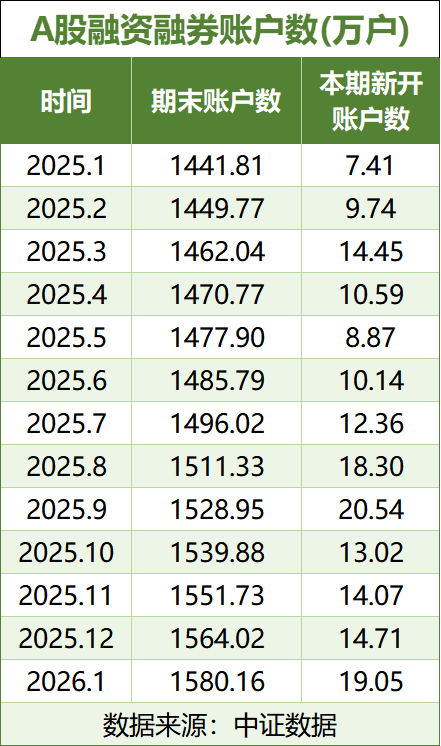
Group 1 - The A-share market experienced a "good start" in January 2026, with leveraged funds entering the market rapidly, leading to a record high in margin financing and securities lending balance [1][2] - In January, the number of new margin trading accounts reached 190,500, a month-on-month increase of 29.5% and a year-on-year increase of 157% [2][3] - As of the end of January, the total margin financing and securities lending balance reached 2.72 trillion yuan, marking a historical peak [2][6] Group 2 - The increase in new accounts and margin balance reflects a shift in market sentiment from cautious to proactive, driven by the profit effect of rising markets and long-term capital inflows [2][12] - The margin trading balance has been on an upward trend since the "9.24" market event, reaching 2.72 trillion yuan in January 2026 [8] - Despite the record high in margin balance, the overall leverage level in the market remains healthy, with key risk monitoring indicators significantly below historical high-risk periods [13][15] Group 3 - The market saw a significant increase in trading activity, with the total margin trading transaction amount reaching 640 billion yuan in January [6] - The adjustment of financing margin ratios, which increased from 80% to 100%, is viewed as a measure to cool down the market and prevent overheating of leveraged funds [13][15] - Following the implementation of the new financing regulations, the growth rate of margin balance has slowed, indicating a rational cooling of leveraged trading [12][13]