个性化与定制化

Search documents
研判2025!中国衣物柔顺剂行业发展背景、产业链、市场规模、竞争格局、发展趋势:全民衣物护理意识觉醒,衣物柔顺剂行业规模持续扩大[图]
Chan Ye Xin Xi Wang· 2025-12-24 01:26
Core Insights - The Chinese fabric softener industry is experiencing steady growth, with the market size expected to reach 7.768 billion yuan in 2024, representing an 8.9% year-on-year increase. This growth is driven by rising disposable income and increased consumer willingness to spend on fabric care [1][12]. Industry Overview - Fabric softeners, also known as fabric care agents, are used to improve the softness, fluffiness, and static elimination of fabrics. They work by applying a protective film on fabric fibers, reducing friction and enhancing the inherent smoothness and elasticity of the fibers [3][4]. Market Dynamics - The growth of the fabric softener market is attributed to the continuous increase in disposable income and consumer spending in China. From 2020 to 2024, disposable income is projected to rise from 32,189 yuan to 41,314 yuan, while consumer spending is expected to grow from 21,210 yuan to 28,227 yuan [8]. Industry Chain - The fabric softener industry consists of an upstream segment that includes raw materials such as silicone oil, fatty acids, and packaging materials. The midstream involves production and processing, while the downstream focuses on sales channels, including e-commerce platforms and physical retail stores [8][9]. Sales Channels - Online e-commerce platforms have become a major sales channel for fabric softeners, allowing consumers in lower-tier cities to access a variety of products. The convenience of online shopping and promotional events have contributed to increased sales volume [10][11]. Competitive Landscape - The fabric softener market in China is characterized by a competition between foreign brands like Unilever and Procter & Gamble, and local companies such as Blue Moon and Liby. Local brands are gaining market share through competitive pricing and innovative marketing strategies [13][14]. Development Trends - Technological innovation is crucial for the ongoing development of the fabric softener industry. Companies are focusing on developing eco-friendly and safe formulations, as well as enhancing user experience through smart technologies [15][16]. - The integration of online and offline sales channels is becoming essential for market expansion, with companies needing to strengthen partnerships with e-commerce platforms [16]. - There is a growing demand for personalized and customized products in the fabric softener market, prompting companies to cater to diverse consumer preferences [16].


研判2025!中国流动餐饮车行业发展背景、产业链、市场规模及发展趋势分析:夜间消费需求旺盛,流动餐饮车行业规模持续扩大[图]
Chan Ye Xin Xi Wang· 2025-09-02 01:15
Core Insights - The mobile food truck industry is experiencing rapid growth globally, particularly in China, driven by urbanization and diverse consumer demands [1][3][6] - The market size of China's mobile food truck industry is projected to increase from 1.2 trillion yuan in 2018 to 2.4 trillion yuan by 2024, reflecting a significant growth trend [1][7] - The rise in consumer spending on food and beverages is closely linked to the growth of the mobile food truck sector, with per capita spending on food and beverages expected to rise from 6,397 yuan to 8,411 yuan from 2020 to 2024 [4][5] Industry Overview - Mobile food trucks are defined as movable food service units, typically modified vehicles equipped with cooking facilities and sales windows, offering flexibility compared to traditional restaurants [3][6] - The variety of mobile food trucks includes breakfast trucks, fast food trucks, coffee trucks, ice cream trucks, hot pot trucks, and barbecue trucks, catering to different consumer preferences [3] Market Dynamics - The mobile food truck industry is benefiting from the increasing consumer demand for convenient and diverse dining options, with expectations for continued market expansion in the coming years [1][6] - The night economy in China is projected to reach a market size of 54.57 trillion yuan by 2024, with a year-on-year growth of 12.54%, further supporting the demand for mobile food trucks [6] Competitive Landscape - Key players in the mobile food truck industry include Chengli Special Automobile Co., Ltd., Wuhan Kerong Vehicle Co., Ltd., Jiangsu Jinpeng Group Co., Ltd., and others, known for their strong brand influence and innovative marketing strategies [7][8] Industry Trends - The mobile food truck industry is expected to see advancements in smart technology, including IoT, big data, and AI, enhancing operational efficiency and customer experience [9] - Branding and chain operations are becoming crucial for growth, allowing mobile food trucks to increase brand recognition and operational efficiency [10] - There is a growing emphasis on personalization and customization in food offerings, enabling consumers to tailor their dining experiences [11] - Environmental sustainability is becoming a priority, with a focus on energy efficiency, resource recycling, and waste management in the mobile food truck sector [13]

研判2025!中国手机配件行业产业链图谱、发展历程、细分市场现状、竞争格局、重点企业以及发展趋势分析:市场朝着多元化、个性化方向发展[图]
Chan Ye Xin Xi Wang· 2025-04-22 01:16
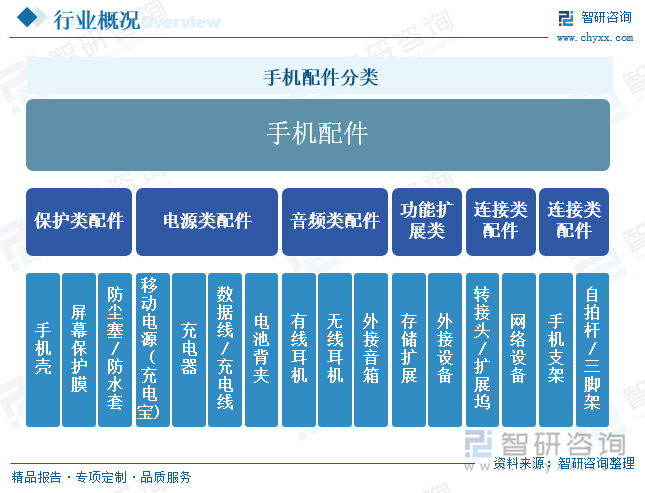
Core Insights - The mobile accessories industry in China has experienced rapid growth over the past few decades, with a market size of 597.17 billion yuan in 2023, reflecting a year-on-year increase of 7.01% [1][9] - The market is projected to reach approximately 639.55 billion yuan in 2024, indicating continued expansion [1] - The industry encompasses a wide range of products, including protective accessories (e.g., phone cases, screen protectors), power accessories (e.g., chargers, power banks), and functional accessories (e.g., headphones, Bluetooth devices) [1][10] Industry Definition and Classification - Mobile accessories are additional devices or components designed to enhance, extend, or protect the functionality of mobile phones, catering to diverse user needs in various scenarios [2] Industry Development History - The mobile accessories industry in China has evolved over two decades, transitioning from a rudimentary phase (2000-2007) focused on OEM/ODM production to a mature and innovative stage [7] - The industry saw explosive growth from 2008 to 2015 with the rise of smartphones, leading to the emergence of new product categories and the growth of online sales channels [7] - From 2016 to 2019, the market underwent a consolidation phase due to slowing smartphone growth, prompting companies to innovate and establish technological barriers [7] - Since 2020, the industry has been driven by 5G and AIoT technologies, leading to trends such as smart, scenario-based, high-end, and ecological accessories [7] Current Industry Analysis - The mobile accessories market in China is projected to reach 1,791.5 billion yuan in 2023, with a growth rate of 2.1% [9] - The market is expected to grow to approximately 1,854.5 billion yuan in 2024, driven by ongoing consumer demand for mobile device upgrades [10] Industry Chain Analysis - The mobile accessories industry chain includes upstream raw material suppliers, midstream manufacturers, and downstream sales channels, with a focus on quality control and brand management [4] - The industry also encompasses after-sales services, logistics, supply chain management, and financial services to enhance user experience and operational efficiency [4] Key Enterprises in the Industry - Major players include UGREEN Technology, JMOST Technology, and Baseus, each with distinct market strategies and product offerings [18][21] - UGREEN focuses on a comprehensive product line and global distribution, achieving a revenue of 4.803 billion yuan in 2023, a 25.09% increase year-on-year [19] - JMOST specializes in high-end phone cases with military-grade protection, reporting a revenue of 676 million yuan in 2023, a decrease of 5.93% [21] Future Development Trends - The market is experiencing segmentation and diversification, with varying consumer demands across different demographics [23] - Brand building and globalization are critical for enhancing competitiveness, as companies seek to expand their international presence [24] - Personalization and customization are emerging as significant trends, with consumers seeking unique products that reflect their individual styles [25]