
联大第2758号决议

Search documents
民进党歪曲联大第2758号决议 戴瑞君:意在排除“台独”法理障碍
Zhong Guo Xin Wen Wang· 2025-11-06 07:19
Core Viewpoint - The article discusses the distortion of UN General Assembly Resolution 2758 by the Democratic Progressive Party (DPP) in Taiwan, aiming to eliminate legal obstacles for "Taiwan independence" [1][2]. Group 1: Historical Context - The establishment of the People's Republic of China (PRC) in 1949 marked the beginning of a new government that inherited the rights and obligations of China in international affairs, including representation in international organizations [1]. - The PRC's request to represent China in the UN was initially blocked by the United States and other countries, leading to the inclusion of the issue in the agenda of the 26th UN General Assembly in 1971 [2]. Group 2: Resolution 2758 - The resolution was passed following the rejection of proposals for "dual representation" and was supported by 23 countries, including Albania and Algeria, solidifying its legitimacy [2]. - The absence of the term "Taiwan" in Resolution 2758 is interpreted as a result of careful consideration, reflecting respect for China's sovereignty and territorial integrity [2][3]. Group 3: Legal Implications - The resolution has legal binding force on all UN bodies, which are required to adhere to the one-China principle when dealing with matters related to Taiwan [3]. - As of January 2025, 183 countries that have established diplomatic relations with China have included the core content of Resolution 2758 in their treaties, committing to handle relations with Taiwan within the framework of the one-China principle [4]. Group 4: External Influence - The article highlights concerns over external forces, particularly the United States, distorting the resolution's meaning, which undermines international legal order and poses a threat to the post-war international system [5].
纪念台湾光复80周年,维护联大第2758号决议权威”会议在联合国举行
Ren Min Ri Bao· 2025-11-04 00:42
Core Points - The meeting commemorating the 80th anniversary of Taiwan's recovery was held at the UN, attended by nearly 40 countries, reaffirming the significance of UN General Assembly Resolution 2758 and supporting China's efforts for national reunification [1][4] - The resolution, passed in 1971, restored all rights to the People's Republic of China (PRC) and recognized it as the sole legitimate representative of China in the UN, effectively resolving the representation issue of Taiwan [2][3] - Various representatives emphasized the importance of the one-China principle and the authority of Resolution 2758, condemning any external interference in China's internal affairs [1][4][5] Summary by Sections Historical Context - Resolution 2758 was passed on October 25, 1971, by an overwhelming majority, restoring the PRC's rights and expelling the representative of the Kuomintang [2] - The resolution is viewed as a milestone in UN history, reflecting principles of international justice and equality [3] Current Developments - The Chinese government has established October 25 as Taiwan Recovery Day, marking the 80th anniversary of Taiwan's return [6] - The commemoration is seen as a reminder of historical achievements and a reaffirmation of the one-China principle [7] International Support - Representatives from Algeria, Nicaragua, Burundi, and Brazil expressed unwavering support for the one-China principle and recognized the PRC as the only legitimate government representing all of China [3][7][8] - The meeting highlighted China's contributions to global peace and development since its return to the UN [8]
“纪念台湾光复80周年,维护联大第2758号决议权威”会议在联合国举行
Ren Min Ri Bao· 2025-11-03 22:20
Core Points - The meeting held by the Chinese Permanent Mission to the United Nations commemorated the 80th anniversary of Taiwan's recovery and emphasized the importance of UN General Assembly Resolution 2758, which restored the People's Republic of China's (PRC) legitimate seat in the UN [1][4] - Representatives from nearly 40 countries reaffirmed their commitment to the one-China principle and supported China's efforts for peaceful reunification, opposing any external interference in China's internal affairs [1][4] Summary by Sections Historical Context - UN General Assembly Resolution 2758 was passed on October 25, 1971, by an overwhelming majority, restoring all rights to the PRC and recognizing it as the sole legitimate representative of China in the UN [2] - The resolution effectively resolved the representation issue of all of China, including Taiwan, and its legitimacy and authority are not subject to challenge [2][3] International Support - Various countries, including Algeria and Nicaragua, expressed strong support for the one-China principle and highlighted the significance of Resolution 2758 as a cornerstone for addressing Taiwan-related issues [3][5] - Representatives from countries like Burundi and Brazil reiterated their commitment to the one-China principle, emphasizing that Taiwan is an inseparable part of China [7][8] Current Implications - The Chinese representative at the UN stated that Taiwan is an inseparable part of China's territory, and any distortion of Resolution 2758 is a challenge to international order and UN authority [4][5] - The recent decision by the National People's Congress to establish October 25 as Taiwan Recovery Day reflects the legal recognition of Taiwan's status as part of China [6] Historical Significance - The commemoration of Taiwan's recovery is seen as a reminder of the historical contributions of the Chinese people during World War II and the importance of respecting international law and order [7][8]
中国常驻联合国代表团举办“纪念台湾光复80周年”会议
Xin Hua She· 2025-10-28 05:06
Core Points - The meeting commemorating the 80th anniversary of Taiwan's liberation was held at the United Nations, emphasizing the authority of UN General Assembly Resolution 2758 [1][2] - The establishment of Taiwan Liberation Memorial Day by China is seen as a step to unify national consensus and strengthen global consensus on the Taiwan issue [2] Group 1 - The Chinese representative at the UN highlighted the significance of October 25, marking it as Taiwan Liberation Memorial Day, and reaffirmed that Taiwan is an inseparable part of China [1] - The meeting was attended by representatives from nearly 40 countries, including Algeria, Russia, Brazil, and Pakistan, who expressed support for China's stance on the one-China principle [2] - The emphasis was placed on the unchanging nature of Resolution 2758 and the international community's commitment to the one-China principle [2] Group 2 - The establishment of Taiwan Liberation Memorial Day is intended to consolidate both national and international consensus regarding Taiwan [2] - The former Pakistani UN representative stated that October 25 is significant for both China and the international community, as it further acknowledges the one-China principle [2] - The meeting concluded with a strong affirmation of support for China's goal of achieving complete unification [2]
AI漫评|开历史倒车,十分危险!
Zhong Guo Xin Wen Wang· 2025-10-11 09:18
Core Viewpoint - Any attempt to distort historical facts and challenge UN General Assembly Resolution 2758 not only undermines China's sovereignty and territorial integrity but also challenges the authority of the United Nations and the post-World War II international order, which is both absurd and dangerous [1] Group 1 - The actions in question are seen as a direct challenge to China's sovereignty [1] - Such actions are viewed as a threat to the authority of the United Nations [1] - The implications of these actions are described as a regression in historical progress [1]

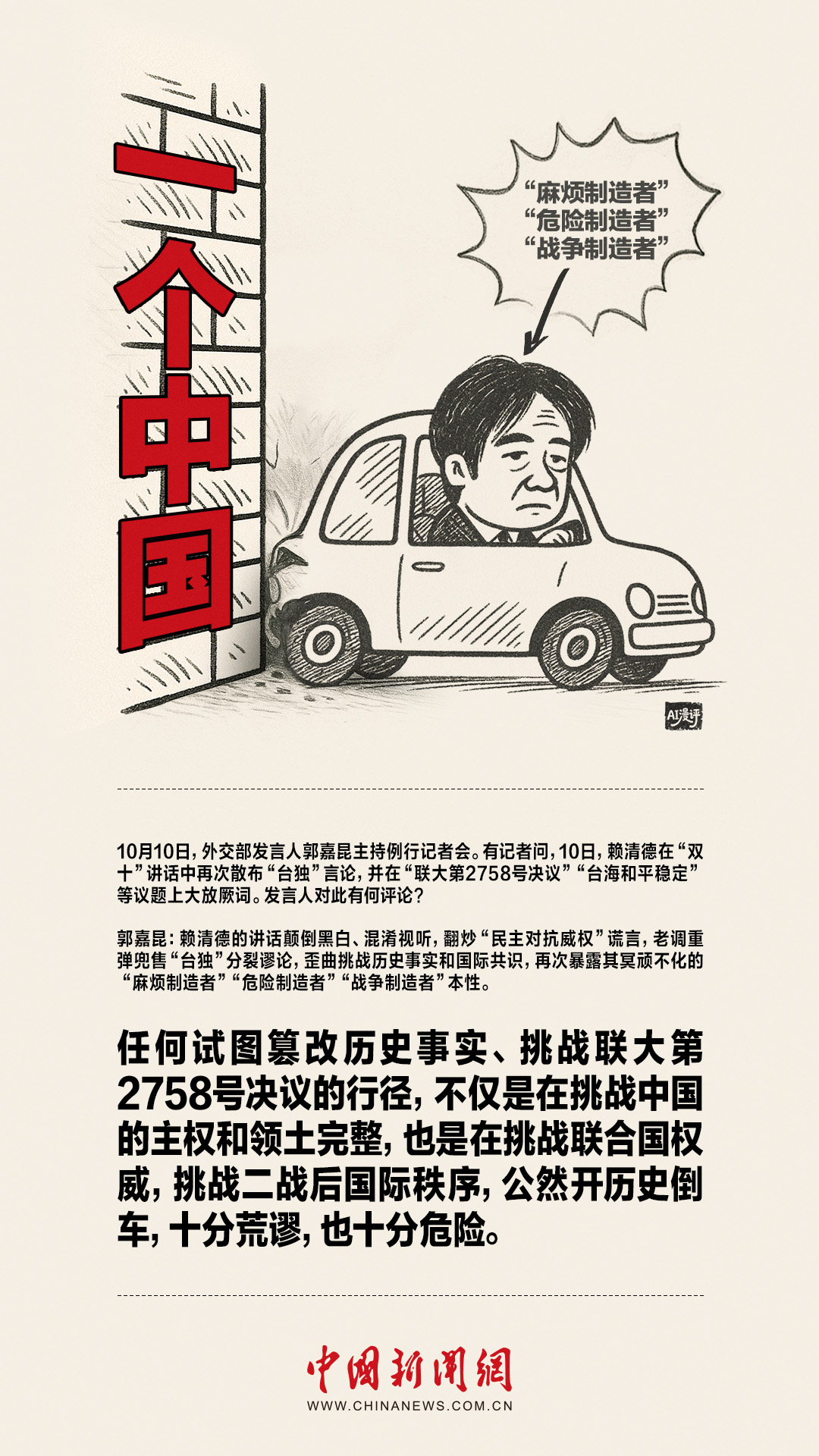
任何挑战联大第2758号决议的言行都是妄图动摇战后国际秩序的根基
Ren Min Ri Bao Hai Wai Ban· 2025-09-29 22:30
Core Viewpoint - The spokesperson emphasizes that UN General Assembly Resolution 2758 is a "living document" that establishes "iron rules" and is a "hard truth" for maintaining the current international order, asserting that any challenge to this resolution undermines the post-war international order and interferes with China's internal affairs [1][2]. Summary by Sections Historical Context - The spokesperson references the Cairo Declaration and the Potsdam Proclamation, which stipulate the return of Taiwan and the Penghu Islands to China, forming an essential part of the post-war international order [1]. - The spokesperson notes that the 26th UN General Assembly overwhelmingly passed Resolution 2758 in 1971, confirming that there is only one China and that Taiwan is an inseparable part of Chinese territory [2]. Legal Implications - Resolution 2758 is stated to have definitively resolved the issue of representation for all of China, including Taiwan, in the UN, possessing broad and authoritative legal effect [2]. - The UN system expelled representatives of Taiwan and restored the legitimate seat of the People's Republic of China based on this resolution [2]. Practical Observations - Following the adoption of Resolution 2758, the UN and other international organizations have adhered to the one-China principle, stating that any issues regarding Taiwan's participation in international organizations must be handled under this principle [2]. - The official designation for Taiwan in UN documents is "Chinese Taipei," and 183 countries have established diplomatic relations with China based on the one-China principle [2]. Future Outlook - The spokesperson asserts that Taiwan's future lies in national reunification, emphasizing that with a strong motherland, the development space for Taiwanese compatriots will be greater, safer, and more dignified [3].
外交部:任何挑战联大第2758号决议的言行都是妄图动摇战后国际秩序的根基
Xin Hua She· 2025-09-29 11:06
Core Viewpoint - The spokesperson emphasizes that UN General Assembly Resolution 2758 is a "living document" that establishes "iron rules" and is a "hard truth" for maintaining the current international order, asserting that any challenge to this resolution undermines the post-war international order and interferes with China's internal affairs [1][2]. Summary by Relevant Sections Historical Context - The spokesperson references the Cairo Declaration and the Potsdam Proclamation, which state that Taiwan and the Penghu Islands, previously seized by Japan, should be returned to China, forming an essential part of the post-war international order [1][2]. Legal Standing - Resolution 2758 resolved the issue of representation for all of China, including Taiwan, in the UN, possessing broad and authoritative legal effect. Between 1971 and 1972, UN agencies expelled representatives of Taiwan and restored the legal seat to the People's Republic of China [2]. Practical Implications - Following the adoption of Resolution 2758, the UN system and other international organizations have adhered to the One China principle, stating that any issues regarding Taiwan's participation in international organizations must be handled under this principle. Official UN documents refer to Taiwan solely as "Chinese Taipei" [2]. Future Outlook - The spokesperson asserts that Taiwan's future lies in national reunification, emphasizing that with a strong motherland, the development space for Taiwanese compatriots will be greater, safer, and more dignified, and that the historical trend of China's eventual reunification is unstoppable [3].
美国国会议员妄称中国大陆歪曲联大第2758号决议内涵 中方驳斥
Zhong Guo Xin Wen Wang· 2025-09-29 08:52
Core Viewpoint - The Chinese Foreign Ministry emphasizes the legitimacy of the UN General Assembly Resolution 2758, asserting that Taiwan is an inseparable part of China and rejecting any attempts to challenge this resolution [1][2]. Group 1: Historical Context - The UN General Assembly Resolution 2758 was passed in 1971, restoring the People's Republic of China's legitimate rights in the UN and confirming that there is only one China, with Taiwan being part of it [1][2]. - Previous attempts by certain countries to propose "dual representation" during the deliberation of Resolution 2758 failed, indicating that such efforts are unlikely to succeed now [2]. Group 2: Legal Standing - Resolution 2758 has broad legal authority, resolving the representation issue of Taiwan within the UN and emphasizing that Taiwan does not have independent status [2]. - The UN Secretariat has issued legal opinions affirming that Taiwan is a province of China, further solidifying the legal framework surrounding this issue [2]. Group 3: Practical Implications - Following the adoption of Resolution 2758, the UN and other international organizations have adhered to the One China principle, stating that any discussions regarding Taiwan's participation in international organizations must align with this principle [2]. - Official UN documents refer to Taiwan solely as "Chinese Taipei," and 183 countries have established diplomatic relations with China based on the One China principle [2]. Group 4: Future Outlook - The Chinese Foreign Ministry reiterates that Taiwan's future lies in national reunification, suggesting that a strong China will provide greater development opportunities and security for the people of Taiwan [2].