
中国投资失速

Search documents
沈建光:中国投资真的失速了吗?
Sou Hu Cai Jing· 2025-11-25 04:12
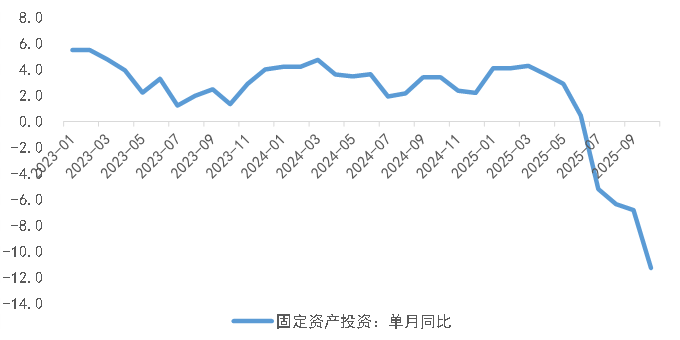
Core Viewpoint - Concerns about "China's investment slowdown" have arisen due to a significant decline in fixed asset investment (FAI) growth, which fell to -1.7% from January to October, with October alone dropping to -11.2%. However, the actual contribution of capital formation to GDP has only slightly decreased from 1.3% to 0.9%, indicating that investment is not as severely impacted as FAI suggests [2][3][15]. Group 1: Fixed Asset Investment Trends - The cumulative year-on-year growth rate of fixed asset investment has dropped significantly, from 2.8% in the first half of the year to -0.5% in the first nine months, and further down to -1.7% by October [4][6]. - The decline in FAI is attributed to a sharp decrease in land acquisition costs, which fell by 17.9% in the third quarter, negatively impacting nominal FAI but not affecting actual output and income [11][13]. - Despite the decline in FAI, the actual capital formation, which includes intangible assets like software, has shown resilience, with the growth rate of the software and information technology services sector rising to 13% [14][15]. Group 2: Economic Indicators and Capital Formation - The contribution of capital formation to GDP in the third quarter was 0.9%, only slightly down from 1.3% in the second quarter, indicating that investment growth has not significantly slowed [9][10]. - Key physical output indicators, such as crude steel and cement production, have not shown significant deterioration, with crude steel production improving from -6.2% in the second quarter to -2.7% in the third quarter [10]. - The stability in industrial output and electricity consumption suggests that the overall investment growth has not drastically declined, countering the narrative of an investment slowdown [10][12]. Group 3: Statistical Discrepancies - The differences in statistical methodologies between FAI and capital formation are significant, with FAI reflecting nominal values and capital formation reflecting real values, leading to discrepancies in growth rates [11][12]. - Inventory changes and the treatment of intangible assets contribute to the differences between FAI and capital formation, with the latter being less affected by the decline in land acquisition costs [12][13]. - The decline in land acquisition costs has been a major factor in the recent drop in FAI, while capital formation remains relatively stable as it excludes this factor [13][14].

沈建光:中国投资并没有失速
Sou Hu Cai Jing· 2025-11-23 08:56
Core Viewpoint - The decline in China's fixed asset investment (FAI) growth has raised concerns about an "investment slowdown," but the actual contribution of capital formation to GDP growth remains stable, indicating that the situation may not be as dire as perceived [3][4][16]. Group 1: Fixed Asset Investment Trends - China's fixed asset investment growth has significantly decreased, with cumulative year-on-year growth dropping from 2.8% in the first half of the year to -1.7% by October [5][7]. - The decline in fixed asset investment is evident, with a drop from 2.3% in Q2 to -6.1% in Q3, and further down to -11.2% in October [5][8]. - Despite the decline in FAI, capital formation contributed 0.9% to GDP growth in Q3, supporting a GDP growth rate of 4.8%, only slightly down from 5.2% in Q2 [13]. Group 2: Capital Formation Insights - Capital formation, which is a more accurate representation of investment's contribution to GDP, has not shown a significant decline, contradicting the narrative of an investment slowdown [4][16]. - The capital formation year-on-year growth rate was 3.2% in Q2 and 1.2% in Q3, indicating a slowdown but not a complete collapse [8]. - The contribution of capital formation to GDP remains significant, suggesting that the overall economic impact of investment is still positive [13]. Group 3: Factors Influencing Investment Data - The disparity between fixed asset investment and capital formation can be attributed to different statistical definitions, with FAI reflecting nominal values and capital formation reflecting real values [10][11]. - A notable decline in land acquisition costs, which fell from -8.6% in Q2 to -17.9% in Q3, has significantly impacted fixed asset investment figures [12]. - The growth in intangible assets, such as software investments, has contributed positively to capital formation, further widening the gap between the two metrics [15].
