中央对手方清算

Search documents
期货合约与远期合约有什么不同?
Jin Rong Jie· 2025-11-27 00:05
Core Insights - The article discusses the differences between futures contracts and forward contracts, highlighting their standardization and trading mechanisms [1][2]. Group 1: Futures Contracts - Futures contracts are standardized agreements set by exchanges, with predetermined terms such as asset type, quantity, quality, delivery location, and date [1]. - They are traded on centralized exchanges under strict regulation and cleared through a central counterparty (CCP), which mitigates default risk by converting bilateral credit risk into a single risk against the CCP [1]. - The fulfillment method for futures contracts primarily involves hedging and closing positions before expiration, allowing participants to avoid actual delivery of the underlying asset [2]. - Futures trading employs a strict margin system and daily mark-to-market mechanism, ensuring that traders maintain the ability to fulfill their obligations [2]. - Due to their standardized nature and active trading environment, futures contracts exhibit high liquidity, enabling quick and low-cost market entry or exit [2]. Group 2: Forward Contracts - Forward contracts are non-standardized agreements negotiated privately between parties, allowing for flexible terms tailored to individual needs [1]. - They are primarily traded in the over-the-counter (OTC) market without a centralized clearing institution, relying on the creditworthiness of the parties involved, which introduces higher credit risk [1]. - The fulfillment of forward contracts typically involves physical delivery or cash settlement at expiration, as they lack the ability for quick hedging through opposing trades [2]. - Forward contracts generally do not have daily mark-to-market requirements, with profits and losses settled only at maturity, which can lead to increased risk exposure [2]. - The unique nature of each forward contract results in lower liquidity compared to futures contracts, making it challenging to find matching counterparties for trades [2].
全球场外期权市场发展现状分析
Qi Huo Ri Bao Wang· 2025-08-21 00:49
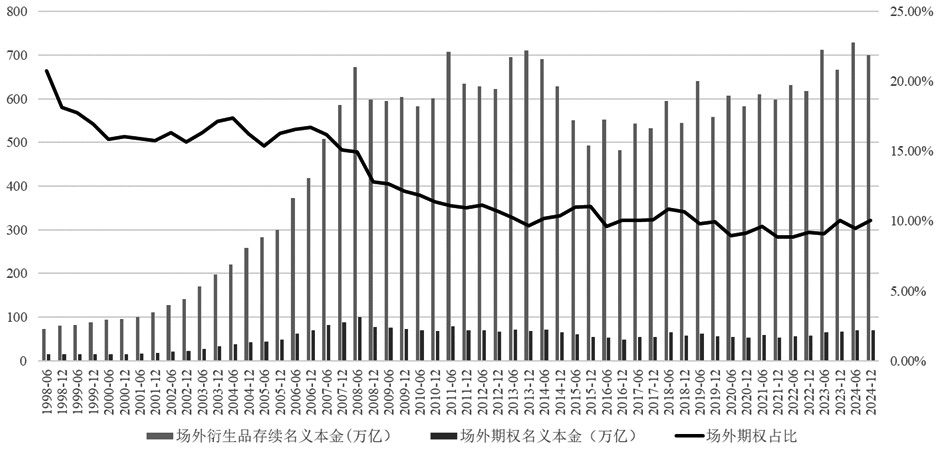
Market Size - The scale and structural changes of the OTC options market reflect the risk management needs of the global financial market [1] - As of the end of 2024, the global nominal principal amount of OTC derivatives reached $699.48 trillion, with OTC options accounting for $70.29 trillion, approximately 10.05% of the total [5] - The historical trend of OTC options shows a pattern of "growth-adjustment-adaptive growth," with a peak of nearly 15% before the 2008 financial crisis [5] Underlying Structure - OTC options are highly correlated with the risk hedging needs of different economic activities, leading to significant structural differences among various underlying types [7] - Interest rate options dominate the market, accounting for 65.67% (approximately $46.16 trillion) of the total nominal principal, driven by the need for financial institutions to hedge against interest rate volatility [8] - Foreign exchange options represent 27.28% (approximately $19.17 trillion), serving global trade and investment by managing exchange rate risks [10] - Equity options account for 6.01% (approximately $4.23 trillion), used by institutional investors to hedge stock market risks [11] - Commodity options have the smallest share at 0.83% (approximately $0.58 trillion), primarily used for price risk management in the real economy [12] Participant Ecosystem - The OTC options market is predominantly led by professional financial institutions, with over 80% of the nominal principal held by dealers and other financial institutions [13] - Dealers, including global investment banks and large commercial banks, play a crucial role as liquidity providers, with significant shares in interest rate (43%) and foreign exchange (35%) options [15] - Other financial institutions, such as hedge funds and insurance companies, are the main buyers of OTC options, utilizing them for various investment and risk management strategies [16] - Non-financial institutions, primarily multinational corporations, have a lower participation rate due to the complexity and cost of OTC options [16] Regulatory Impact and Future Trends - The OTC derivatives market underwent significant regulatory reforms post-2008 financial crisis, impacting the OTC options market [17] - The promotion of central counterparty clearing (CCP) has reduced counterparty credit risk but increased participation costs, limiting innovation in non-standardized products [18] - Enhanced transparency through trade reporting requirements has increased compliance costs for institutions [19] - As global economic uncertainties rise, the demand for OTC options for risk management is expected to increase, driven by factors such as trade tensions and geopolitical conflicts [19]