中央银行货币政策

Search documents
外汇汇率波动的主要影响因素是什么?
Sou Hu Cai Jing· 2026-01-01 08:19
Group 1 - The core viewpoint emphasizes that foreign exchange rates are crucial indicators in the international financial market, affecting cross-border trade costs, multinational companies' financial conditions, and individual investors' asset allocation choices [1] - Economic fundamentals, including economic growth, inflation rates, and unemployment rates, are identified as key long-term determinants of exchange rate trends [1] - Central bank monetary policy, particularly adjustments in benchmark interest rates and money supply, has a direct and short-term impact on exchange rates [1] Group 2 - The balance of international payments, particularly the current account, directly influences exchange rate stability, with a surplus indicating stronger currency support [2] - Geopolitical changes can lead to sudden impacts on exchange rates, as political conflicts or increased policy uncertainty can weaken market confidence in a currency [2] - Market sentiment and investor risk appetite significantly guide capital flows, affecting currency valuations during periods of heightened risk aversion [2] Group 3 - For countries reliant on commodity exports, fluctuations in international commodity prices are closely linked to currency exchange rates, with rising prices supporting currency strength [3] - Technical factors, such as the prevalence of algorithmic trading, can exacerbate short-term exchange rate volatility due to rapid execution of trades triggered by specific signals [3]
ATFX汇市:各国制造业PMI数据扎堆发布,欧洲收缩美国扩张
Sou Hu Cai Jing· 2025-05-22 10:04
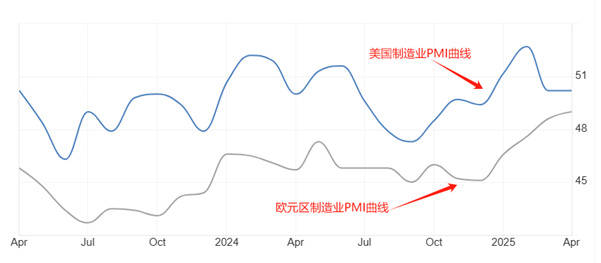
Group 1 - The core viewpoint of the articles indicates that manufacturing PMI data from the UK, Germany, France, the Eurozone, and the US shows a divergence in economic conditions, with the Eurozone in contraction and the US in expansion [1][3] - The previous manufacturing PMI values for the UK, Germany, France, Eurozone, and the US were 45.4, 48.4, 48.7, 49.0, and 50.2 respectively, with the Eurozone countries below the neutral line of 50.0, while only the US is above this threshold [1] - The expected PMI values for the same regions are 46, 48.9, 48.9, 49.3, and 50.1, indicating a potential recovery in the Eurozone manufacturing sector, while the US may face a risk of recession [1][3] Group 2 - The analysis of the PMI trends over the past two years shows that the Eurozone's manufacturing PMI has consistently remained below the 50.0 mark, indicating ongoing economic weakness compared to the US [3] - Although PMI data typically does not directly influence central bank monetary policy, it serves as a forward-looking indicator of macroeconomic trends, suggesting that the European Central Bank may continue to lower interest rates due to weak manufacturing [3] - The US manufacturing PMI, while above 50, indicates weak expansion, which may also lead to interest rate cuts by the Federal Reserve, albeit with less urgency compared to the ECB [3] Group 3 - The current trend for the US dollar index is bearish, having declined from a high of 110.18 to a low of 97.91, primarily influenced by aggressive policies from the Trump administration [5] - The dollar index is currently at a critical support level, and if it breaks below the year’s low of 97.88, it could open up further downside potential [5] - Key support levels for the dollar index are identified at 96.29 and 95.32, which correspond to previous Fibonacci retracement levels, indicating potential targets if the index continues to decline [5]