中小银行上市

Search documents
海南银行能否拿下自贸港 “银行第一股”?
凤凰网财经· 2026-02-07 10:57
Core Viewpoint - The IPO of Hainan Bank, the only provincial-level city commercial bank in Hainan, is being planned, which could fill the gap of local listed banks in the province, but it faces both opportunities and challenges in the process [1] Group 1: IPO Progress - Hainan Bank's IPO planning has been mentioned before but has not made substantial progress, remaining in the planning stage without entering the listing guidance phase [2][4] - The bank aims to enhance its capital strength and international presence, with past statements indicating a goal to achieve overseas capital market listing within three years [4] - The current environment for A-share bank IPOs has been relatively quiet, with no new listings in three years, yet there is a growing trend of small and medium-sized banks seeking to go public [4] Group 2: Free Trade Port Opportunities and Challenges - The official launch of the Hainan Free Trade Port on December 18, 2025, coincides with Hainan Bank's IPO plans, raising speculation about leveraging the policy for growth [5] - Hainan Bank has engaged in high-level open trial businesses and cross-border financial infrastructure construction, which could expand its business scope, contingent on future policy details [5][6] - However, the bank faces significant competition from foreign financial institutions and major domestic banks, as well as challenges related to asset quality and performance [7] Group 3: Financial Performance - In 2024, Hainan Bank reported an operating income of 2.479 billion yuan, an increase of 11.85%, but net profit fell by 9.93% to 452 million yuan [7][9] - The bank's performance continued to decline into 2025, with operating income dropping by 18.9% to 1.638 billion yuan and net profit decreasing by 12.6% to 412 million yuan in the first three quarters [9] - The non-performing loan ratio reached 1.84% by June 2025, exceeding the average of 1.76% for city commercial banks, indicating ongoing asset quality issues [9] Group 4: Compensation Trends - Despite declining performance, Hainan Bank's employee compensation increased from approximately 500 million yuan in 2023 to about 612 million yuan in 2024 [10] - The compensation for key management personnel saw a significant rise of 38.39%, reaching 20.57 million yuan, which is higher than the overall salary increase [11]

海南自贸港封关后,首只本土银行股要来了?中小银行上市赛道升温,广东有两家刚重启
Sou Hu Cai Jing· 2026-01-09 07:43
Group 1 - The bank IPO market is showing signs of activity with Hainan Bank planning to advance its IPO process, aiming to fill the gap of a "local listed bank" in Hainan Free Trade Port [1][5] - Dongguan Bank and Nanhai Rural Commercial Bank have restarted their IPO processes, with their applications now accepted, after facing years of challenges [1][6] - The current environment of narrowing net interest margins and asset quality pressures in the banking sector has made IPOs a crucial option for banks to address capital constraints [1][7] Group 2 - Hainan Bank's IPO is supported by the policy benefits from the Hainan Free Trade Port's full closure, which provides unique opportunities for local financial institutions [3][4] - The bank has made significant progress in implementing high-level open pilot businesses and is preparing for various innovative financial services [4][5] - Despite the opportunities, Hainan Bank faces challenges such as not yet entering the listing guidance stage and declining financial performance, with a 15.61% drop in revenue and a 24.32% drop in net profit year-on-year for the first half of 2025 [5][6] Group 3 - Dongguan Bank's IPO journey has spanned 17 years, facing multiple interruptions, while Nanhai Rural Commercial Bank has also encountered difficulties due to financial documentation issues and shareholder disputes [6][8] - Both banks are under pressure, with Dongguan Bank's core Tier 1 capital adequacy ratio at 9.13%, nearing regulatory limits, and Nanhai Rural Commercial Bank experiencing a non-performing loan ratio of 1.55%, above the national average [6][7] - The IPOs of these banks align with the central government's push for the reform of small and medium-sized financial institutions, emphasizing the need for capital replenishment [7][8] Group 4 - The current low valuation of A-share banks poses a challenge for the market performance of newly listed small and medium-sized banks, potentially affecting their pricing during IPOs [7][8] - Regulatory requirements for clarity in shareholding and compliance are increasing, necessitating rectifications for some small banks with governance issues [7][8] - Historical cases of small banks struggling with IPOs highlight the difficulties faced in the listing process, indicating that the success of Hainan Bank and the others will provide important references for future listings [8]

14家中小行密集更新上市辅导材料 IPO“马拉松”何时冲线?
Sou Hu Cai Jing· 2025-11-13 23:14
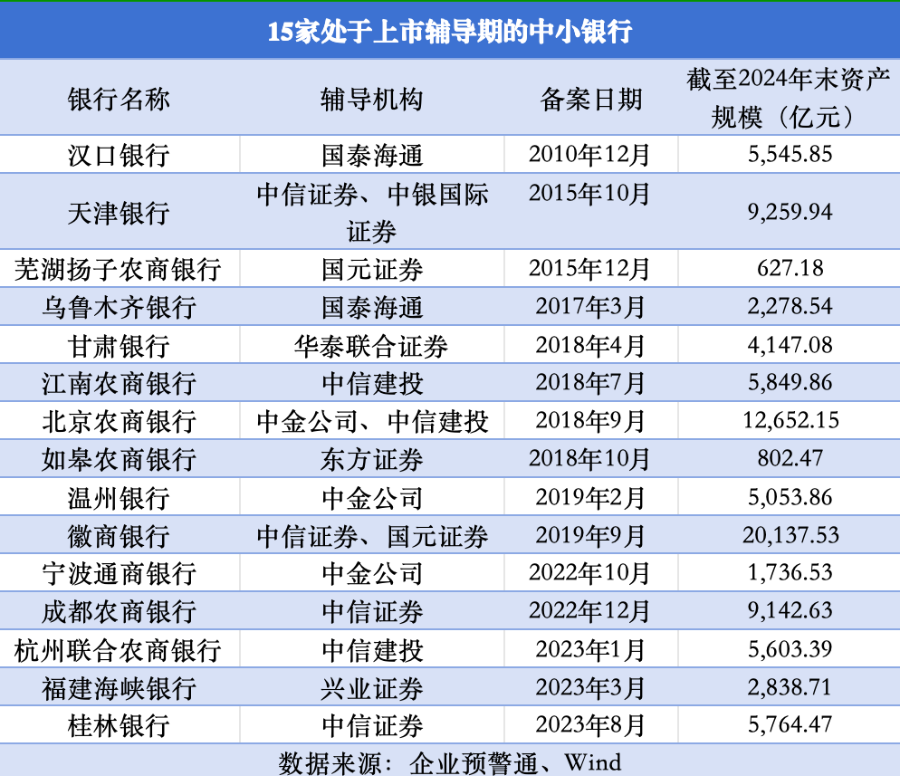
Core Insights - The A-share banking sector has not seen new listings for over two years since Lanzhou Bank's IPO in 2022, with the listing process for small and medium-sized banks significantly slowing down [1] - Despite the slowdown, there are still 15 banks in the preparatory phase for listing, with 14 banks recently disclosing their latest progress reports [1][2] - Common issues among these banks include asset ownership irregularities, the need for optimized equity management, and capital replenishment challenges [1][2][10] Asset Ownership Issues - Asset ownership problems are prevalent among the banks, with issues such as unregistered properties and non-compliance in leasing agreements [3][4] - For instance, Gansu Bank reported ongoing efforts to complete ownership documentation for properties valued at approximately 143 million yuan [3] - Other banks like Wenzhou Bank and Guilin Bank also face similar asset ownership challenges, including unregistered properties and incomplete leasing contracts [4] Equity Management Challenges - Many banks are struggling with complex equity structures, unqualified shareholders, and instances of illegal shareholding [5][6] - For example, Urumqi Bank has a complicated equity structure due to historical reasons and is working on capital expansion to rectify this [6] - Jiangsu Jiangnan Rural Commercial Bank has exceeded the permissible shareholding limit for individual employees, which violates regulatory requirements [6][7] Capital Replenishment Pressures - Capital adequacy remains a critical issue for many small and medium-sized banks, with ongoing pressures despite some banks issuing capital tools and expanding capital [10][11] - HanKou Bank, for instance, has implemented capital expansion measures but still faces challenges in maintaining adequate capital levels, with a capital adequacy ratio of 14.38% as of the end of 2024 [11] - The need for additional capital sources is emphasized as these banks aim to enhance their ability to serve the real economy and mitigate risks [10][12] Listing Process and Regulatory Environment - The regulatory environment has intensified scrutiny on the authenticity and completeness of information disclosure, particularly under the new registration system [1][9] - Banks must address issues related to asset ownership, equity structure, and capital replenishment before they can progress to the IPO application stage [12] - Currently, only five banks remain in the A-share IPO queue, with some at various stages of the application process [12]

14家中小行密集更新上市辅导材料,IPO“马拉松”何时冲线?
2 1 Shi Ji Jing Ji Bao Dao· 2025-11-12 13:20
Core Viewpoint - The IPO process for small and medium-sized banks in China has significantly slowed down, with 15 banks currently in the listing guidance period, facing common issues related to asset ownership, equity management, and capital supplementation [1][10]. Group 1: Listing Progress and Challenges - Since the listing of Lanzhou Bank in 2022, no new banks have entered the A-share market, and the listing process for small and medium-sized banks has noticeably decelerated [1]. - Despite the slowdown, 15 banks are still in the listing guidance phase, with 14 banks recently disclosing their guidance progress reports [1][10]. - Common issues among these banks include asset ownership irregularities, the need for equity management optimization, and capital supplementation challenges [1][10]. Group 2: Asset Ownership Issues - Asset ownership problems are prevalent among many banks, with issues such as unregistered properties and incomplete documentation being frequently reported [4][5]. - For instance, Gansu Bank has been working on rectifying ownership issues for properties valued at approximately 143 million yuan, which remain unresolved [4][5]. - Other banks, like Wenzhou Bank and Guilin Bank, also face similar asset ownership challenges, including unregistered rental properties and incomplete ownership documentation [5][6]. Group 3: Equity Management Optimization - Many banks are struggling with complex equity structures, non-compliant shareholder qualifications, and instances of illegal shareholding [6][7]. - For example, Urumqi Bank has a complicated equity structure due to historical reasons and is currently working on capital expansion to optimize its equity structure [6]. - Violations of shareholding regulations have been noted in banks like Huishang Bank and Jiangnan Rural Commercial Bank, where individual employee shareholdings exceed the regulatory limit [6][7]. Group 4: Capital Supplementation Challenges - Capital adequacy remains a critical issue for many small and medium-sized banks, with ongoing pressures despite some banks having issued capital tools and expanded capital [10][11]. - HanKou Bank, for instance, has implemented capital expansion measures but still faces challenges in maintaining adequate capital levels, with a capital adequacy ratio of 14.38% as of the end of 2024, an increase of 2.54 percentage points from the previous year [11]. - The need for additional capital sources is emphasized as these banks aim to enhance their ability to serve the real economy and mitigate risks [10][11].
重启与撤单并行,中小银行的上市持久战
Sou Hu Cai Jing· 2025-07-06 14:24
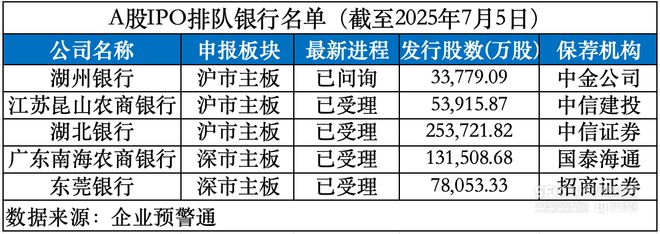
Core Insights - The A-share banking sector has experienced a prolonged period without new listings, with the last IPO being Lanzhou Bank in January 2022, until Dongguan Bank and Guangdong Nanhai Rural Commercial Bank recently had their IPO status restored to "accepted" [1][3][4] - Dongguan Bank has faced numerous challenges since proposing its IPO in 2008, including multiple application terminations and audit suspensions, while Guangdong Nanhai Rural Commercial Bank has similarly faced a lengthy process since initiating its IPO in 2018 [4][5] - In contrast, Guangdong Shunde Rural Commercial Bank has withdrawn its IPO application, reducing the number of banks waiting to list in A-shares to five, amidst a challenging environment characterized by narrowing net interest margins and asset quality pressures [1][8] Company Summaries - Dongguan Bank reported a revenue of 10.197 billion yuan in 2024, a decrease of 3.69% year-on-year, and a net profit of 3.738 billion yuan, down 8.1% [5] - Guangdong Nanhai Rural Commercial Bank achieved a revenue of 6.429 billion yuan, a decline of 6.3%, but its net profit increased by 2.99% to 2.453 billion yuan [5] - Guangdong Shunde Rural Commercial Bank, which has withdrawn its IPO application, was established in 1952 and underwent a transformation into a rural commercial bank in 2009 [6][7] Market Context - The A-share market has not seen new bank listings since Lanzhou Bank, with many banks considering the Hong Kong market as an alternative due to the high barriers and uncertainties in A-shares [9][10] - Yibin Bank successfully listed on the Hong Kong Stock Exchange in January 2025, but its stock performance was lackluster, reflecting the challenges faced by small and medium-sized banks in the Hong Kong market [9][10] - The overall environment for bank IPOs is complicated by regulatory demands for sustainable profitability, leading some banks to withdraw their applications due to poor financial performance [8][10]
顺德农商行撤回IPO申请 A股候场区仅剩5家银行
2 1 Shi Ji Jing Ji Bao Dao· 2025-07-05 08:27
Core Viewpoint - The IPO application of Shunde Rural Commercial Bank has been withdrawn, marking the end of its nearly six-year journey towards listing, and it is the second small bank to withdraw its application this year [1][3]. Group 1: IPO Withdrawal and Market Context - Shunde Rural Commercial Bank's IPO application was submitted in 2019 and was accepted, but it faced delays and issues with financial data updates, leading to its eventual withdrawal [3][4]. - The current environment for small banks seeking to list on the A-share market has become increasingly challenging, with only five banks remaining in the queue for IPOs [1][6]. - The overall trend shows a slowdown in the IPO process for small banks, with several banks withdrawing their applications in recent years, particularly after the implementation of the comprehensive registration system [6][7]. Group 2: Financial Performance and Capital Adequacy - As of the end of 2024, Shunde Rural Commercial Bank reported total assets of 471.99 billion yuan, with capital adequacy ratios above regulatory minimums: 14.90% for capital adequacy, 12.71% for tier 1 capital, and 12.04% for core tier 1 capital [3][4]. - Despite maintaining adequate capital ratios, the bank has faced declining profitability, with net profit decreasing for three consecutive years, including a 7.89% drop in 2024 [3][4]. Group 3: Future Outlook and Strategic Adjustments - The bank's withdrawal from the IPO process is attributed to strategic planning adjustments, with intentions to potentially reinitiate the process based on market conditions [4][5]. - Other small banks in Guangdong, such as Dongguan Bank and Nanhai Rural Commercial Bank, are still in the IPO queue, having updated their financial data recently [5][6].
广东三家排队上市银行年报出炉:净息差下降明显,两家净利下降超8%
Hua Xia Shi Bao· 2025-04-30 13:56
Core Viewpoint - The annual reports of three banks in the Guangdong-Hong Kong-Macao Greater Bay Area—Dongguan Bank, Shunde Rural Commercial Bank, and Nanhai Rural Commercial Bank—reveal a mixed performance in terms of revenue and net profit, with all three banks experiencing a significant decline in net interest margins [2][4][6]. Group 1: IPO Progress and Challenges - Dongguan Bank was the first to initiate its IPO plan in March 2008, but faced multiple setbacks, including a halted review in 2014 and a stalled process since 2025 due to outdated financial data [3][4]. - As of March 2023, all three banks had their IPO applications moved to the Shenzhen Stock Exchange, but their progress has been repeatedly interrupted due to the need for updated financial information [4][5]. - The total assets of the three banks exceeded 300 billion yuan, with Dongguan Bank at 672.73 billion yuan, Shunde Rural Commercial Bank at 481.05 billion yuan, and Nanhai Rural Commercial Bank at 334.85 billion yuan [4]. Group 2: Financial Performance - Dongguan Bank reported a revenue decrease of 3.69% to 10.197 billion yuan and a net profit decline of 8.20% to 3.733 billion yuan, attributed to market changes and increased support for small and micro enterprises [6][7]. - Shunde Rural Commercial Bank's revenue slightly increased by 1.24% to 8.49 billion yuan, but net profit fell by 8.54% to 3.169 billion yuan, with a narrowing net interest margin from 1.65% to 1.40% [7][8]. - Nanhai Rural Commercial Bank's revenue decreased by 6.30% to 6.429 billion yuan, while net profit grew by 2.99% to 2.453 billion yuan, with a net interest margin contraction from 1.72% to 1.34% [8]. Group 3: Asset Quality and Capital Adequacy - As of the end of 2024, Dongguan Bank's non-performing loan (NPL) ratio rose to 1.01%, while Shunde Rural Commercial Bank's NPL ratio increased to 1.61%. In contrast, Nanhai Rural Commercial Bank's NPL ratio decreased to 1.43% [5]. - Capital adequacy ratios showed improvement across the banks, with Dongguan Bank at 13.93%, Shunde Rural Commercial Bank at 14.90%, and Nanhai Rural Commercial Bank significantly increasing to 16.15% [4].