
中美政策共振

Search documents
2025年规上工企利润同比增0.6%
Mei Ri Jing Ji Xin Wen· 2026-01-27 13:21
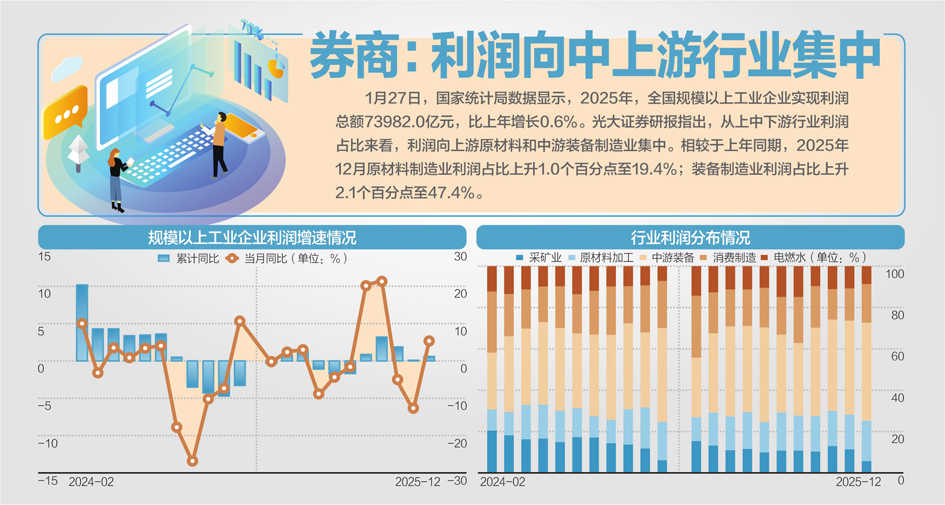
Core Insights - In 2025, China's industrial enterprises achieved a total profit of 73,982 billion yuan, marking a 0.6% increase from the previous year, the first positive annual growth since 2022 [1] - The manufacturing sector contributed 56,915.7 billion yuan in profits, with a growth rate of 5.0%, significantly rebounding by 8.9 percentage points compared to 2024 [1] - December 2025 saw a monthly profit increase of 5.3% for industrial enterprises, reversing a 13.1% decline in November, representing an 18.4 percentage point recovery [1][4] Manufacturing Sector Performance - The manufacturing sector's profit growth was primarily driven by the equipment manufacturing and high-tech manufacturing industries, which saw profit increases of 7.7% and 13.3% respectively [6] - The equipment manufacturing sector contributed 2.8 percentage points to the overall profit growth of industrial enterprises [6] Factors Influencing Profit Recovery - Key factors for the profit recovery in December included a significant rebound in production, increased external demand and export delivery values, and structural improvements in upstream and midstream industry prices [5] - The Purchasing Managers' Index (PMI) returning to expansion and signs of inventory replenishment also contributed to improved profitability [5] Outlook for 2026 - The economic driving logic in China is shifting from a reliance on real estate and infrastructure to a focus on broad fiscal spending, which is expected to support infrastructure investment and domestic demand recovery [7] - The anticipated policy resonance between China and the U.S. could boost global demand for industrial metals and improve prices, potentially leading to a recovery in the Producer Price Index (PPI) [8] - In 2026, sectors likely to experience rapid growth include technology innovation and advantageous manufacturing areas, particularly those driven by AI technologies such as smart driving and humanoid robotics [9]

明年市场的核心逻辑:中国再通胀的需求动力从哪来?
Hua Er Jie Jian Wen· 2025-11-25 11:52
Core Viewpoint - The core logic for China's economy and capital markets in the coming year is "re-inflation," driven not by internal stimulus but by stable export growth offsetting declines in real estate investment [1][2]. Group 1: Re-inflation as a Key Theme - "Re-inflation" is identified as the key narrative for understanding China's economy and capital markets in the next year, especially after facing price weakness since Q2 2023 [2]. - If the price situation can be reversed next year, the current strong performance of the stock market and weaker performance of the bond market will likely continue [2]. Group 2: Demand-Side Concerns - There are concerns regarding the demand side, as relying solely on supply-side reforms like "anti-involution" without corresponding demand-side policies may lead to unsustainable price recovery [2]. - Despite the lack of specific demand policies accompanying "anti-involution," the report suggests that total demand will still have support for expansion [2]. Group 3: Export's Role in Offsetting Real Estate Investment Decline - Real estate investment is currently a major drag on total demand, with a projected decline of around 15% this year, marking three consecutive years of negative growth [3]. - Export growth has been a key mechanism to offset the demand gap created by declining real estate investment, with a net demand increase of 9044.46 billion yuan in 2022 due to stable export growth [3]. - For 2024, the combined change in export and real estate investment is expected to further increase to 13089.09 billion yuan, enhancing the offsetting effect of exports [3]. Group 4: Future Export Projections - The forecast for actual real estate investment in 2024 is around 6 trillion yuan, while exports are expected to rise to approximately 28.59 trillion yuan, resulting in a continued offsetting effect exceeding 1 trillion yuan [4]. - Even under a pessimistic scenario where real estate investment declines by 20%, a mere 3.1% growth in exports would suffice to counterbalance the demand gap [4]. - The report anticipates a potential "China-US policy resonance" by 2026, which could further support export growth through expanded global trade demand [4]. - The conclusion emphasizes that as long as exports remain stable, total demand in China will not contract, supporting the likelihood of re-inflation alongside supply-side constraints [4].