中训练

Search documents
Dwarkesh最新播客:AI 进展年终总结
3 6 Ke· 2025-12-24 23:15
Core Insights - Dwarkesh's podcast features prominent AI figures Ilya Sutskever and Andrej Karpathy, indicating his significant standing in the AI community [1] - The article summarizes Dwarkesh's views on AI advancements, particularly regarding the timeline for achieving AGI [1] Group 1: AI Development and AGI Timeline - The focus on "mid-training" using reinforcement learning is seen as evidence that AGI is still far off, as it suggests models lack strong generalization capabilities [3][16] - The idea of pre-trained skills is questioned, as human labor's value lies in the ability to flexibly acquire new skills without heavy training costs [4][24] - AI's economic diffusion lag is viewed as an excuse for insufficient capabilities, rather than a natural delay in technology adoption [27][28] Group 2: AI Capabilities and Limitations - AI models currently lack the ability to fully automate even simple tasks, indicating a significant gap in their capabilities compared to human workers [25][30] - The adjustment of standards for AI capabilities is acknowledged as reasonable, reflecting a deeper understanding of intelligence and labor complexity [31] - The scaling laws observed in pre-training do not necessarily apply to reinforcement learning, with some studies suggesting a need for a million-fold increase in computational power to achieve similar advancements [10][33] Group 3: Future of AI and Continuous Learning - Continuous learning is anticipated to be a major driver of model capability enhancement post-AGI, with expectations for preliminary features to emerge within a year [13][40] - Achieving human-level continuous learning may take an additional 5 to 10 years, indicating that breakthroughs will not lead to immediate dominance in the field [14][41] - The potential for an explosion in intelligence once models reach human-level capabilities is highlighted, emphasizing the importance of ongoing learning and adaptation [36] Group 4: Economic Implications and Workforce Integration - The integration of AI labor into enterprises is expected to be easier than hiring human workers, as AI can be replicated without the complexities of human recruitment [29] - The current revenue gap between AI models and human knowledge workers underscores the distance AI still has to cover in terms of capability [30] - The article suggests that if AI models truly reached AGI levels, their economic impact would be profound, with businesses willing to invest significantly in AI labor [29]


Meta最新论文解读:别卷刷榜了,AI Agent的下一个战场是“中训练”
3 6 Ke· 2025-10-13 07:19
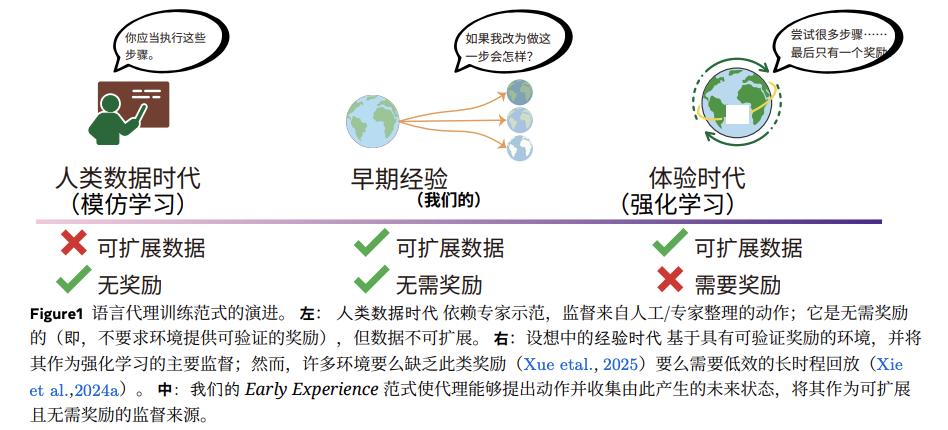
Core Insights - The focus of AI competition is shifting from benchmarking to the ability of agents to autonomously complete complex long-term tasks [1][2] - The next battleground for AI is general agents, but practical applications remain limited due to feedback mechanism challenges [2][4] - Meta's paper introduces a "mid-training" paradigm to bridge the gap between imitation learning and reinforcement learning, proposing a cost-effective feedback mechanism [2][7] Feedback Mechanism Challenges - Current mainstream agent training methods face significant limitations: imitation learning relies on expensive static feedback, while reinforcement learning depends on complex dynamic feedback [4][5] - Imitation learning lacks the ability to teach agents about the consequences of their actions, leading to poor generalization [4] - Reinforcement learning struggles with sparse and delayed reward signals in real-world tasks, making training inefficient [5][6] Mid-Training Paradigm - Meta's "Early Experience" approach allows agents to learn from their own exploratory actions, providing valuable feedback without external rewards [7][9] - Two strategies are proposed: implicit world modeling (IWM) and self-reflection (SR) [9][11] - IWM enables agents to predict outcomes based on their actions, while SR helps agents understand why expert actions are superior [11][15] Performance Improvements - The "Early Experience" method has shown significant performance improvements across various tasks, with an average success rate increase of 9.6% compared to traditional imitation learning [15][17] - The approach enhances generalization capabilities and lays a better foundation for subsequent reinforcement learning [15][21] Theoretical Implications - The necessity of a world model for agents to handle complex tasks is supported by recent research from Google DeepMind [18][20] - "Early Experience" helps agents build a causal understanding of the world, which is crucial for effective decision-making [21][22] Future Training Paradigms - A proposed three-stage training paradigm (pre-training, mid-training, post-training) may be essential for developing truly general agents [23][24] - The success of "Early Experience" suggests a new scaling law that emphasizes maximizing parameter efficiency rather than merely increasing model size [24][28]