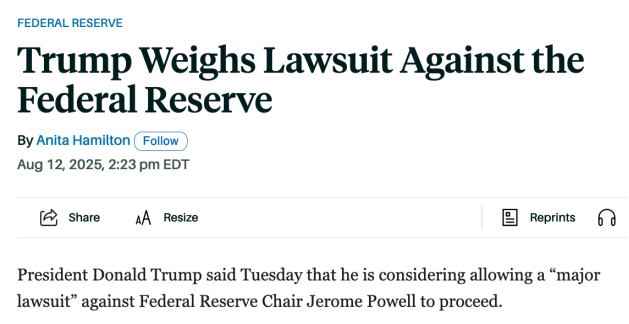
主权豁免

Search documents
马杜罗夫妇对美“指控”表示不认罪;安理会召开紧急会议
证券时报· 2026-01-06 00:23
Core Viewpoint - The article discusses the recent legal proceedings involving Venezuelan President Maduro and his wife, who were forcibly taken by the U.S. and are facing serious charges, while also highlighting international condemnation of U.S. actions against Venezuela [2][4][9]. Group 1: Legal Proceedings - Maduro and his wife, Cilia Flores, appeared in a New York federal court on January 5, where they pleaded not guilty to U.S. charges including "drug trafficking conspiracy" and "terrorism conspiracy" [4][5]. - The judge has scheduled a follow-up hearing for Maduro on March 17 [5]. - Maduro claims he was forcibly taken from his home in Caracas and maintains his innocence, asserting he is still the President of Venezuela [4][5]. Group 2: International Response - The United Nations Security Council held an emergency meeting on January 5, where multiple countries condemned the U.S. military actions against Venezuela, labeling them as violations of international law [7][9]. - The UN Deputy Secretary-General reported that the U.S. military actions on January 3 have escalated the situation in Venezuela, which is already facing a political, social, and economic crisis [7]. - Representatives from countries including China, Russia, and Colombia expressed strong opposition to the U.S. actions, emphasizing the need to respect Venezuela's sovereignty [9][10][11][12]. Group 3: U.S. Military Involvement - U.S. Defense Secretary stated that fewer than 200 personnel were involved in the military operation against Venezuela [13][14]. - The exact number may refer to those on the ground in Caracas or include support personnel [15].


俄罗斯起诉欧洲清算银行!欧盟内部吵翻,小国怕得连夜求担保
Sou Hu Cai Jing· 2025-12-20 04:30
Core Viewpoint - The EU's decision to indefinitely freeze €210 billion of Russian central bank assets reflects internal divisions among member states, balancing support for Ukraine with domestic political considerations [3][4][6][7]. Group 1: EU's Actions and Strategies - Denmark announced the indefinite freezing of €210 billion of Russian assets, equivalent to approximately ¥1.6 trillion, which represents several years of Russian military spending [4]. - The EU has been imposing continuous sanctions on Russia since the onset of the Ukraine conflict in February 2022, with increasing severity, marking a shift from temporary to indefinite asset freezes [6]. - The EU is considering using the interest generated from these frozen assets, estimated at €3 billion annually, to provide a €45 billion loan to Ukraine, effectively leveraging Russian funds to support Ukraine without using member states' finances [11][13]. Group 2: Political Implications and Reactions - Countries like Belgium, Bulgaria, Malta, and Italy express support for freezing Russian assets but emphasize the need for EU summit approval before using these funds for Ukraine, indicating reluctance to bear responsibility [3]. - The freezing of Russian assets allows EU countries to show support for Ukraine while avoiding direct financial contributions, a politically strategic move given domestic opposition to spending public funds [7][15]. - Belgium's Foreign Minister has raised concerns about the unprecedented risks associated with the loan plan, suggesting that if Russia wins its lawsuit, the financial implications could be severe for Belgium [15]. Group 3: Legal and Economic Consequences - The EU's approach of using frozen Russian assets as loan collateral challenges the principle of sovereign immunity, potentially leading to increased caution among countries regarding holding assets in euros [19]. - Russia has indicated its capability to retaliate by freezing European assets, which could lead to significant financial liabilities for the EU and its banking institutions [21]. - The current situation poses a risk to the credibility of the euro as a major international currency, as the EU's actions may prompt other nations to reconsider their euro reserves in favor of alternatives like the yuan or gold [21].
从威胁起诉到名单曝光 特朗普对美联储“双线施压”
Yang Shi Xin Wen· 2025-08-14 04:56
Core Viewpoint - President Trump is considering legal action against Federal Reserve Chairman Jerome Powell over the rising renovation costs of the Fed's headquarters, which have escalated from $1.9 billion to approximately $2.5 billion, indicating a strategy to pressure Powell to resign before his term ends in 2026 [1][4][9]. Group 1: Legal Action and Implications - Trump's potential lawsuit against Powell is seen as a rare and direct pressure tactic, as historically, presidents have had contentious but less confrontational relationships with Fed chairs [1][4]. - The lawsuit is perceived as part of a broader strategy to create public pressure and find justification for Powell's removal, as the president cannot directly dismiss him due to term protections [4][7]. - Legal challenges to the lawsuit include sovereign immunity, lack of standing, and the political question doctrine, which may hinder Trump's ability to proceed with the case [7][9]. Group 2: Candidate List for New Fed Chair - Following Trump's announcement of a potential lawsuit, a new list of candidates to succeed Powell has emerged, expanding from four to eleven candidates, with eight identified as core contenders [12][13]. - Key candidates include Michelle Bowman, Kevin Hassett, Kevin Walsh, Christopher Waller, James Bullard, Philip Jefferson, Loree K. Logan, and Kevin Summerlin, with Waller being a prominent choice due to his pragmatic policies aligning with Trump's economic views [14][16]. - The candidate list reflects a mix of political loyalty and policy alignment, indicating Trump's intent to appoint someone who can support his economic and monetary policy goals [17]. Group 3: Strategic Messaging - The candidate list signals a dual approach of maintaining some continuity while also preparing for significant policy shifts, balancing market reassurance with potential future changes [17]. - Trump's actions represent a coordinated effort to undermine Powell's legitimacy while simultaneously shaping market expectations regarding future monetary policy [18].
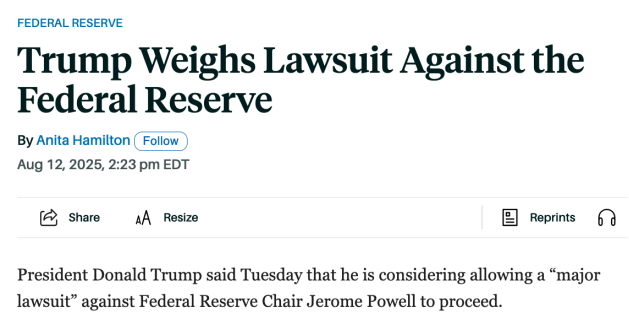
北美观察丨从威胁起诉到名单曝光 特朗普对美联储“双线施压”
Sou Hu Cai Jing· 2025-08-14 04:49
Core Viewpoint - President Trump is considering legal action against Federal Reserve Chairman Jerome Powell over the rising renovation costs of the Fed's headquarters, which have escalated from $1.9 billion to approximately $2.5 billion, citing "mismanagement" and potential fraud [1][3]. Group 1: Legal Action Considerations - Trump's legal threat is seen as a strategy to increase public pressure on Powell, aiming to force his resignation before the end of his term in 2026, as the President cannot directly dismiss the Fed Chair due to term protections [5]. - The lawsuit faces significant legal hurdles, including sovereign immunity, lack of standing, and the political question doctrine, which may prevent the courts from intervening in disputes between the executive branch and independent agencies like the Fed [9][12]. Group 2: Potential Successors - Following the announcement of the lawsuit, a new list of potential candidates to succeed Powell emerged, expanding from 4 to 11 candidates, with 8 identified as core contenders [14]. - Key candidates include Michelle Bowman, Kevin Hassett, Kevin Walsh, Christopher Waller, James Bullard, Philip Jefferson, Loretta Mester, and Kevin Summerlin, with Waller being viewed as a leading candidate due to his pragmatic policies aligning with Trump's economic views [15][18]. Group 3: Implications of the Candidate List - The candidate list signals a blend of political loyalty and policy alignment, as most candidates have either worked directly with Trump or share similar economic ideologies, contrasting with Powell's deteriorating relationship with the President [18]. - The inclusion of current Fed officials like Jefferson and Bowman suggests a potential transitional approach, allowing for continuity while still making significant changes to the leadership [18]. - The list aims to balance market reassurance with the potential for future policy shifts, indicating a strategic maneuver to influence both monetary policy direction and political power dynamics [18].