二元对立

Search documents
克里希那穆提逝世40周年|成为更好的自己是一个伪命题
Xin Lang Cai Jing· 2026-02-17 02:48
Core Ideas - Krishnamurti's philosophy emphasizes the importance of understanding time and its impact on human perception and consciousness [3][4][12] - The concept of awareness is central to Krishnamurti's teachings, advocating for a non-judgmental observation of oneself and the world [7][8][11] - Freedom, according to Krishnamurti, is an inner state that transcends cultural and societal constraints, achievable through self-exploration and awareness [12][13][16] Group 1: Time - Krishnamurti views time as a construct that affects human perception, suggesting that the past, present, and future exist only in consciousness [3][4] - He critiques the human tendency to live in a state of anticipation for a better future, which distracts from the present moment [4][5] - The struggle with time leads to a cycle of desire and dissatisfaction, preventing individuals from experiencing their true selves [5][7] Group 2: Awareness - Awareness, as defined by Krishnamurti, is a pure observation devoid of judgment, comparison, or motivation, which can lead to profound personal transformation [7][8][11] - He encourages individuals to engage all their senses in a holistic manner to dissolve the fragmented perception of reality [8][9] - This state of awareness allows for a deeper connection with the present, breaking down the barriers between the observer and the observed [9][10] Group 3: Freedom - Krishnamurti posits that true freedom is not about liberation from external constraints but rather an internal state of being that arises from self-awareness [12][13][16] - He challenges the notion that freedom can be achieved gradually, asserting that it is an immediate realization rather than a process over time [16] - The essence of freedom lies in the ability to observe life without the influence of past experiences or societal expectations [12][16]


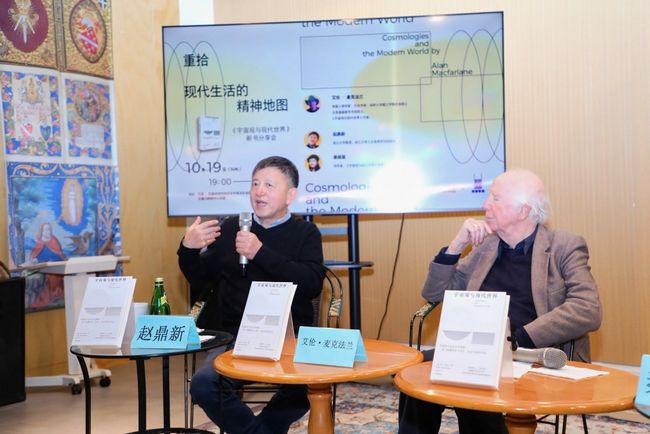
学者麦克法兰、赵鼎新对谈:欣赏文明多样性,差异不是威胁
Sou Hu Wang· 2025-10-23 02:50
Core Ideas - The discussion revolves around the concept of cosmology and its influence on civilization, emphasizing the need to make the invisible aspects of our worldview visible [2][5] Group 1: Understanding Cosmology - Cosmology is described as a comprehensive system of beliefs, ideas, and assumptions that forms the underlying framework of human thought, often unnoticed [2] - The book aims to elucidate how our current worldview has historically developed, making the invisible aspects of cosmology visible [2] Group 2: East-West Cosmological Differences - The fundamental differences between Eastern and Western cosmologies are highlighted, with Western thought rooted in binary oppositions, while Chinese civilization emphasizes harmony and interconnectedness [5] - This divergence in thought processes has led to different paths in technological and philosophical development, with Chinese civilization focusing on holistic understanding rather than mere categorization [5] Group 3: Historical Perspectives on Power and Cosmology - The evolution of cosmology is closely linked to power structures, with historical shifts in perception of China by the West reflecting changes in power dynamics, particularly post-Industrial Revolution [8][9] - The narrative of China transitioning from a model of rational governance to being perceived as "backward" is discussed, emphasizing the role of European industrial and military superiority in shaping these views [8][9] Group 4: Crisis of Belief Systems - The collapse of cosmological frameworks can be abrupt and painful, as illustrated by the impact of World War I on Western belief systems, leading to a reevaluation of progress and rationality [10][11] - The current technological revolution, including AI and the internet, is likened to the upheaval of World War I, reshaping societal, political, and economic landscapes [11] Group 5: Existential Challenges in Modern Society - The conversation touches on the existential crises faced by youth in both China and the West, with concerns about employment, meaning in life, and the efficacy of capitalism [12] - The role of social media and AI in exacerbating cognitive dissonance and societal polarization is emphasized, highlighting the need for open-mindedness to combat cognitive pollution [12] Group 6: Future Perspectives on Civilizational Coexistence - The future is envisioned as a symphony of diverse civilizations coexisting rather than merging, with metaphors of trees coexisting and orchestras harmonizing to illustrate this point [14][15] - Embracing diversity is seen as a source of creativity, with the notion that differences should be appreciated rather than viewed as threats [15]