社会极化

Search documents
【环球财经】世界经济论坛报告:地缘经济对抗是2026年首要风险
Xin Hua She· 2026-01-14 22:44
Core Insights - The World Economic Forum's "Global Risks Report 2026" identifies geopolitical and economic risks as escalating in a new competitive era, with geopolitical economic confrontation being the primary risk for 2026 [1][2] - Other significant risks for 2026 include armed conflict between nations, extreme weather, social polarization, and misinformation, with economic risks rising the fastest [1] - The report highlights worsening debt issues and potential asset bubbles, compounded by geopolitical economic conflicts, which could trigger a new wave of turmoil [1] Short to Medium-Term Risk Outlook - Geopolitical economic confrontation is deemed the most severe risk in the short to medium term (next two years) [2] - The World Economic Forum's Executive Director, Sadia Zahidi, states that the world has entered a new competitive era, impacting all subsequent global risks [2] - The President and CEO of the World Economic Forum, Borge Brende, emphasizes that the changing competitive landscape has altered the global cooperation dynamic, underscoring the importance of collaborative pathways and dialogue [2] Expert Contributions - The report consolidates insights from over 1,300 global experts, analyzing current, short-term, and long-term risks faced worldwide [3]
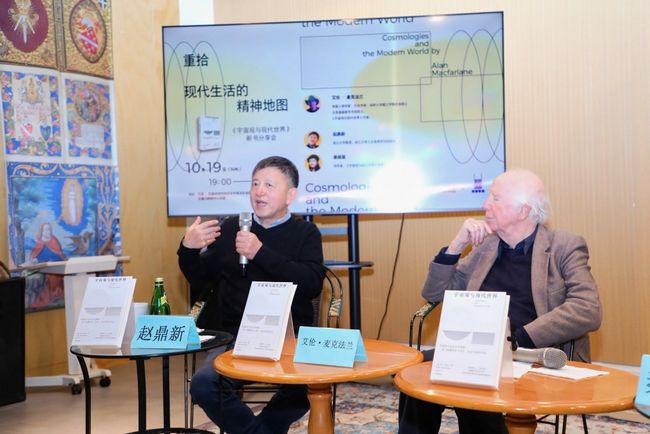
学者麦克法兰、赵鼎新对谈:欣赏文明多样性,差异不是威胁
Sou Hu Wang· 2025-10-23 02:50
Core Ideas - The discussion revolves around the concept of cosmology and its influence on civilization, emphasizing the need to make the invisible aspects of our worldview visible [2][5] Group 1: Understanding Cosmology - Cosmology is described as a comprehensive system of beliefs, ideas, and assumptions that forms the underlying framework of human thought, often unnoticed [2] - The book aims to elucidate how our current worldview has historically developed, making the invisible aspects of cosmology visible [2] Group 2: East-West Cosmological Differences - The fundamental differences between Eastern and Western cosmologies are highlighted, with Western thought rooted in binary oppositions, while Chinese civilization emphasizes harmony and interconnectedness [5] - This divergence in thought processes has led to different paths in technological and philosophical development, with Chinese civilization focusing on holistic understanding rather than mere categorization [5] Group 3: Historical Perspectives on Power and Cosmology - The evolution of cosmology is closely linked to power structures, with historical shifts in perception of China by the West reflecting changes in power dynamics, particularly post-Industrial Revolution [8][9] - The narrative of China transitioning from a model of rational governance to being perceived as "backward" is discussed, emphasizing the role of European industrial and military superiority in shaping these views [8][9] Group 4: Crisis of Belief Systems - The collapse of cosmological frameworks can be abrupt and painful, as illustrated by the impact of World War I on Western belief systems, leading to a reevaluation of progress and rationality [10][11] - The current technological revolution, including AI and the internet, is likened to the upheaval of World War I, reshaping societal, political, and economic landscapes [11] Group 5: Existential Challenges in Modern Society - The conversation touches on the existential crises faced by youth in both China and the West, with concerns about employment, meaning in life, and the efficacy of capitalism [12] - The role of social media and AI in exacerbating cognitive dissonance and societal polarization is emphasized, highlighting the need for open-mindedness to combat cognitive pollution [12] Group 6: Future Perspectives on Civilizational Coexistence - The future is envisioned as a symphony of diverse civilizations coexisting rather than merging, with metaphors of trees coexisting and orchestras harmonizing to illustrate this point [14][15] - Embracing diversity is seen as a source of creativity, with the notion that differences should be appreciated rather than viewed as threats [15]