云边协同架构

Search documents
2026年中国燃煤添加剂行业分类、产业链图谱、市场现状及趋势分析:双碳战略驱动行业迈向低碳环保高效综合解决方案新纪元[图]
Chan Ye Xin Xi Wang· 2026-01-24 02:37
Core Insights - The Chinese coal additive industry is evolving from a simple "fuel-saving" role to a comprehensive solution that integrates "low carbon emissions, environmental compliance, and efficient combustion" [1][4] - The market size of the coal additive industry in China is projected to reach approximately 57.8 billion yuan in 2024, representing a year-on-year growth of 9.89% [1][4] Industry Overview - Coal additives are chemical substances added to coal to improve combustion efficiency, reduce pollutant emissions (such as SO₂, smoke, NOₓ), prevent boiler fouling and corrosion, and extend equipment lifespan [2][3] - The core principles of coal additives include lowering the activation energy of coal oxidation reactions, promoting complete combustion, converting harmful substances into harmless ones, and optimizing combustion conditions [2] Industry Value Chain - The upstream of the coal additive industry includes raw materials such as potassium nitrate, potassium chlorate, potassium permanganate, manganese dioxide, iron oxide, aluminum oxide, titanium dioxide, rare earth elements, and various sulfur-fixing agents [2] - The midstream involves the production and manufacturing of coal additives, while the downstream applications are primarily in thermal power, steel, cement, and chemical industries [2] Market Size - The coal additive industry is a crucial component of the clean and efficient utilization of coal, driven by the "dual carbon" strategy and stringent emission reduction requirements in high coal-consuming industries [1][4] - The demand for coal additives is increasing as industries seek to lower coal consumption, enhance combustion efficiency, and achieve simultaneous desulfurization, denitrification, carbon reduction, and ash removal [1][4] Key Companies - Yuan Da Environmental Protection Co., Ltd. focuses on a composite solution of "desulfurization efficiency agents + fuel-saving agents" and has covered over 20 units within its group [5] - Shandong Jiahe New Energy Development Co., Ltd. specializes in "HS" series environmental fuel-saving catalysts, leveraging partnerships with top universities for R&D [7] - The National Energy Investment Group's subsidiary emphasizes the development of coal additives and environmental technology integration, achieving significant efficiency improvements in desulfurization and fuel-saving [5] Industry Development Trends 1. **Policy and Technology Dual Drive**: The industry is shifting from "end-of-pipe treatment" to "process optimization" due to stricter environmental regulations and advancements in technology [8] 2. **Diversified Market Demand**: While the power industry remains the core demand driver, sectors like steel, cement, and chemicals are rapidly increasing their demand for coal additives [8] 3. **Optimized Competitive Landscape**: The industry is seeing increased concentration, with small and medium enterprises leveraging technological differentiation to compete [9]


华为中国政企业务油气矿山军团作答: AI技术如何扎根能源化工行业?
Zhong Guo Hua Gong Bao· 2025-12-03 02:38
Core Insights - The core idea presented is that advanced technology, particularly AI, should be integrated into the oil and gas industry by addressing real business pain points, allowing technology to grow from the ground up [1] Group 1: AI Application in Oil and Gas - The traditional energy and chemical industry faces challenges such as safety management, efficiency improvement, and green transformation, which create significant pressure for development [2] - Huawei has partnered with Yuntianhua to create the world's first real-time online optimization technology (RTO) model for coal gasification, which is expected to save over 9,000 tons of coal and reduce CO2 emissions by more than 20,000 tons annually, generating over 10 million yuan in direct economic benefits each year [2] - In equipment maintenance, Huawei collaborates with Wanhua to utilize the Pangu AI model for predictive maintenance, allowing for early identification of equipment aging trends [2] Group 2: Overcoming Fragmentation in AI Implementation - As AI applications deepen, the complexity of models and the volume of data increase, leading to challenges in avoiding fragmented AI projects within the energy and chemical industry [3] - Huawei proposes a "dual-drive" solution through "root technology + ecological collaboration" to transition from isolated AI applications to coordinated intelligence across the entire industry chain [3] - The economic benefits of industrial AI have matured, transforming AI-managed systems from being mere "landscapes" to integral parts of operations [3] Group 3: Integration of AI Models - Industrial large models encompass various categories such as language, scientific computing, prediction, and machine vision, requiring a comprehensive approach to integrate different systems into a unified model [4] - Huawei's collaboration with China National Petroleum Corporation on the Kunlun large model demonstrates the ability to quickly implement and optimize across 119 business areas through a unified platform [4] - The company is focused on establishing industry digital standards and ensuring that each AI application can evolve and be replicated effectively [4] Group 4: Data-Driven Transformation - The core driving force behind the intelligent development of industries like oil and gas is shifting from process digitization to a deep integration of data and AI [5] - Huawei has introduced a cloud-edge collaborative architecture and layered model construction to facilitate rapid development of scenario applications based on general large models, lowering the barriers to AI usage [5] Group 5: Infrastructure and AI Value - The ability of infrastructure must grow in tandem with the value generated from AI applications, as these applications produce vast amounts of operational data and optimization needs [6] - Huawei collaborates with leading companies across industries to build competitive solutions that promote intelligent development [6] - The future trend indicates a transition of high-risk job roles to digital operators and intelligent engineers, marking a significant shift in the oil and gas industry's core operational systems [6]
沙利文市场地位背后:中国NAS消费级市场的爆发与领跑者
Sou Hu Wang· 2025-10-28 02:37
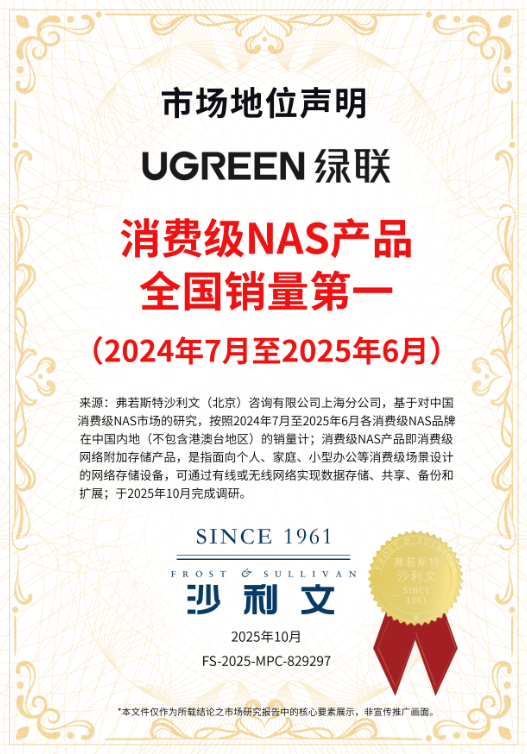
Core Insights - UGREEN has been confirmed as the top seller in China's consumer NAS market for the period from the second half of 2024 to the first half of 2025, reflecting a significant reshaping of the market landscape and showcasing the ability of Chinese brands to drive industry upgrades through technological innovation [1][4]. Market Overview - The global home NAS market reached a sales figure of 2.44 billion in 2023, projected to grow to 28.93 billion by 2030. China's market specifically accounted for 712 million in 2023, representing 29.19% of the global market, with expectations to grow to 9.619 billion by 2030 [4][5]. Historical Context - The early stages of China's NAS market were dominated by international brands focused on enterprise-level products, which limited the technology's accessibility to a broader consumer base due to high complexity and cost [5][6]. UGREEN's Strategy - UGREEN has successfully simplified the user experience by introducing products like the DH2000 and DH4300 Plus, which feature user-friendly mobile app setups and competitive pricing, making NAS technology more accessible to the general public [5][7]. - The company's focus on understanding consumer needs has led to the development of the UGOS Pro system, which offers a zero-learning-cost experience and integrates AI functionalities for enhanced user experience [6][10]. Market Trends - The consumer NAS market is transitioning from a focus on hardware functionality to becoming intelligent lifestyle partners, with devices now capable of active data management and edge computing [9][10]. - As the user base expands to include ordinary households, there is an increasing demand for simplified operations and enhanced security features, alongside the need for interoperability with smart home devices [9][10]. Competitive Landscape - The current market is characterized by a price war among brands, with leading companies like UGREEN establishing competitive advantages through proprietary systems and algorithm optimizations [10][12]. - The evolution of the market is shifting from mere hardware comparisons to a comprehensive competition based on user experience, technological ecosystems, and sustainability [10][12]. Future Outlook - The integration of 5G, AI, and IoT technologies is expected to create broader opportunities in the consumer NAS market, with UGREEN and other Chinese brands positioned to leverage their early advantages for future global competition [12].