
产业与就业协同

Search documents
破局行业结构性就业矛盾,SHEIN开启热门岗位零基础培训
Nan Fang Du Shi Bao· 2026-01-19 06:15
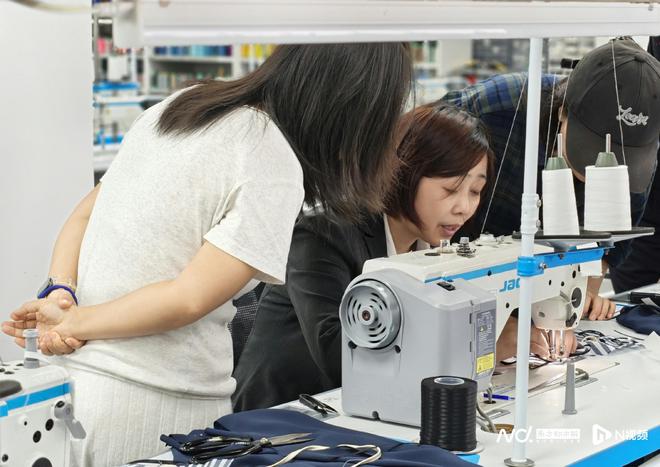
Core Viewpoint - SHEIN is expanding its role as a "chain master" in the apparel industry by promoting high-quality employment through skill training programs aimed at various employment groups, including unemployed graduates and flexible workers [1][3]. Group 1: Employment Support Initiatives - SHEIN, in collaboration with the Guangdong Provincial Federation of Trade Unions, has launched free skill training programs for eight popular job roles, focusing on sewing and garment pattern-making for zero-basis learners [1][3]. - The training includes practical courses and real production environment simulations, ensuring participants acquire valuable hands-on skills [3]. Group 2: Industry Context and Challenges - The textile and apparel industry employs over 20 million people and plays a significant role in stabilizing employment and increasing income [3]. - There is a structural talent mismatch in the traditional garment manufacturing sector, with weak training systems in small factories and a disconnect between educational institutions and industry needs [3][4]. Group 3: Policy and Strategic Initiatives - The "14th Five-Year Plan" emphasizes the need for coordinated industry and employment development, improving human resource matching mechanisms, and enhancing lifelong vocational training systems [4]. - SHEIN has initiated a "5 billion yuan" supplier empowerment plan to address common challenges in technology and talent training, with plans for nearly 600 training sessions covering 3.7 million business interactions by 2025 [5]. Group 4: Training and Development Models - SHEIN has established a training and evaluation base to expand its training outreach and has developed a four-in-one model integrating job demand, training, evaluation, and employment [5]. - The company is also working to include "garment quality inspectors" as a new occupational classification and is developing evaluation standards for this role [5]. Group 5: Community and Employee Support - SHEIN is committed to enhancing the sense of belonging and stability among supplier employees through initiatives like the "Star Light" project, which has supported 815 families and 1,716 youth in education [6]. - The company plans to host skill competitions to promote skill integration and improvement among employees [6].

链式招聘畅通产业人才循环
Jing Ji Ri Bao· 2026-01-06 22:09
Core Insights - The "Million Talents Gathering in South Guangdong" recruitment event showcases a collaborative approach where leading companies like Huawei, Tencent, BYD, and Xiaopeng recruit together with their upstream and downstream partners, making job searching more convenient for candidates [1] - Guangdong's strategy reflects the belief that managing industry should also involve managing employment, emphasizing the synergy between industry and job creation [1] - Throughout the year, over 5,000 recruitment events were held, focusing on attracting talent for 20 strategic industrial clusters in Guangdong, demonstrating the effectiveness of the "industry-employment synergy" approach [1] Group 1: Industry Demand - The "chain-based advancement" is crucial for the growth of Guangdong's economy, with both traditional and emerging industries needing to attract high-quality talent [2] - The "Talent Demand Directory" for the Guangdong-Hong Kong-Macao Greater Bay Area indicates a significant shortage of talent in rapidly developing sectors such as new-generation information technology, biomedicine, and renewable energy [2] - Chain-based recruitment facilitates the efficient introduction of urgently needed talent into the industry [2] Group 2: Talent Supply - The rapid pace of technological change in industries outstrips the education system's ability to adapt, leading to a phenomenon where graduates find their skills outdated [2] - Guangdong has pioneered the development of a skills ecosystem led by "chain master" companies, integrating industry needs with education and evaluation to create a responsive talent supply chain [2] - The emergence of chain-based recruitment is a natural progression that aims to close the loop from strong industry to stable employment [2] - By 2026, the number of college graduates in China is expected to reach a record high of 12.7 million, highlighting ongoing structural employment challenges due to advancements in technologies like artificial intelligence [2]


