
人参产业标准化

Search documents
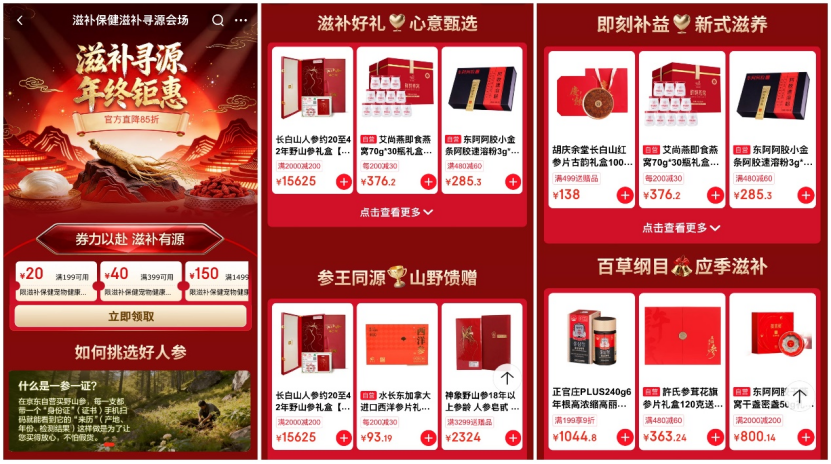
京东健康携手吉林人参产业带合作伙伴 以人参品质溯源体系推动行业高质量发展
Jin Rong Jie Zi Xun· 2026-01-04 02:51
Core Insights - The demand for health supplements, particularly ginseng, has surged during the New Year holiday, with sales increasing by 55% year-on-year according to JD Health's data [1] - JD Health has established a "one ginseng, one certificate" quality traceability system, allowing consumers to verify product origins, growth years, and testing results through QR codes [1][3] Group 1: Industry Overview - Jilin Province is recognized as the original and core production area for ginseng in China, benefiting from unique ecological conditions and extensive cultivation experience [3] - The province has developed a comprehensive ginseng industry system that integrates planting, processing, and research, positioning itself as a key player in the global ginseng market [3] - JD Health is collaborating with Jilin Province to enhance the ginseng industry from a resource advantage to a brand and value advantage, promoting high-quality, traceable ginseng products [3] Group 2: Product Standards and Quality Control - In 2023, JD Health, in collaboration with authoritative institutions, launched the "JD Good Ginseng" standards, which set clear and strict requirements for ginseng definition, age labeling, and testing certification, exceeding national standards in some areas [3] - JD Health applies rigorous quality control and traceability systems to both everyday health supplements and high-grade, rare ginseng resources, ensuring a regulated display and certification environment [4] - A notable auction of a century-old wild ginseng from Changbai Mountain showcased a specimen weighing 123 grams, surpassing national standards for premium wild ginseng [4] Group 3: Future Developments - JD Health plans to continue enhancing its quality control standards and traceability systems while deepening collaboration with local governments and industry in Jilin Province to promote standardized, transparent, and scalable development of health supplements [5]


吉林通化县推进一二三产融合发展——锚定富民产业延链提质增效(发展各具特色的县域经济)
Ren Min Ri Bao· 2025-06-08 22:21
Core Insights - The article highlights the advancements in ginseng cultivation and processing in Tonghua County, Jilin Province, emphasizing the integration of technology and sustainable practices to enhance productivity and quality [1][3][5]. Group 1: Technological Advancements - The introduction of remote monitoring and integrated sensors allows for better management of ginseng fields, improving the standardization of cultivation practices [1]. - The construction of electronic fencing and enhancement of communication and power infrastructure in ginseng planting bases are part of the county's modernization efforts [1]. Group 2: Sustainable Practices - Comprehensive surveys of suitable ginseng forest land have been conducted to optimize resource use and enhance sustainability [3]. - The county is focusing on the protection and propagation of ginseng seed resources to ensure the quality of ginseng production [3]. Group 3: Value Addition through Processing - The shift from raw material sales to refined product offerings is evident, with over 600 types of ginseng products developed, including pharmaceuticals, beverages, health products, cosmetics, and food [5]. - The emphasis on deep processing techniques, such as freeze-drying, is aimed at maximizing the value derived from ginseng [4]. Group 4: Market Regulation and Brand Development - The implementation of a traceability system for ginseng products, where each ginseng root has its own "ID," enhances market regulation and consumer trust [6]. - Continuous efforts to strengthen market oversight and quality inspection are in place to elevate the brand value of ginseng from Tonghua County [6]. Group 5: Economic Impact - The total output value of the ginseng industry chain in Tonghua County is projected to reach 15.027 billion yuan in 2024, reflecting a year-on-year growth of 126% [7]. - The county aims to achieve growth in the primary sector, quality enhancement in the secondary sector, and expansion in the tertiary sector through the ginseng industry [7].