生育相关

Search documents
连增两年!韩国去年新生儿数量同比增长6.8%,创十五年来最大增幅
Hua Er Jie Jian Wen· 2026-02-25 09:23
Group 1 - The core point of the article is that South Korea's newborn numbers are projected to increase in 2025 for the second consecutive year, with a total fertility rate returning to the 0.8 range, signaling a rare positive development for an economy long troubled by "ultra-low fertility" [1][2] - In 2025, the number of newborns is expected to reach 254,500, representing a year-on-year increase of 6.8%, which is the largest annual growth in 15 years [1][2] - The increase in newborns is attributed to changes in population structure and marriage patterns, including a rise in marriage registrations and an increase in the population of women of childbearing age [1][3] Group 2 - The government has invested significantly in policies to encourage childbirth, including cash subsidies, housing support, extended parental leave, and childcare assistance, although the causal relationship between these policies and the increase in birth rates remains unclear [4] - Structural constraints such as high housing costs, rising private education expenses, workplace stigma against parents, and stagnant youth employment continue to pose challenges to further increases in fertility rates [6] - The supply side is also under pressure, with pediatric clinics closing faster than new ones are opening, and some local governments lacking sufficient delivery facilities, reflecting systemic consequences of years of ultra-low birth rates [6]
破防!生娃送房,开始了!
Sou Hu Cai Jing· 2026-01-05 01:21
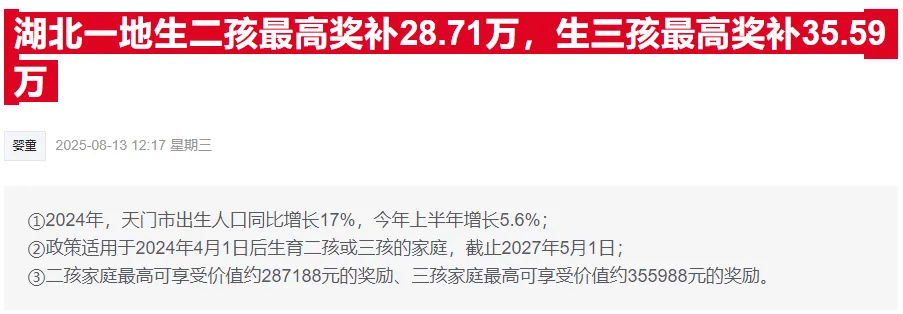
Group 1 - The core viewpoint of the article highlights the recent birth incentive policies in Hubei province, particularly in cities like Tianmen and Zhushan, aimed at reversing declining birth rates through various financial and social support measures [2][4][6] - Tianmen city has introduced a series of incentives for families having second and third children, including housing vouchers, tax benefits, and increased maternity leave, effective from April 2024 to May 2027 [2][3] - Zhushan county's policy includes retroactive benefits for families who had second or third children between June 2021 and June 2026, offering substantial housing subsidies and monthly childcare allowances [4][6] Group 2 - The article discusses the demographic challenges faced by Tianmen and Zhushan, noting significant population declines over the past decade, with Tianmen's population decreasing by 74,600 from 2020 to 2024 [8][10] - The birth rate in Zhushan has dropped from 13.36‰ in 2017 to 4.88‰ in 2024, indicating a critical demographic shift [14] - The article emphasizes that despite the introduction of these policies, the overall trend of declining birth rates may not be significantly altered, as the underlying issues affecting marriage and childbirth remain unresolved [16][24] Group 3 - The United Nations predicts that China's newborn population may fall to around 8.71 million by 2025, reflecting a broader national trend of declining birth rates [16][18] - The article outlines the relationship between marriage rates and birth rates, noting that the number of marriages has been declining since 2013, which directly impacts future birth rates [19][24] - The central government's recent statements indicate an urgent need to stabilize the birth population, with plans for more robust support measures anticipated in 2026 [29][32]