人工智能(AI)制药

Search documents
JPM2026观察:超百亿巨额并购降温、AI投资热情飙升,中国药企变“台上主角”
Cai Jing Wang· 2026-01-26 08:16
Core Insights - The JPMorgan Global Healthcare Conference serves as a significant platform for the biopharmaceutical industry, influencing capital flows and industry dynamics for the year ahead [1] - This year's conference highlighted the increasing presence of Chinese biotech companies, marking a shift from being mere spectators to key players in the global market [2][3] Group 1: Chinese Biotech Companies - Seven Chinese companies, including WuXi AppTec and BeiGene, presented on the main stage, with an additional 17 companies showcasing in the Asia-Pacific session [2] - The transformation of Chinese companies from the periphery to the center of the conference reflects their substantial innovation value, evidenced by numerous licensing deals announced during the event [3] Group 2: Licensing Deals and Collaborations - Notable licensing agreements included a $650 million upfront payment from AbbVie to Rongchang Biopharma for the global rights to its PD-1/VEGF dual-specific antibody, with a total potential deal value of up to $5.6 billion [3] - Other significant collaborations involved Zhongsheng Peptide and Sai Shen Pharmaceutical partnering with Novartis, with the latter's deal valued at approximately $1.665 billion [3] Group 3: MNCs and Market Dynamics - The cautious approach of multinational corporations (MNCs) towards acquisitions is driven by the impending "patent cliff," with over $320 billion in market potential products set to lose patent protection in the next decade [3][5] - MNCs are increasingly favoring "asset-based acquisitions" over full company buyouts, allowing them to efficiently acquire core assets without the burdens of integrating entire companies [4] Group 4: AI in Drug Development - AI's integration into drug development emerged as a central theme, with Eli Lilly and NVIDIA announcing a partnership to establish a $1 billion AI innovation lab aimed at addressing long-standing challenges in the pharmaceutical industry [5][6] - The acquisition of Modella AI by AstraZeneca further emphasizes the growing importance of AI in enhancing drug discovery and clinical development processes [6] Group 5: Future Outlook - The 2026 JPM conference is expected to reflect a new paradigm where Chinese innovation becomes essential, and AI evolves from a supportive tool to a foundational infrastructure in drug development [8][9]
英矽智能更新招股书,但港股AI制药热已“退烧”
Sou Hu Cai Jing· 2025-11-18 10:01
Core Viewpoint - Insilico Medicine is actively pursuing an IPO in Hong Kong, having updated its prospectus after six months without completing the hearing, indicating ongoing efforts to enter the market [1][2]. Company Overview - Insilico Medicine, founded in 2014, is recognized as a leading player in the "AI drug discovery" sector, backed by prominent investors including Warburg Pincus, Qiming Venture Partners, WuXi AppTec, Eli Lilly Asia Ventures, Blue Lake Capital, and Baidu Ventures [2]. - The company gained attention during the COVID-19 pandemic when its AI-discovered drug Baricitinib received emergency use authorization from the FDA [2]. Market Context - The AI drug discovery field has seen a surge in new companies, including Evolutionary Scale, which focuses on protein design and raised $142 million in seed funding before merging with the Chan Zuckerberg Initiative [2]. - In China, Jingtaiketech successfully listed on the Hong Kong Stock Exchange in June 2024, becoming the only AI drug company to do so amid a cooling global capital market [4]. IPO Significance - The success of Insilico Medicine's IPO is crucial for validating the AI drug discovery narrative, especially as it remains the only major player still seeking to go public after multiple attempts [4][5]. - The company is one of the first biotech firms to advance AI-discovered drugs into clinical trials, with its core asset, Rentosertib (ISM001-055), currently in Phase II trials [5]. Financial Health - As of mid-2023, Insilico Medicine's cash and equivalents increased from $126 million to $213 million, primarily due to a $123 million Series E funding round [6]. - The company has no commercialized drugs yet but generates revenue through various licensing agreements, including a total of $32 million in upfront payments from collaborations with Exelixis and Stemline [8]. Competitive Landscape - The AI capabilities of Insilico Medicine are critical for its competitive edge, but the increasing number of companies focusing on AI in drug development poses a challenge [9]. - Research indicates that while AI can accelerate drug discovery and preclinical phases, its impact on clinical trial success rates remains limited [9]. Performance Metrics - Insilico Medicine's revenue is projected to grow significantly, from $30.1 million in 2022 to $85.6 million in 2024, while net losses are expected to decrease from $222 million to $17.1 million over the same period [10]. - The company’s financial performance shows improvement, with a notable reduction in losses and an increase in revenue [10]. Industry Sentiment - The IPO landscape for AI drug companies is challenging, with two competitors opting for NASDAQ listings and one pausing financing, reflecting a cautious approach from long-term investors due to liquidity issues and high failure rates [11].


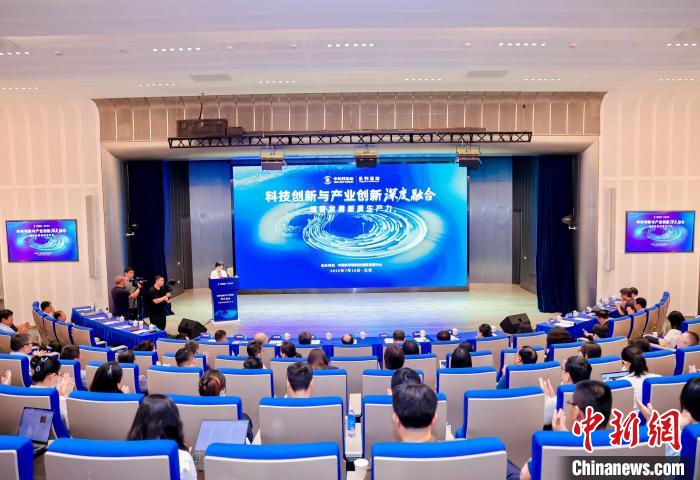
【中国新闻网】聚焦培育发展新质生产力 科技创新与产业创新融合研讨会举行
Zhong Guo Xin Wen Wang· 2025-07-18 02:19
Group 1 - The "Technology Innovation and Industry Innovation Integration Seminar" was held on July 16 in Beijing, focusing on the key topic of "cultivating new quality productivity" to explore new mechanisms, models, and practices for integrated development [3] - The seminar gathered representatives from government departments, scientists, entrepreneurs, and think tank scholars, aiming to establish a collaborative platform for seamless integration of technological and industrial innovation [3][4] - A series of "pay after use" technology transfer pilot agreements were signed, along with the release of a "Deep Integration Business Service System" to support integrated innovation practices [3][4] Group 2 - The seminar featured five thematic reports addressing future development insights from various perspectives, including theoretical mechanisms, policy systems, innovation practices, industrial development, and local explorations [3] - The roundtable discussions explored innovative integration methods, institutional mechanisms, and the ecosystem of integrated development, generating several forward-looking ideas [3][4] - In the life and health sector, representatives from research institutions, enterprises, and the investment community engaged in deep exchanges on cutting-edge technologies, facilitating initial cooperation intentions [4] Group 3 - The China Academy of Sciences emphasized that the current technological revolution and industrial transformation are undergoing systematic restructuring, challenging traditional innovation paradigms [6] - The center aims to leverage its rich research resources to promote incremental integration and resource aggregation, enhancing the connection between research and industry [6]