代码共享合作

Search documents
中国南方航空与维珍澳大利亚航空签署代码共享合作协议
Zhong Guo Xin Wen Wang· 2025-12-08 11:59
Core Viewpoint - China Southern Airlines (CSA) has signed a code-sharing agreement with Virgin Australia Airlines, which will enhance CSA's route network coverage in Oceania [2] Group 1: Code-Sharing Agreement - The code-sharing cooperation is set to officially launch in early 2026 [2] - Passengers traveling on CSA flights to major cities such as Sydney, Melbourne, Brisbane, and Darwin will have efficient connections to Virgin Australia's network, reaching 17 popular destinations in Australia, New Zealand, and Vanuatu [2] Group 2: Route Network Expansion - The route coverage includes not only major commercial cities like Newcastle, Townsville, and Mackay but also well-known tourist destinations such as the Gold Coast, Sunshine Coast, Cairns, and Queenstown, as well as Vanuatu's Port Vila [2] - CSA currently operates seven main routes between Guangzhou and cities including Sydney, Melbourne, Brisbane, Perth, Adelaide, Darwin, and Shenzhen to Sydney, with a peak weekly flight volume of 77 flights [2] - The partnership with Virgin Australia will further strengthen CSA's route network in Oceania, providing passengers with more convenient transfer options, a wider range of flight choices, and more flexible travel combinations [2]


土豪外航,再开中国航线
3 6 Ke· 2025-12-05 12:22
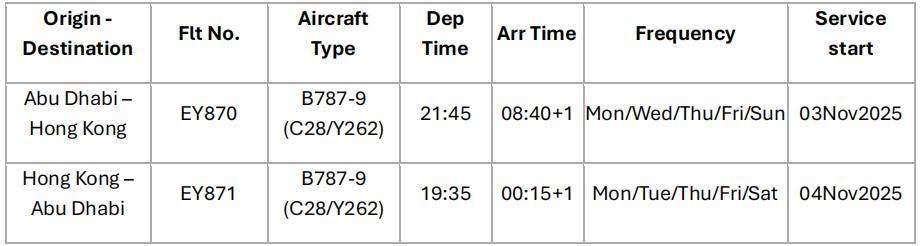
Core Viewpoint - Etihad Airways has resumed flights to Hong Kong, marking a significant step in its strategy to strengthen its presence in the Chinese market and capitalize on the rebound in global air travel [1][4]. Group 1: Flight Resumption and Market Strategy - The resumption of the EY870 flight from Abu Dhabi to Hong Kong is a response to the growing demand for outbound travel from the Greater Bay Area, offering a cost-effective option for consumers [1][4]. - The airline operates five weekly flights using the Boeing 787-9 Dreamliner, which features premium business class seating and economy class services [1]. - The one-way economy class fare from Hong Kong to Abu Dhabi starts at 2,190 RMB, significantly undercutting many connecting flights [1]. Group 2: Competitive Landscape - Etihad's return to Hong Kong is part of a broader strategy to enhance its market share in Asia, particularly as competition intensifies with other airlines like Air China planning to launch new routes [5][7]. - The airline has established a code-sharing agreement with Hong Kong Airlines, allowing both carriers to expand their route networks and better serve customers [8][9]. Group 3: Network Expansion and Future Plans - Etihad aims to develop a comprehensive route network across Asia, having recently opened over 30 new destinations, with plans to add 31 more in 2025 [10][12]. - The airline's growth is supported by a significant increase in passenger numbers, with 2 million passengers transported in October alone, reflecting a 28% year-on-year increase [14][16]. - The fleet expansion includes the addition of 22 new aircraft in 2025, enhancing long-haul capabilities and supporting regional growth [17]. Group 4: Financial Performance - Etihad's net profit for 2024 is projected at 1.7 billion AED (approximately 476 million USD), more than tripling its profit from 2023, indicating strong operational performance [12]. - The airline's passenger load factor reached 88% in October, demonstrating effective capacity management and demand recovery [14][16].
把握中马免签机遇 服务区域互联互通——本报记者专访马来西亚航空集团董事总经理依占·依斯迈
Zhong Guo Min Hang Wang· 2025-10-28 08:52
Core Insights - Malaysia Airlines Group (MAG) is experiencing significant growth in passenger traffic, particularly from China, driven by the increasing connectivity between Malaysia, ASEAN, and China [1][5][12] Group 1: Market Growth and Performance - The passenger load factor for business class has exceeded 90%, indicating strong demand for travel between China and Malaysia [3][5] - During the recent "Golden Week" holiday, Malaysia Airlines carried over 6,000 Chinese outbound tourists, marking a year-on-year increase of over 41% [5] - The average passenger load factor for flights from China to Malaysia is maintained at 81%-82%, showcasing robust travel demand [5] Group 2: Strategic Initiatives - Malaysia Airlines is expanding its flight offerings to 60 weekly flights by January 2026, with plans to open new routes including Chengdu and potentially Shenzhen [6][11] - The airline is leveraging a multi-brand strategy, with Firefly focusing on leisure travel and Malaysia Airlines catering to high-end customers, enhancing competitiveness in a low-cost airline market [7][11] - Malaysia Airlines is enhancing its hub-and-spoke model to connect more Chinese travelers to various international destinations, while also improving ground transportation and tourism services in Malaysia [11] Group 3: Future Vision - The company aims to rank among the top ten global airlines by 2030, with the Chinese market playing a crucial role in achieving this goal [12]