价值驱动投资

Search documents
这一次不一样?本轮“锂价牛市”与历史不同
Hua Er Jie Jian Wen· 2026-01-15 06:18
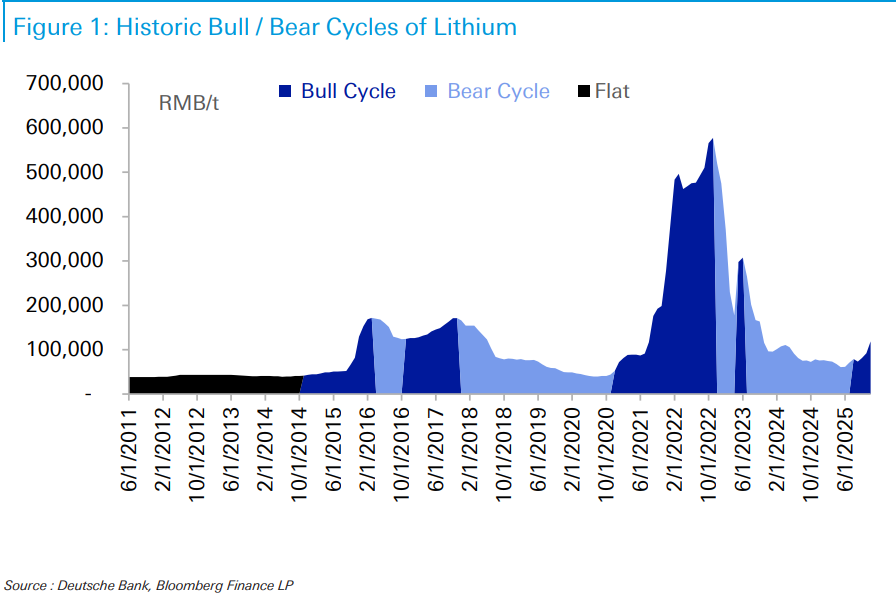
Core Viewpoint - The lithium market is experiencing a significant shift, moving from a cycle of irrational exuberance to rational growth, driven by a more mature market and fundamental demand from AI and battery energy storage systems (BESS) [1][9]. Group 1: Market Dynamics - The lithium market has undergone five booms and four busts over the past 15 years, defined by price fluctuations exceeding 20% [2]. - Historical price volatility has been attributed to the small market size and severe supply-demand mismatches, with past booms often based on overly optimistic expectations [3]. - The recent peak price of lithium reached approximately $82 per kilogram during the 2020-2022 period, followed by a dramatic decline to about $8 per kilogram, marking a nearly 90% drop [3]. Group 2: Recent Trends and Predictions - Deutsche Bank predicts that the bottom of the current cycle occurred in August 2025, with lithium spot prices rising approximately 160% and futures prices soaring 180% since that low [1]. - The average duration of boom periods is about 13 months, while busts last around 18 months, with the most recent major downturn lasting approximately 25 months [8]. Group 3: Key Drivers of Price Fluctuations - Three main factors contribute to the volatility of lithium prices: 1. The Dornbusch overshooting mechanism, where prices react excessively to shocks due to delayed corporate pricing responses and slow new supply adjustments [7]. 2. The market's small size historically, where minor supply-demand changes could lead to significant price swings [11]. 3. Dynamic policy impacts, where government support can exacerbate overheating during booms and worsen oversupply during downturns [11]. Group 4: Market Maturity and Future Outlook - The lithium market is projected to have a supply volume in 2025 that is approximately 11 times larger than that of 2015, indicating significant market maturation [11]. - The introduction of financial instruments like GFEX futures has increased market transparency and reduced speculative behavior, fostering a more rational valuation environment [11]. - The shift in demand drivers from electric vehicles (EVs) to BESS is a critical difference in the current cycle, with the latter being driven by fundamental needs rather than government subsidies [11].