
基本面投资

Search documents
时隔十年,融资保证金再收紧,释放出哪些信号?
私募排排网· 2026-01-19 03:20
Core Viewpoint - The adjustment of financing margin from 100% to 80% by the three major exchanges in August 2023 laid the foundation for a liquidity bull market a year later, with significant market participation observed in early 2026 [2]. Market Reaction - On January 14, 2026, the financing margin was raised back to 100%, leading to a sharp market adjustment, with the Shanghai and Shenzhen 300 index erasing early gains and closing down by 0.40% [2]. - The market's "V-shaped" fluctuation indicates a struggle between exuberant sentiment and rational regulation, with the regulatory intent being to conduct necessary "counter-cyclical adjustments" in response to signs of overheating [2]. Financing Margin Adjustment History - The last increase in financing margin occurred on November 14, 2015, during a period of market rebound after a leveraged bull market bubble burst, with significant increases in financing balance and trading activity [5]. - In October 2015, the financing balance increased by 126.1 billion, with daily financing buy amounts rising by 76% compared to September, prompting regulatory concerns about excessive leverage [5]. Impact on Market Liquidity - The increase in financing margin is expected to suppress market trading volume, as seen in late 2015 when trading volumes returned to previous average levels despite slight index gains [8]. - The theoretical reduction in financing purchasing power by 20% will lead to a decrease in new leveraged funds, resulting in a structural optimization of market volume rather than a simple decline in trading activity [8]. Investment Logic - The policy aims to shift market focus from speculative trading to fundamental-based investments, emphasizing the importance of earnings certainty, valuation safety margins, and sustainable dividend capabilities [10]. - Large-cap stocks are expected to outperform as the reliance on leveraged trading diminishes, with blue-chip and dividend assets likely to rise quickly to compensate for previous underperformance [10]. Differences from Previous Adjustments - The current margin adjustment is considered more moderate compared to 2015, focusing on preemptive risk management rather than reacting to a market crisis [14]. - Despite the increase in margin, the current market is characterized by a recovery in earnings structure and confidence, with the financing balance relative to market capitalization remaining lower than in 2015 [15].


董少鹏建议规范量化交易:限用于超级大盘股、禁止频繁撤单,以维护市场短线交易公平
Xin Lang Cai Jing· 2026-01-15 13:47
Core Viewpoint - The event highlighted the importance of fundamental factors in determining the long-term trends of the stock market, rather than relying on market manipulation or short-term trading strategies [1][4]. Group 1: Market Dynamics - The movement of funds in the market is not driven by a single directive but is influenced by fundamental conditions [5]. - The Chinese stock market has seen a rapid increase in listings since 2021, but the quality of some stocks has been questioned [5]. - There is a need to enhance the quality of listed companies, with a slowdown in IPOs and an acceleration in restructuring to solidify the market's foundation [5]. Group 2: Investment Strategies - Recommendations were made to utilize quantitative trading in large-cap stocks, while small-cap stocks, which have high turnover rates, may not require such strategies [7]. - It was emphasized that quantitative trading should not involve frequent order cancellations, as this creates unfair conditions in short-term trading [7]. - The focus should return to fundamental investing to address issues of short-term speculation, with regulatory bodies and companies playing a crucial role in market management [7]. Group 3: Role of Investors and Institutions - Investors are considered the foundation of the capital market, while listed companies are its basis, highlighting the value of retail investors in the economic development of China [7]. - There is a call for value investing to become mainstream, which may require regulatory support and guidance from major institutions [7]. - Large investment institutions and companies should prioritize human-centric approaches to share market and economic benefits, alongside improving market management and services [7].
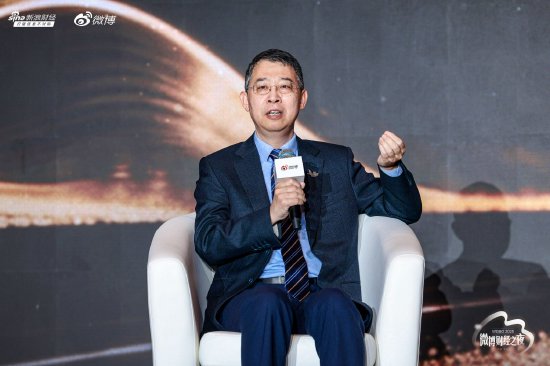
董少鹏不赞成李大霄“压盘托盘”说法:市场资金流向非指挥棒能驱动,中长期走势由基本面决定
Xin Lang Cai Jing· 2026-01-15 13:47
Core Viewpoint - The event highlighted the importance of fundamental factors in determining the long-term trends of the stock market, rather than relying on market manipulation or short-term trading strategies [1][4]. Group 1: Market Dynamics - The movement of funds in the market is not driven by a single directive but is influenced by fundamental conditions [5]. - The Chinese stock market has seen a rapid increase in listings since 2021, but the quality of some stocks has been questioned [5]. - There is a need to enhance the quality of listed companies, with a slowdown in IPOs and an acceleration in restructuring to solidify the market's foundation [5]. Group 2: Investment Strategies - Recommendations were made to utilize quantitative trading in large-cap stocks, while small-cap stocks, which have high trading frequency and turnover, may not require such strategies [7]. - It was emphasized that quantitative trading should not involve frequent order cancellations, as this creates unfair competition in short-term trading [7]. - The focus should return to fundamental investing to address short-term trading issues, with regulatory bodies and companies playing a crucial role in market management [7]. Group 3: Role of Investors and Institutions - Investors are considered the foundation of the capital market, while listed companies are its basis, highlighting the value of retail investors in the economic development of China [7]. - For value investing to become mainstream, regulatory support and guidance from major institutions are necessary [7]. - Large investment institutions and companies should prioritize human-centric approaches to share market and economic benefits, alongside improving market management and services [7].
这一次不一样?本轮“锂价牛市”与历史不同
Hua Er Jie Jian Wen· 2026-01-15 06:18
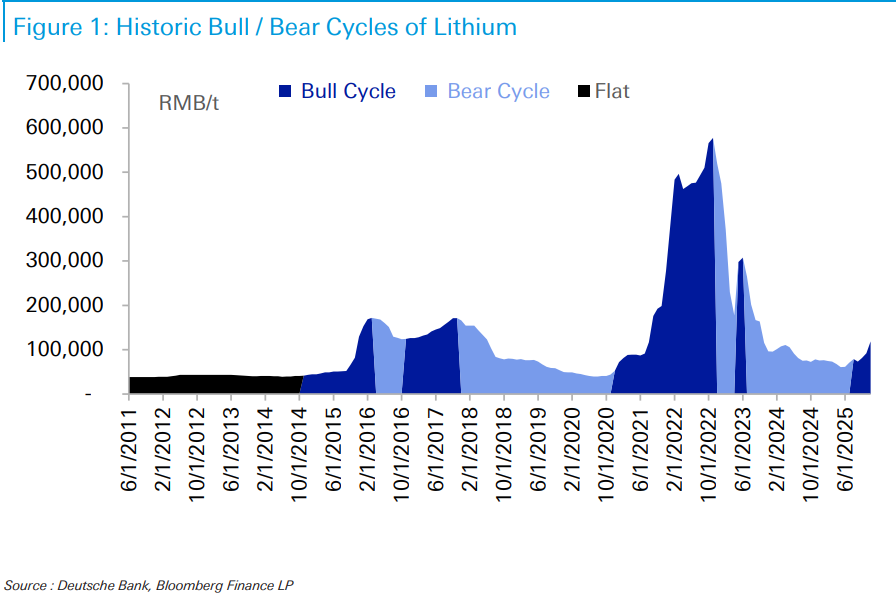
Core Viewpoint - The lithium market is experiencing a significant shift, moving from a cycle of irrational exuberance to rational growth, driven by a more mature market and fundamental demand from AI and battery energy storage systems (BESS) [1][9]. Group 1: Market Dynamics - The lithium market has undergone five booms and four busts over the past 15 years, defined by price fluctuations exceeding 20% [2]. - Historical price volatility has been attributed to the small market size and severe supply-demand mismatches, with past booms often based on overly optimistic expectations [3]. - The recent peak price of lithium reached approximately $82 per kilogram during the 2020-2022 period, followed by a dramatic decline to about $8 per kilogram, marking a nearly 90% drop [3]. Group 2: Recent Trends and Predictions - Deutsche Bank predicts that the bottom of the current cycle occurred in August 2025, with lithium spot prices rising approximately 160% and futures prices soaring 180% since that low [1]. - The average duration of boom periods is about 13 months, while busts last around 18 months, with the most recent major downturn lasting approximately 25 months [8]. Group 3: Key Drivers of Price Fluctuations - Three main factors contribute to the volatility of lithium prices: 1. The Dornbusch overshooting mechanism, where prices react excessively to shocks due to delayed corporate pricing responses and slow new supply adjustments [7]. 2. The market's small size historically, where minor supply-demand changes could lead to significant price swings [11]. 3. Dynamic policy impacts, where government support can exacerbate overheating during booms and worsen oversupply during downturns [11]. Group 4: Market Maturity and Future Outlook - The lithium market is projected to have a supply volume in 2025 that is approximately 11 times larger than that of 2015, indicating significant market maturation [11]. - The introduction of financial instruments like GFEX futures has increased market transparency and reduced speculative behavior, fostering a more rational valuation environment [11]. - The shift in demand drivers from electric vehicles (EVs) to BESS is a critical difference in the current cycle, with the latter being driven by fundamental needs rather than government subsidies [11].

为什么你总是拿不住好股票?或许忽略了投资的“三大支柱”
Sou Hu Cai Jing· 2025-12-19 10:24
Group 1 - A-shares continued to recover with all three major indices closing in the green, with the Shanghai Composite Index up 0.36%, the Shenzhen Component Index up 0.66%, and the ChiNext Index up 0.49% [1] - The total trading volume in the two markets increased to 1.75 trillion, indicating a warming market sentiment [1] - The consumer sector experienced a significant surge, with the retail index rising by 3.66% and multiple stocks hitting the daily limit [1] Group 2 - The Hainan local stocks were stimulated by the major news of "full island closure operation," leading to a surge in the index by over 7% [1] - There was a noticeable rotation of funds, with previous hot technology themes experiencing a pullback, while funds flowed into consumer and regionally themed stocks benefiting from policies [1] - The market remains in a stock game structure, characterized by significant structural features, with a focus on consumer recovery and certain policy themes for future investment strategies [1]
现代金融财富邂逅传统非遗文化 投资哲思“跃然纸上”
Sou Hu Cai Jing· 2025-12-17 05:52
Core Insights - The event organized by Pengyang Fund focused on investment strategies in the AH market, analyzing macroeconomic conditions and asset allocation strategies for the upcoming "14th Five-Year Plan" period in China [3] - The analysis highlighted a shift in market dynamics towards investments with solid performance and growth potential, emphasizing the importance of domestic demand, technological innovation, and the establishment of a unified national market as key policy variables for economic and capital market performance in the coming year [3] - The discussion also pointed out that the global preference for dollar assets is ending, with investors increasingly favoring Chinese assets that offer better valuation and cost-effectiveness [3] Investment Strategy - Investment should focus on high-quality core assets with proven competitive advantages and stable governance, serving as a "ballast" in asset allocation [6] - Long-term investment strategies should prioritize emerging growth areas driven by industrial upgrades, technological innovation, and policy support [6] - The capital market is expected to see increased activity and a more balanced supply-demand dynamic, allowing investors to capitalize on greater opportunities [6] Cultural Integration - The event incorporated traditional culture, specifically the "Yanchang Paper-Cutting" art, to enhance the understanding of investment philosophies among participants [8][13] - The paper-cutting process symbolizes the balance between decisive action and careful preservation, paralleling the investment logic of maintaining core values while adapting to market changes [8] - The initiative aims to promote the integration of traditional Chinese culture with financial education, emphasizing that true wealth encompasses both numerical growth and spiritual enrichment [13]

历史新高!私募基金规模首破22万亿元
证券时报· 2025-11-30 00:15
Core Insights - The latest report from the China Securities Investment Fund Industry Association indicates that the private fund industry has reached a record high of 22.05 trillion yuan as of October 2025, surpassing the previous peak of 20.81 trillion yuan in September 2023 [1][2]. Group 1: Private Fund Scale - As of October 2025, there are 19,367 registered private fund managers managing 137,905 funds with a total scale of 22.05 trillion yuan [2]. - The private securities investment fund sector has shown remarkable growth, with its scale reaching 7.01 trillion yuan for the first time, accounting for over 60% of the new registrations in October [3]. Group 2: Fund Types Growth - In addition to securities funds, private equity and venture capital funds have also seen steady growth, with scales of 11.18 trillion yuan and 3.56 trillion yuan respectively as of October 2025 [3]. Group 3: Stock Fund Positioning - The stock private fund position index reached 81.13% as of November 14, 2025, marking a significant increase and the highest level in nearly 112 weeks [4]. - The proportion of fully invested stock private funds has risen to 65.90%, indicating a shift towards higher investment levels among medium-positioned funds [4]. Group 4: Market Drivers - Key drivers for the increase in private fund positions include the sustained rise in the A-share market since August, positive policy signals for long-term market health, and the trend of asset allocation towards equity markets [5]. - The performance of large private funds, particularly in sectors like technology and innovative pharmaceuticals, has encouraged concentrated investments to capture structural opportunities [5]. Group 5: Market Outlook - The market outlook suggests a growing expectation for a long-term bull market in A-shares, driven by a shift in market pricing logic from valuation to fundamentals [7]. - The focus is on sectors with structural growth potential that can maintain profitability without relying on overall economic recovery [7].
历史新高!私募基金规模首破22万亿,股票私募仓位大增
券商中国· 2025-11-29 14:43
Core Insights - The latest report from the China Securities Investment Fund Industry Association indicates that the private fund industry has reached a record high of 22.05 trillion yuan as of October 2025, surpassing the previous peak of 20.81 trillion yuan in September 2023 [1][3]. Private Fund Scale - As of October 2025, there are 19,367 registered private fund managers managing 137,905 funds with a total scale of 22.05 trillion yuan. This includes 7,592 managers of private securities investment funds, 11,594 managers of private equity and venture capital funds, 6 managers of private asset allocation funds, and 175 managers of other private investment funds [2]. Highlights of Growth - The significant growth in private fund scale is attributed to two main factors: 1. The private securities investment fund sector has seen its scale exceed 7 trillion yuan for the first time, reaching 7.01 trillion yuan, with new registrations in October amounting to 429.20 billion yuan, accounting for over 60% of all new registrations [4]. 2. Other types of funds, including private equity and venture capital funds, have also experienced steady growth, with their scales reaching 11.18 trillion yuan and 3.56 trillion yuan respectively, contributing to the overall increase in private fund scale [4]. Stock Private Fund Positioning - As of November 14, 2025, the stock private fund positioning index has risen to 81.13%, marking a significant increase of 1.05 percentage points from the previous week. This is the highest level in nearly 112 weeks, driven by an increase in the willingness of medium-position private funds to increase their holdings [5]. Factors Driving Increased Positions - The rise in private fund positions is driven by three main factors: 1. The continuous upward trend in the A-share market since August has improved the performance of private fund products, boosting institutional confidence in increasing positions [6]. 2. Ongoing positive signals from policy levels regarding the long-term healthy development of the capital market, alongside a clear trend of residents shifting assets towards equity markets [6]. 3. Large private funds, as industry benchmarks, are more willing to concentrate their investments in sectors like technology and innovative pharmaceuticals, capturing structural opportunities [6]. Outlook on A-shares - Investment firms like Dongshuiquan express optimism about the future of A-shares, noting the increasing importance of the capital market in wealth allocation and a strategic shift in national policy towards the capital market. Expectations for a long-term bull market in A-shares are growing, with a shift in market pricing logic from valuation-driven to fundamental-driven [7]. Market Dynamics - The current market dynamics indicate that while A-shares and Hong Kong stocks have seen a rebound in valuations, there is no systemic bubble. The capital market may experience temporary disturbances, but a systemic downturn is unlikely. Focus is shifting towards sectors with structural growth potential that can maintain profitability without relying on overall economic recovery [7].

年底私募投资“关键词”出炉
Zhong Guo Zheng Quan Bao· 2025-11-25 20:27
Core Viewpoint - The recent adjustment in the A-share market is attributed to a combination of internal and external factors, leading to a collective risk-averse behavior among funds [1][2]. Group 1: Market Adjustment Factors - The market adjustment is seen as a result of multiple factors, including concerns over the economic fundamentals and a complex external environment, alongside fluctuations in liquidity expectations for December [2]. - The tightening of overseas liquidity, particularly following the Federal Reserve's hawkish stance, has led to a net outflow of foreign capital, putting pressure on high-valuation technology sectors in A-shares [2]. - Defensive behaviors, such as institutions cashing in on floating profits as the year-end approaches, have contributed to short-term market volatility [2]. Group 2: Private Equity Strategies - Private equity firms have adopted varied strategies in response to the high market positions, with an average stock position of 81.13% among private equity firms, reaching a 112-week high [3]. - Some firms, like Zhiyu Zhi Shan, utilize risk hedging techniques, such as purchasing out-of-the-money put options to protect against extreme drawdowns [4]. - Others, like Yongjin Investment, have adjusted their portfolios to include cyclical stocks while maintaining a balanced approach to technology sectors [4]. Group 3: Long-term Market Outlook - Despite short-term challenges, private equity firms maintain confidence in the long-term market, actively seeking new investment opportunities during the adjustment [4][5]. - Firms like Dushuquan emphasize that the current market does not exhibit systemic bubbles, focusing on sectors with structural growth potential that can sustain performance without relying on overall economic recovery [5]. - The adjustment is viewed as a healthy correction within a long-term upward trend, helping to manage leverage levels and optimize market trading structures [5].
价值投资老将,业绩确实能打
Xin Lang Ji Jin· 2025-11-14 09:45
Core Viewpoint - The article emphasizes the importance of experienced fund managers who can navigate through bull and bear cycles to create long-term returns for investors [1][2]. Group 1: Fund Manager Profile - Hu Song, a veteran fund manager with over 20 years in finance and 14 years of investment experience, is highlighted as a rare example of a value investor in the current A-share market [2]. - Under Hu Song's management, the Guotai Jinpeng Blue Chip Fund has achieved a return of 75.63% since September 25, 2020, with an annualized return of 11.87%, outperforming its benchmark and peer average [2][3]. Group 2: Fund Performance - The Guotai Jinsheng Fund, launched at a market low in February 2024, has seen a performance increase of 50.73% this year, surpassing the CSI 300 Index and its benchmark [2][3]. - The Guotai Jinpeng Blue Chip Fund has delivered nearly 60% positive returns over the past three years, ranking in the top 10% among peers, with a maximum drawdown significantly lower than the average [6][7]. Group 3: Investment Philosophy - Hu Song's investment strategy focuses on fundamental analysis, emphasizing the importance of a company's competitive advantages and reasonable valuations [4][5]. - The principle of "margin of safety" guides Hu Song's investment decisions, favoring growth stocks that can create long-term value [5][6]. Group 4: Risk Management - Hu Song employs a balanced approach to risk and return, actively managing drawdowns and diversifying across industries to mitigate market volatility [6][9]. - The investment portfolio is dynamically adjusted based on macroeconomic conditions and individual stock performance, ensuring a robust response to market changes [4][9]. Group 5: Market Outlook - Hu Song remains optimistic about sectors such as AI, new energy, industrial metals, and technology, citing favorable domestic and international economic conditions [8][9]. - The article notes that despite challenges in the real estate and consumer sectors, there are structural highlights in emerging industries that could present investment opportunities [8][9].
