
AI与数据中心

Search documents
集邦咨询:预估2026年第一季度存储器价格全面上涨
Jing Ji Guan Cha Wang· 2026-02-02 09:31
Core Viewpoint - The demand for AI and data centers is expected to exacerbate the global imbalance in memory supply and demand in Q1 2026, leading to increased pricing power for manufacturers [1] Group 1: DRAM Market - TrendForce has revised its forecast for the price increase of Conventional DRAM contracts from an initial estimate of 55%-60% to a new range of 90%-95% for Q1 [1] - The upward revision indicates a significant strengthening of the DRAM market driven by heightened demand [1] Group 2: NAND Flash Market - The forecast for NAND Flash contract prices has been adjusted from a previous estimate of 33%-38% to a new range of 55%-60% for Q1 [1] - There is potential for further upward adjustments in NAND Flash pricing as demand continues to rise [1]
这一次不一样?本轮“锂价牛市”与历史不同
Hua Er Jie Jian Wen· 2026-01-15 06:18
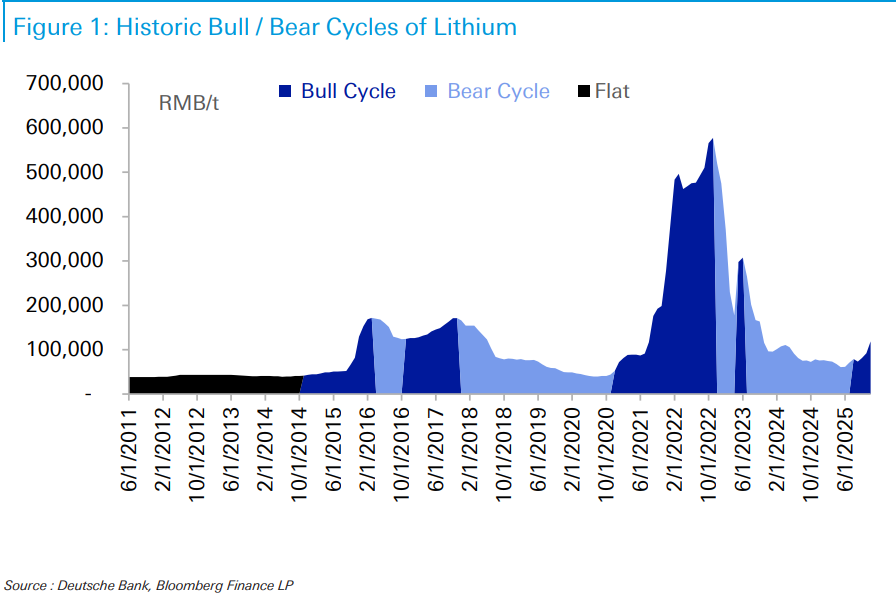
Core Viewpoint - The lithium market is experiencing a significant shift, moving from a cycle of irrational exuberance to rational growth, driven by a more mature market and fundamental demand from AI and battery energy storage systems (BESS) [1][9]. Group 1: Market Dynamics - The lithium market has undergone five booms and four busts over the past 15 years, defined by price fluctuations exceeding 20% [2]. - Historical price volatility has been attributed to the small market size and severe supply-demand mismatches, with past booms often based on overly optimistic expectations [3]. - The recent peak price of lithium reached approximately $82 per kilogram during the 2020-2022 period, followed by a dramatic decline to about $8 per kilogram, marking a nearly 90% drop [3]. Group 2: Recent Trends and Predictions - Deutsche Bank predicts that the bottom of the current cycle occurred in August 2025, with lithium spot prices rising approximately 160% and futures prices soaring 180% since that low [1]. - The average duration of boom periods is about 13 months, while busts last around 18 months, with the most recent major downturn lasting approximately 25 months [8]. Group 3: Key Drivers of Price Fluctuations - Three main factors contribute to the volatility of lithium prices: 1. The Dornbusch overshooting mechanism, where prices react excessively to shocks due to delayed corporate pricing responses and slow new supply adjustments [7]. 2. The market's small size historically, where minor supply-demand changes could lead to significant price swings [11]. 3. Dynamic policy impacts, where government support can exacerbate overheating during booms and worsen oversupply during downturns [11]. Group 4: Market Maturity and Future Outlook - The lithium market is projected to have a supply volume in 2025 that is approximately 11 times larger than that of 2015, indicating significant market maturation [11]. - The introduction of financial instruments like GFEX futures has increased market transparency and reduced speculative behavior, fostering a more rational valuation environment [11]. - The shift in demand drivers from electric vehicles (EVs) to BESS is a critical difference in the current cycle, with the latter being driven by fundamental needs rather than government subsidies [11].


瑞可达(688800):连接AI,通信未来
China Post Securities· 2025-12-26 11:42
Investment Rating - The report maintains a "Buy" rating for the company, expecting significant growth in stock performance relative to the benchmark index [6][13]. Core Insights - The company has experienced rapid revenue growth, with a 46.04% year-on-year increase in revenue to 2.321 billion yuan for the first three quarters of 2025, and a 119.89% increase in net profit attributable to shareholders, reaching 233 million yuan [3][4]. - Key drivers of profit growth include increased order volume, technological innovation, management reforms, improved overseas operations, and successful expansion into new business areas [3][4]. - The company is deepening its focus on the communication and new energy vehicle sectors, with significant supply agreements with leading manufacturers and ongoing development of advanced solutions in these fields [4][5]. Financial Projections - Revenue projections for 2025, 2026, and 2027 are 3.0 billion yuan, 4.3 billion yuan, and 5.5 billion yuan respectively, with corresponding net profits of 300 million yuan, 429 million yuan, and 549 million yuan [6][9]. - The company is expected to maintain strong growth rates, with revenue growth rates of 55.29% in 2024, 26.03% in 2025, and 34.07% in 2026 [9][12]. Company Overview - The latest closing price of the company's stock is 88.03 yuan, with a total market capitalization of 18.1 billion yuan [2]. - The company has a debt-to-asset ratio of 50.7% and a price-to-earnings ratio of 79.31 [2]. - The largest shareholder is Wu Shijun [2].

半导体设备ETF(561980)盘中直线拉升!机构:半导体行业进入“三重共振”兑现期
Jin Rong Jie· 2025-12-08 02:53
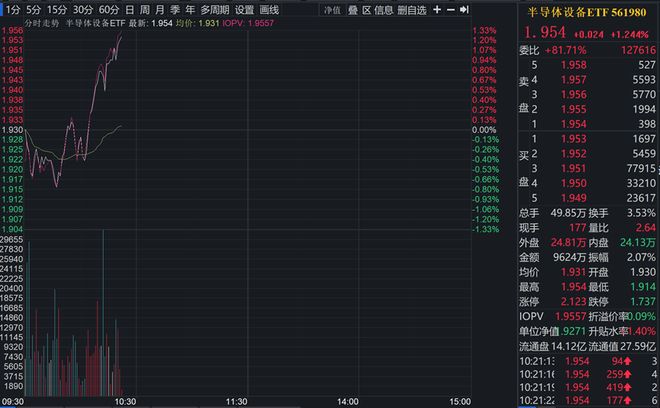
Group 1 - The semiconductor equipment ETF (561980) experienced a midday increase of 1.24%, with significant gains in constituent stocks such as Haiguang Information rising over 4% and Cambrian increasing by 3.40% [1] - The ETF's latest trading volume reached 1.03 billion, indicating active trading, and it attracted 17.25 million in capital on the previous trading day [2] - The ETF tracks the CSI semiconductor index, which has seen a year-to-date increase of 53.87%, with a maximum increase of over 80% during the period, ranking first among major semiconductor indices [2] Group 2 - According to SIA data, global semiconductor sales surged by 33% year-on-year in October, totaling 71.3 billion USD (approximately 504 billion RMB), with DRAM sales skyrocketing by 90% [3] - WSTS forecasts that global semiconductor revenue will grow by 22.5% to 772 billion USD in 2025, and further increase by 26.3% in 2026, driven by demand from AI and data centers [3] - Huatai Securities anticipates that the storage cycle will remain favorable in 2026, with price increases supported by AI data center demand, benefiting domestic storage chip manufacturers and related sectors [3] - Huachuang Securities believes that by 2025, domestic advanced manufacturing capabilities will steadily improve, and the semiconductor self-sufficient industrial chain will continue to develop [3] Group 3 - External restrictions on Chinese semiconductors have expanded from advanced process products to equipment, components, and key production lines at mature nodes, increasing the urgency for supply chain self-sufficiency [4] - The manufacturing capabilities for advanced logic and storage are essential for the AI era, with a projected resonance in storage and advanced logic expansion in 2026, providing clear order momentum for domestic equipment and components [4]



电力出海:燃气轮机+HRSG行情持续发酵
傅里叶的猫· 2025-12-05 03:48
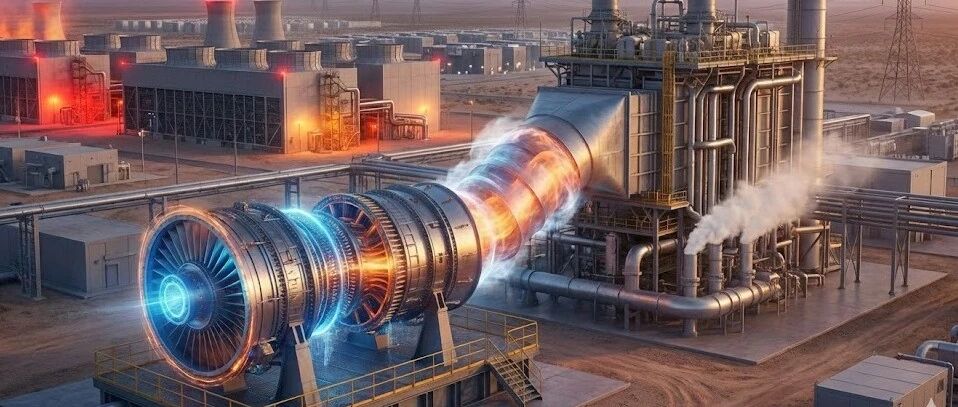
Core Viewpoint - The article discusses the significant growth and investment opportunities in the gas turbine and HRSG (Heat Recovery Steam Generator) sectors, particularly focusing on Siemens Energy and its market dynamics driven by increasing electricity demand and structural changes in the energy sector [1][3]. Group 1: Gas Turbine Market Dynamics - The core challenge in gas turbine production lies in the main engine, which must withstand high temperatures and pressures, with only Siemens Energy, GE, and Mitsubishi Heavy Industries capable of manufacturing them [3]. - Siemens Energy has a backlog of orders totaling €138 billion, a 42% increase from 2022, with €65 billion coming from service-related orders, indicating strong demand in the gas services and grid technology sectors [3]. - Global electricity demand is expected to grow nearly 50% over the next decade, with AI and data centers projected to double their electricity consumption in the same period [3]. Group 2: Growth in Gas Services - The gas services segment is identified as the primary growth driver for Siemens Energy, as gas-fired power generation emits half the carbon of coal, making it a viable alternative [4]. - From 2025 to 2035, the global annual increase in gas-fired power generation capacity is expected to reach 90-100 GW, nearly double the average of the past decades, with data centers contributing 15%-20% to this demand [4]. Group 3: Capacity Expansion and Market Demand - Siemens Energy is accelerating capacity expansion, with plans to increase large gas turbine production in Berlin from 35 units per year to 50 by 2027, and to double the medium gas turbine capacity in Sweden to 100 units by 2028 [5]. - The current production capacity is fully booked, with a delivery cycle of 2-3 years, highlighting a tight market supply situation [5]. - Siemens Energy has achieved a 100% attachment rate for long-term service agreements for large gas turbines, with profit margins on new agreements expected to increase by over 500 basis points compared to existing contracts [5]. Group 4: Domestic HRSG Companies' Outlook - The outlook for domestic HRSG companies in international markets appears optimistic, with BYTH's Vietnam project planning four HRSG production lines in phase one and eight in phase two, targeting North American gas turbine contractors [7]. - HRSG units account for only 7-8% of value but represent 30-40% of power generation capacity, with expectations of price increases exceeding 30-40% due to a 50% supply-demand gap [7]. - Xizi Clean Energy has established a strong position in the global high-end HRSG market through successful projects in Pakistan and Nigeria, with products exported to over 50 countries [7].
瑞可达人形机器人小批量供货 2025年预计销售收入约1000万元
Zheng Quan Shi Bao Wang· 2025-08-04 12:31
Core Viewpoint - The company, 瑞可达, is experiencing significant growth in its connector products and is beginning to explore new business areas such as humanoid robots, with expected sales revenue from this segment projected at approximately 10 million yuan by 2025, representing 0.41% of the total revenue for 2024 [1][2]. Group 1: Financial Performance - 瑞可达 anticipates a net profit attributable to shareholders of between 151 million yuan and 171 million yuan for the first half of 2025, reflecting a year-on-year increase of 132.44% to 163.22% [2]. - The increase in profit is attributed to steady growth across various business segments, leading to a rise in order volume, along with advancements in technology and production automation that enhance product competitiveness and reduce costs [2]. Group 2: Business Development - The company is actively engaging in research and industrial exploration in emerging fields such as humanoid robots and medical devices [2]. - 瑞可达 has established a presence in the embodied intelligent robotics sector, focusing on various components including power connections, motion control connections, visual and perception connections, and high-speed data connections [2]. Group 3: Market Outlook - The global connector industry is witnessing steady demand growth, particularly in China, driven by continuous technological advancements and increasing market demand, indicating a promising market outlook for connectors [3]. - The company plans to enhance its technological research and product development while expanding into new application areas such as AI, data centers, humanoid robots, and low-altitude economy [3].